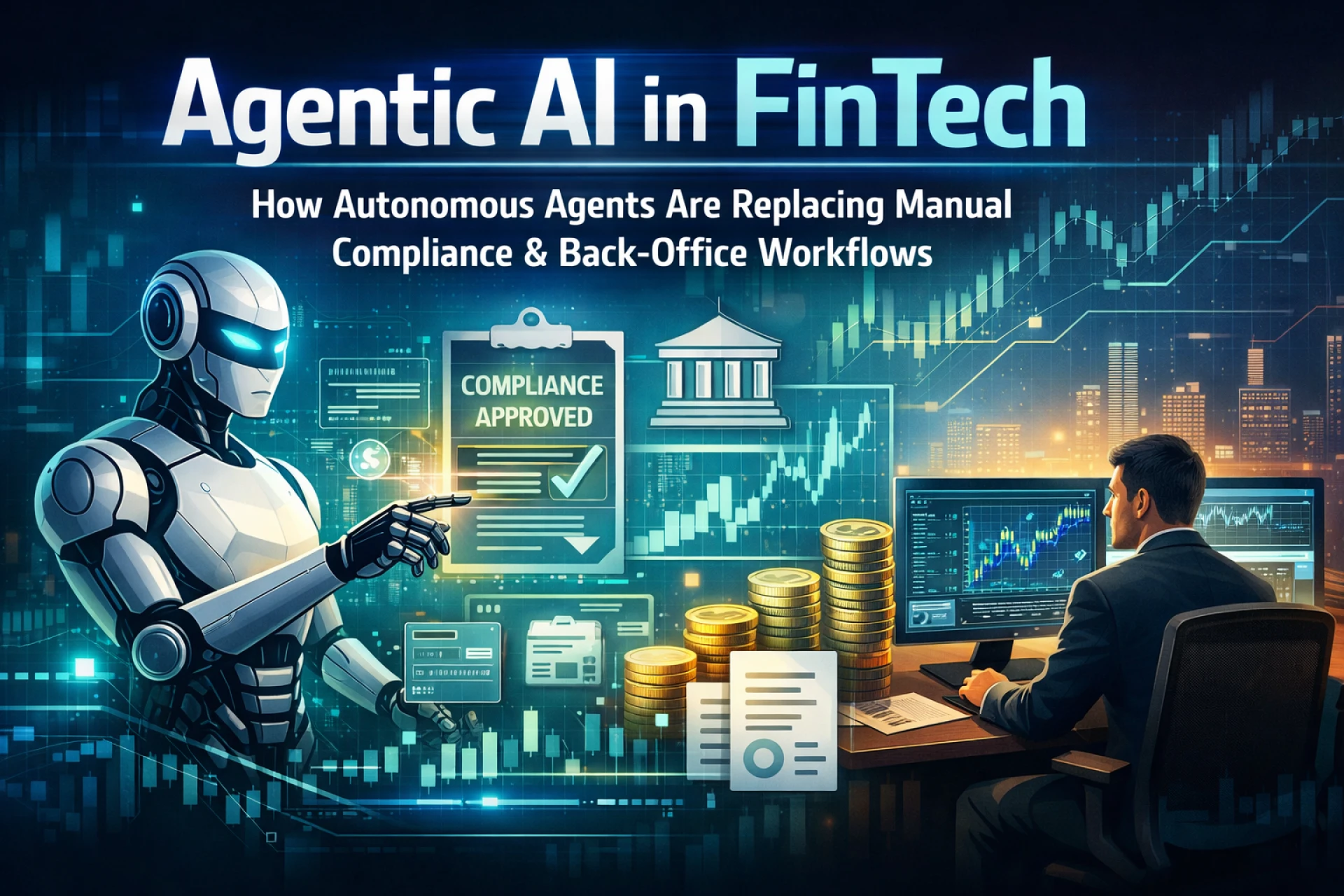

At a mid-tier European bank in 2024, the AML compliance team employed 47 analysts. Their primary function was transaction monitoring: reviewing flagged alerts, investigating suspicious activity, filing Suspicious Activity Reports, and closing false positives. Each analyst handled an average of 85 alerts per day, of which approximately 94% were false positives legitimate transactions caught by overly broad rule-based detection systems. The work was tedious, expensive, and largely thankless. By the second quarter of 2025, the bank had deployed an agentic AI compliance system across its AML and KYC functions. The system did not replace the analysts. It transformed what they did. Routine alert triage, evidence gathering, pattern correlation across accounts, and preliminary SAR drafting were handled autonomously by AI agents. Human analysts reviewed the cases the agents escalated the true positives, the complex patterns, the edge cases requiring judgment. The team's effective throughput tripled. The false positive investigation rate dropped by 60%. The bank's cost per compliant transaction fell by 38%.
This is not a pilot. It is not a future scenario. It is the operational reality of agentic AI in financial services in 2026 and it is playing out across compliance functions, back-office operations, credit decisioning, and customer onboarding at institutions of every size. The question for fintech leaders is no longer whether agentic AI belongs in their stack. It is whether they understand the architectural difference between agentic AI and the automation they have already deployed and whether their implementation approach is positioned to capture the 2.3x ROI that IDC reports organizations achieve within 13 months of deployment.
The Agentic AI Moment in FinTech: KPMG places global market spend on agentic AI at an estimated $50 billion in 2025. IDC reports organizations achieve an average 2.3x return on agentic AI investments within 13 months with frontier firms achieving 2.84x versus 0.84x for laggards. A US bank that deployed agents for credit risk memo creation experienced a 20–60% productivity increase and 30% improvement in credit turnaround. PwC reports agents can reduce cycle times by up to 80% in purchase order processing. Fifty of the world's largest banks announced more than 160 agentic AI use cases in 2025 alone. And 54% of financial services firms had deployed AI initiatives by January 2025, up from 40% a year earlier with compliance and back-office among the top two deployment functions.
Agentic AI vs. Traditional Automation: Why the Distinction Matters
The term 'AI automation' has been applied so broadly in fintech marketing that its meaning has become diluted. Robotic Process Automation, rule-based chatbots, and script-driven workflow tools have all been described as AI. Agentic AI is architecturally distinct from all of these in ways that are directly relevant to its performance on complex financial workflows and understanding that distinction is prerequisite to building a sound implementation strategy.
Traditional Automation: Rules Without Reasoning
Traditional automation in fintech, whether RPA, rule-based fraud detection, or scripted compliance workflows operates on explicit, pre-programmed logic. If a transaction exceeds a threshold, flag it. If a KYC document is missing a field, return it. If a customer query matches a keyword, route it to a queue. These systems are reliable within the scope of their rules and completely helpless outside it. They cannot interpret ambiguous inputs, reason across multiple data sources, adapt to novel situations, or take multi-step actions that require planning. The 94% false positive rate in the European bank's AML system was not a failure of the specific tool it was the structural limitation of rule-based detection applied to a world where fraud evolves faster than rules can be updated.
Agentic AI: Planning, Reasoning, and Autonomous Action
An AI agent can plan, reason, adapt in real time, and execute multi-step tasks across multiple systems with minimal human supervision. In the context of AML compliance, this means an agent does not simply flag a transaction it investigates it. It queries the transaction history for the account, cross-references related accounts for network patterns, searches the sanctions database, retrieves the customer's KYC profile, assesses the risk score against regulatory thresholds, and drafts a preliminary SAR with supporting evidence all autonomously, in minutes, rather than the hours a human analyst would require for the same sequence. The distinction is not one of speed alone. It is one of capability: agentic systems can handle tasks that were genuinely not automatable by any previous generation of automation technology.
Multi-Agent Orchestration: The Architecture Behind Complex Workflows
The most powerful agentic AI deployments in fintech do not rely on a single agent. They deploy multi-agent systems where specialized agents one focused on data retrieval, one on pattern analysis, one on regulatory cross-referencing, one on report generation are orchestrated by a supervising agent that coordinates their outputs toward a defined goal. This architecture, used by 66.4% of enterprise agentic AI implementations, mirrors the way a compliance team actually works: multiple specialists, each with deep expertise in a narrow domain, coordinating toward a shared output. Citi's 2025 analysis of agentic AI in financial services identifies multi-agent orchestration as the architectural pattern most capable of transforming complex, judgment-intensive financial workflows at enterprise scale.
The 5 Back-Office and Compliance Workflows Being Transformed Right Now
The following use cases represent the highest-ROI agentic AI deployments currently in production at financial institutions globally. Each has documented outcomes and critically each involves workflow complexity that makes them unsuitable for traditional automation but highly amenable to agentic systems that can reason and act across multiple data sources.
1. AML Transaction Monitoring and SAR Filing
Anti-money laundering monitoring is the canonical agentic AI use case in fintech compliance high volume, rule-limited, labor-intensive, and heavily regulated. Agentic systems handle the full investigation workflow autonomously: alert triage, account history analysis, network graph correlation, sanctions screening, risk scoring, and SAR draft generation. Human compliance officers review agent-escalated cases and provide final sign-off on SAR filings. The result is not just lower cost it is higher quality. Human analysts focusing exclusively on agent-escalated cases are working on genuinely suspicious activity, not sifting through false positives. Detection accuracy improves. Regulatory examination outcomes improve. The compliance function shifts from reactive to genuinely proactive.
Live Outcome: Credit unions deploying agentic AML agents report 23.53% ROI specifically in automated compliance workflows outperforming portfolio management and most other back-office functions.
2. KYC and Customer Onboarding
KYC onboarding is expensive, slow, and a primary source of customer drop-off in digital financial services. A standard KYC workflow requires document collection, identity verification, sanctions screening, PEP checks, beneficial ownership mapping for corporate customers, and risk tier assignment a sequence that can take days with manual processing and involves multiple systems that rarely communicate natively. Agentic AI compresses this to minutes. Agents autonomously gather documents, query verification APIs, run sanctions and PEP screening, map beneficial ownership structures, and produce a risk-scored onboarding recommendation that either auto-approves low-risk customers or routes complex cases to a human reviewer with a full evidence package already assembled. Organizations using agentic KYC onboarding report faster time-to-revenue from new customers and a measurable reduction in onboarding abandonment rates.
Live Outcome: A US bank deploying AI agents for credit risk memo creation experienced a 20–60% productivity increase and 30% improvement in turnaround with KYC and onboarding workflows showing the strongest initial ROI.
3. Credit Risk Assessment and Loan Decisioning
Traditional credit decisioning relies on a limited set of bureau-reported data points processed through a scoring model. Agentic credit systems analyze a far richer data set transaction patterns, cash flow volatility, behavioral indicators, alternative data sources and reason across them to produce a nuanced risk assessment that reflects the actual creditworthiness of a borrower more accurately than any bureau score. For SME lending in particular, where balance sheets are thin and bureau data is incomplete, agentic credit agents are unlocking credit access for segments that traditional underwriting systematically declines. Machine learning fintech solutions are processing loan applications 10x faster than traditional methods, with AI-driven credit decisioning now handling 60% of digital lending workflows globally.
4. Regulatory Reporting and Audit Trail Generation
Regulatory reporting is one of the most resource-intensive back-office functions in any financial institution and one of the most directly exposed to agentic AI transformation. AI agents can monitor regulatory databases across multiple jurisdictions for rule changes, map those changes to affected products and workflows, update internal compliance documentation, generate required regulatory filings with 99% accuracy, and produce audit trails that document exactly why each decision was made. Fintech generative AI use cases in regulatory reporting reduce preparation time by up to 80% while improving the quality and completeness of audit documentation. As the EU AI Act's high-risk system obligations come into full effect in August 2026, the ability to produce explainable, auditable AI decision records is not just operationally valuable it is a regulatory requirement.
5. Trade Finance and Purchase Order Processing
Trade finance workflows letter of credit processing, document verification, payment matching, compliance screening involve dozens of sequential steps across multiple counterparties and document types. PwC's research on agentic AI in financial operations identifies this function as having among the highest automation potential: agents can reduce cycle times by up to 80% in purchase order transaction processing and matching while simultaneously improving audit trails and reducing compliance risk. For fintech companies serving trade finance clients, deploying agentic back-office systems is not merely an efficiency play it is a competitive differentiator that allows them to offer faster, lower-cost trade finance services than institutions still running manual document workflows.
The Implementation Framework: How to Build Agentic AI Into FinTech Operations
The excitement around agentic AI in fintech is matched by the reality that 40% of projects fail due to inadequate foundations. Data quality, governance frameworks, integration architecture, and regulatory explainability requirements are not technical afterthoughts they are the determinants of whether an agentic deployment captures the 2.3x ROI the data promises or becomes another failed AI pilot. The following framework reflects best practices from the institutions that are operationalizing agentic AI successfully.
Start With a Single High-Volume, Well-Defined Workflow
The most common implementation failure is scope overreach: trying to simultaneously deploy agents across compliance, onboarding, credit decisioning, and customer service. Successful deployments start with one high-volume workflow where success criteria are clear, data quality is sufficient, and ROI is measurable. Alert triage in AML monitoring is the canonical starting point high volume, clear escalation criteria, and a baseline cost that makes ROI calculation straightforward. Once the first workflow is running in production and proving its value, expansion to adjacent functions is a configuration decision, not another major implementation project.
Build Explainability Into the Architecture From Day One
In regulated financial services, explainability is not optional. When an agent declines a loan application, flags a transaction for suspicious activity, or recommends a compliance action, the system must be able to explain why in terms that are auditable by regulators, reviewable by compliance officers, and defensible in legal proceedings. This requirement shapes architectural decisions: the agent's reasoning process must be logged, the data sources it consulted must be documented, and the rules or model outputs it applied must be traceable. Sixty-nine percent of financial institutions prefer buying third-party AI tools rather than building their own specifically because pre-built platforms designed for financial services embed these explainability requirements from the start, rather than requiring them to be retrofitted after deployment.
Design Human-in-the-Loop Escalation Paths Deliberately
The goal of agentic AI in compliance is not to eliminate human judgment it is to direct human judgment at the cases where it adds the most value. This requires deliberate escalation design: defining the thresholds at which agents escalate to humans, the information packages agents prepare for human reviewers, and the feedback mechanisms through which human decisions improve agent performance over time. Institutions that treat human-agent collaboration as a core design principle rather than a reluctant concession to regulatory requirements consistently outperform those that attempt to maximize automation rates without building the human oversight layer that makes the system trustworthy and improvable. McKinsey's analysis of pioneer firms emphasizes that the institutions capturing the largest ROTE advantages are those where human expertise and agentic capability are deliberately combined, not where one replaces the other.
The Competitive Divide Is Opening Now
McKinsey's analysis of agentic AI in financial services identifies a 4% ROTE advantage accruing to pioneer firms a gap that compounds over time as agent systems improve with data, as regulatory frameworks solidify, and as the institutions that moved first build organizational muscle that slower movers cannot quickly replicate. The 50 largest banks announced over 160 agentic AI use cases in 2025. The compliance and back-office functions that have historically been cost centers absorbing analyst headcount, generating regulatory risk, slowing customer onboarding are being transformed into competitive advantages for the institutions that have made the architectural investments.
The fintech companies Codiste builds with are at the earliest and most consequential phase of this transformation: the phase where architectural decisions made today determine whether an agentic AI deployment is production-ready, compliant, explainable, and scalable or whether it joins the 40% of projects that fail because the foundation was not built correctly the first time. The technology is not experimental. The ROI is documented. What remains variable is execution quality and that is precisely where the right development partnership makes the difference between a pilot that proves a concept and a system that transforms a business.










Sign in to leave a comment.