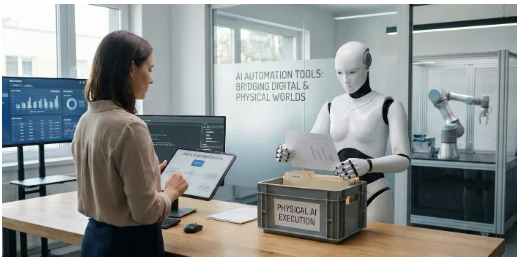

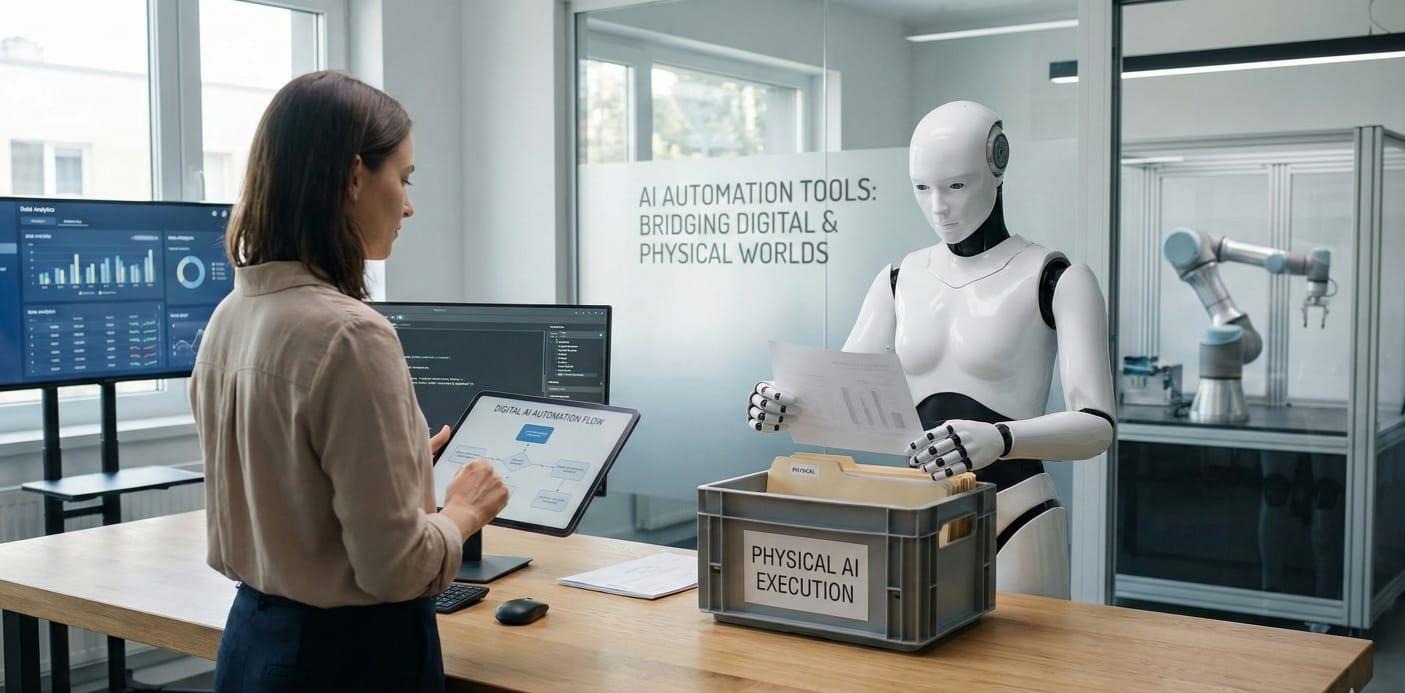
AI automation is no longer limited to software running behind a screen. What started as simple scripts and rule-based workflows has evolved into intelligent systems that can understand language, analyze data, make decisions, and now even act in the physical world. Today, automation exists on two connected fronts: digital AI tools and physical AI robots.
Together, they are shaping the future of how businesses operate and how people interact with technology.
What Are AI Automation Tools?
AI automation tools are software systems designed to perform tasks with minimal human input. Unlike traditional automation, which follows rigid rules, AI-powered tools adapt, learn, and improve over time.
Common examples include:
AI chatbots handling customer support
Content and data-processing tools
Workflow automation platforms that connect apps and services
AI agents that analyze information and take actions automatically
These tools save time, reduce human error, and allow people to focus on higher-value work.
The Power of Digital AI Automation
Digital AI automation lives entirely in the software layer. It works fast, scales easily, and is already deeply embedded in modern workflows.
Key Benefits
Speed & scalability – One system can handle thousands of tasks simultaneously
Cost efficiency – Reduces repetitive manual work
24/7 operation – No downtime, no fatigue
Data-driven decisions – Learns from large datasets in real time
Typical Use Cases
Email routing and responses
Lead qualification and CRM updates
AI writing and content generation
SEO analysis and reporting
Financial monitoring and fraud detection
For many businesses, digital automation is the first and most impactful step toward AI adoption.
The Limitations of Digital-Only Automation
Despite its power, software-based AI has a clear boundary: it cannot interact with the physical world.
Digital AI can:
Schedule a delivery
Optimize logistics
Analyze sensor data
But it cannot:
Pick up an object
Move through a room
Perform physical assistance
This is where physical AI automation enters the picture.
Physical AI Automation: When AI Gets a Body
Physical AI automation refers to robots powered by advanced AI systems. These machines combine multiple capabilities—vision, speech, reasoning, and movement—into a single autonomous entity.
A strong example of this shift is Neo, a humanoid robot designed to operate in human environments rather than factories.
Unlike industrial robots that work in cages, Neo is built to:
Move safely around people
Understand verbal instructions
Perform everyday tasks in homes or workplaces
This represents a major step forward: AI that doesn’t just think, but acts.
How Digital and Physical AI Work Together
The real power of AI automation appears when digital tools and physical robots are connected.
Example Workflow
A digital AI system receives a request (voice, app, or text)
The system analyzes intent and context
Decisions are made in the cloud
A physical robot executes the task in the real world
For instance, an AI automation platform might schedule household tasks, while a robot like Neo physically carries them out—cleaning, organizing, or assisting residents.
Digital AI becomes the brain. Physical AI becomes the body.
Why Humanoid Robots Matter
Humanoid robots are especially important because they are designed for human-centered spaces. Homes, offices, and public buildings are built for people—not machines.
A humanoid form allows robots to:
Use existing tools and furniture
Navigate stairs, doors, and hallways
Communicate naturally with humans
This makes robots like Neo far more adaptable than traditional task-specific machines.
Business Impact of Physical AI Automation
As physical AI matures, industries beyond manufacturing will be transformed.
Potential Applications
Healthcare – Patient assistance, monitoring, and logistics
Hospitality – Room service, cleaning, and guest interaction
Warehousing – Flexible automation in mixed human environments
Home assistance – Supporting elderly or disabled individuals
When combined with digital automation tools, physical AI can create end-to-end autonomous systems—from planning to execution.
Challenges to Overcome
While promising, physical AI automation still faces challenges:
High hardware costs
Safety and regulation requirements
Energy efficiency
Real-world unpredictability
However, these are the same hurdles faced by early digital AI tools—and history shows that rapid improvement follows adoption.
The Future: One Unified Automation Layer
The future of AI automation is not digital or physical—it’s both.
Digital AI tools will handle intelligence, coordination, and optimization
Physical AI robots will execute tasks in the real world
Humans will supervise, guide, and collaborate with these systems
As this convergence continues, automation will feel less like software and more like a seamless extension of daily life.
Final Thoughts
AI automation is entering a new era. Digital tools laid the foundation by automating thinking and decision-making. Physical robots are now extending that intelligence into the real world.
Robots like Neo represent more than a technological milestone—they signal a shift toward AI systems that can understand, decide, and act alongside humans.
The line between software and reality is fading, and automation is no longer confined to screens. It’s stepping into our world.

Sign in to leave a comment.