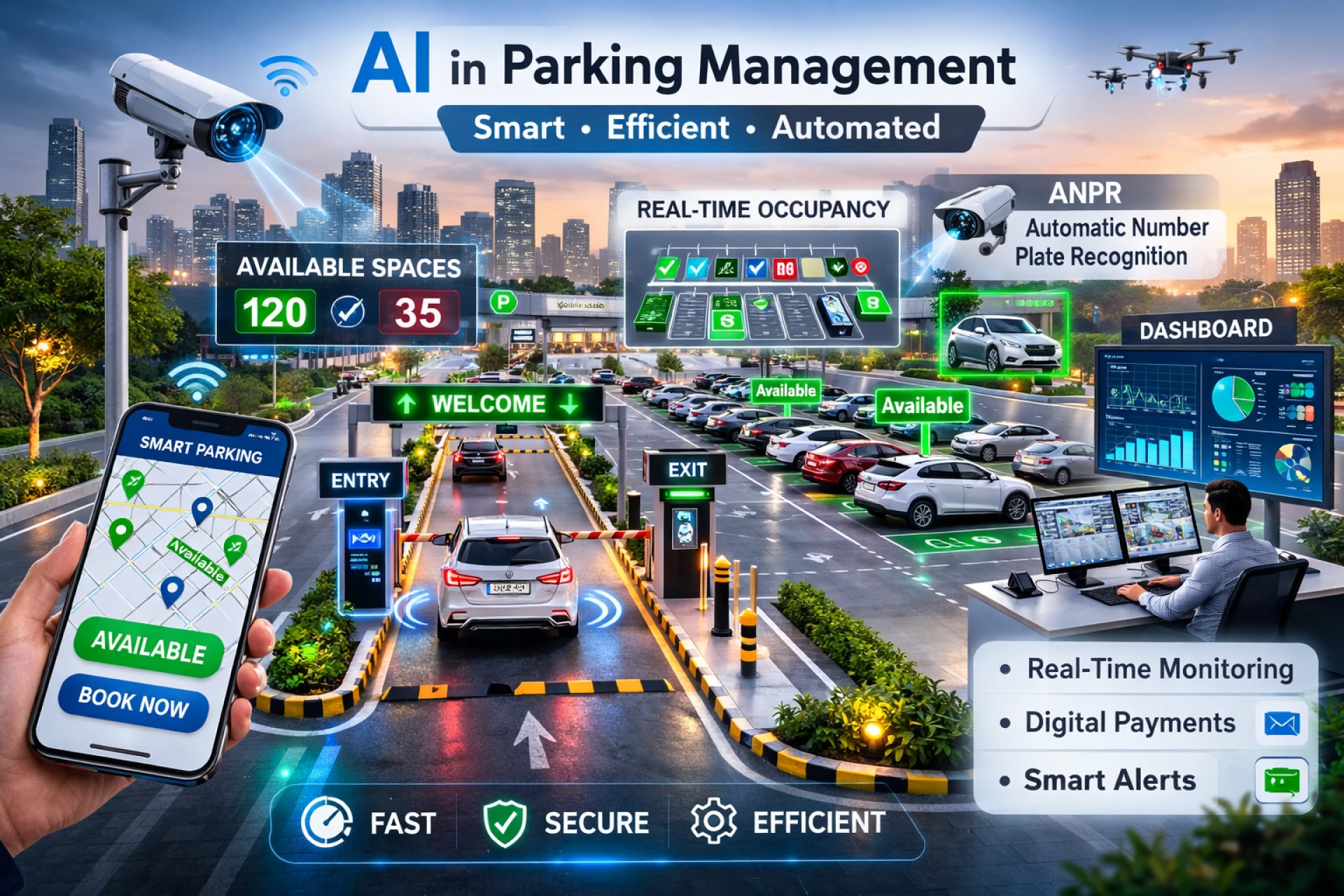

Rapid urbanization has dramatically increased the number of vehicles on the road. Cities today face growing challenges such as congested streets, illegal parking, inefficient monitoring, and poor parking experiences. Traditional parking management systems are no longer capable of handling modern mobility demands.
Manual supervision, outdated ticketing systems, and the absence of real-time visibility often create operational inefficiencies. Drivers waste time searching for parking spaces, businesses lose revenue opportunities, and municipalities struggle with traffic congestion. AI in Parking Management is emerging as a key solution to overcome these growing urban mobility problems.
Artificial Intelligence (AI) is now reshaping this landscape.
AI-powered parking management uses video analytics, machine learning, and real-time data processing to automate operations, improve utilization, and enhance driver convenience. Smart parking systems enable cities and enterprises to reduce congestion, improve security, and make data-driven decisions.
In this article, we explore how AI-driven video analytics is revolutionizing parking management and enabling smarter urban infrastructure.
Problems with Traditional Parking Systems
Conventional parking infrastructure depends heavily on manual monitoring and static systems. These outdated methods create multiple operational issues.
Unauthorized Parking
Vehicles parked in restricted zones, emergency lanes, or reserved areas disrupt traffic flow and safety. Human monitoring cannot continuously supervise large parking spaces, resulting in violations.
Security Risks
Parking areas are highly vulnerable to theft, vandalism, and suspicious activity. Without intelligent surveillance, identifying incidents becomes slow and reactive rather than preventive.
Poor Space Utilization
Operators often lack real-time occupancy data. While some areas remain overcrowded, others stay empty, leading to inefficient use of available space.
Traffic Congestion
Drivers spend several minutes searching for parking spots in malls, airports, offices, and public facilities. This increases fuel consumption, emissions, and user frustration.
Evolution of Parking Management with AI
Parking systems have evolved from manual ticketing to automated gates and digital payments. However, early automation lacked intelligence — it could operate but not analyze or predict.
Modern AI-driven parking solutions combine:
- Computer vision cameras
- Machine learning algorithms
- Cloud analytics platforms
- IoT sensors
These technologies transform parking from a passive infrastructure into an adaptive ecosystem capable of learning and optimizing operations continuously.
How AI Transforms Smart Parking Ecosystems
AI integrates multiple technologies to create a responsive and automated parking environment.
Automated Vehicle Recognition & Access Control
Automatic Number Plate Recognition (ANPR) identifies vehicles instantly at entry and exit points. This eliminates physical tickets, reduces queues, and improves security.
Benefits:
- Faster entry/exit
- Reduced manpower cost
- Accurate vehicle tracking
Real-Time Parking Occupancy Detection
AI cameras detect whether a slot is occupied or vacant and update the system immediately.
Benefits:
- Drivers quickly locate available spots
- Reduced search time
- Lower fuel consumption and emissions
Dynamic Pricing Optimization
AI adjusts parking prices based on demand, duration, and location.
Benefits:
- Balanced space distribution
- Increased operator revenue
- Fair pricing for users
Automated Enforcement & Compliance Monitoring
AI continuously scans parking zones to identify violations such as:
- Unauthorized parking
- Overstays
- Restricted area breaches
Operators receive instant alerts for quick action.
Mobile App Integration
Drivers can:
- Reserve parking in advance
- Navigate directly to a slot
- Pay digitally without waiting
This reduces congestion and enhances convenience.
Smart Guidance Systems
Digital signboards and mobile notifications guide drivers to empty spaces inside large facilities like malls or airports, significantly improving user experience.
Improving Operational Efficiency Using AI
AI is not only about automation — it enables operational intelligence.
Predictive Maintenance
AI monitors gates, sensors, and cameras to detect faults early and prevent system failures, reducing downtime and repair costs.
Space Optimization
By analyzing historical data, AI identifies peak hours and underused zones, allowing operators to reallocate space effectively.
Data-Driven Decisions
AI analytics helps city planners and businesses understand traffic patterns, optimize layouts, and improve revenue strategies.
The Future of AI in Parking Management
Smart parking is becoming a crucial component of smart cities worldwide. Governments and enterprises are adopting AI to manage high-traffic zones such as:
- Airports
- Shopping malls
- Business parks
- Public transport hubs
- Municipal facilities
AI not only reduces congestion but also lowers carbon emissions and enhances urban mobility.
Future advancements will include predictive availability suggestions, autonomous vehicle integration, and fully contactless parking ecosystems.
Nextbrain – AI-Powered Smart Parking Solution Provider
Nextbrain develops intelligent parking management solutions designed for modern urban and enterprise environments using advanced ai video analytics software combined with computer vision and automation.
What Nextbrain Offers
- Automatic vehicle detection & ANPR
- Real-time occupancy monitoring
- Mobile app integration
- Digital payments & reservations
- Violation detection & alerts
- Parking analytics dashboard
Why Choose Nextbrain
- Custom-built solutions for each business
- Seamless integration with existing infrastructure
- Advanced AI and machine learning expertise
- Scalable architecture for smart cities and enterprises
Nextbrain’s solutions help organizations improve parking efficiency, reduce operational costs, and enhance customer satisfaction.
Conclusion
AI-powered parking management is transforming how cities and businesses handle mobility challenges. By automating monitoring, optimizing space utilization, and enabling predictive insights, smart parking systems reduce congestion, improve safety, and enhance user experience.
Organizations adopting AI parking technology gain operational efficiency, data visibility, and revenue optimization — all while creating a seamless parking journey for users.
Ready to implement intelligent parking solutions?
Contact Nextbrain today and modernize your parking infrastructure with AI-driven innovation.
Frequently Asked Questions (FAQs)
1. What is AI-powered parking management?
It is a smart system that uses computer vision and real-time analytics to monitor parking spaces, automate entry/exit, and guide drivers to available spots.
2. How does AI reduce traffic congestion?
AI directs drivers to vacant spaces instantly, minimizing the time spent searching for parking and reducing road congestion.
3. Can AI parking systems improve security?
Yes. AI surveillance detects suspicious activities, unauthorized vehicles, and violations in real time, improving safety.
4. Is AI parking suitable for small businesses?
Yes. AI parking solutions are scalable and can be customized for offices, malls, residential complexes, or large smart cities.
5. What are the benefits of AI parking for operators?
Operators gain better space utilization, automated enforcement, data analytics insights, higher revenue, and reduced manpower costs.











Sign in to leave a comment.