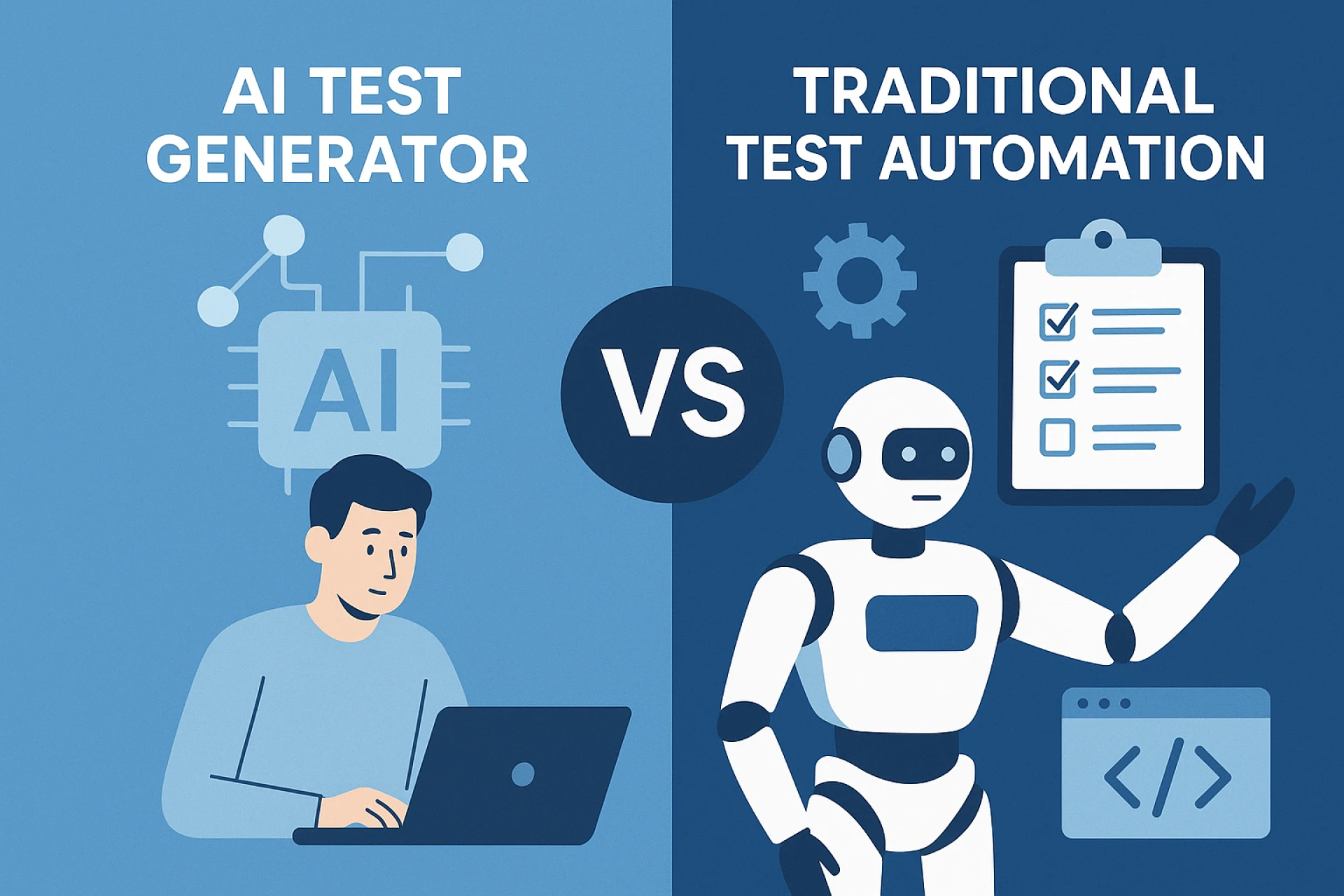

Software testing has always been an essential part of delivering reliable applications. For decades, QA teams relied on manual test writing or rule-based automation tools to validate software quality. However, the rise of artificial intelligence has introduced a new era of automation: the AI test generator. But how exactly does it differ from traditional test automation, and why should development teams care? Let’s break down the key differences.
What Is a Traditional Test Generator?
Before diving into AI, it’s important to understand how a traditional test generator works. These tools automate the process of writing and executing test cases based on predefined rules, frameworks, or scripts. For example, Selenium or JUnit tests still require testers to design and maintain scripts manually.
While this speeds up execution, the burden of creating and updating test cases remains on the QA team. As applications evolve, testers often spend more time maintaining existing test scripts than creating new ones.
What Is an AI Test Generator?
An AI test generator takes automation to the next level by using machine learning and natural language processing to generate tests automatically. Unlike traditional methods, it doesn’t rely solely on human-written scripts. Instead, it analyzes application behavior, user flows, and even production data to create intelligent test cases.
For instance, an AI test generator can:
- Learn from user interactions to predict high-risk areas in an application
- Automatically generate regression tests when code changes occur
- Suggest edge cases that human testers might overlook
This reduces the manual workload while significantly improving coverage and accuracy. Tools like Keploy are exploring this space by enabling developers to auto-generate tests directly from API calls, reducing the dependency on manual test writing.
Key Differences Between AI Test Generator and Traditional Automation
1. Test Creation
- Traditional Automation: Requires manual scripting of test cases, which is time-consuming and prone to human error.
- AI Test Generator: Uses algorithms to auto-generate tests, reducing dependency on human-written scripts.
2. Maintenance
- Traditional Automation: Every UI or code change often requires updates to existing test scripts.
- AI Test Generator: Adapts dynamically, updating tests automatically when application workflows change.
3. Coverage
- Traditional Automation: Limited by the scenarios QA teams manually design.
- AI Test Generator: Identifies hidden patterns, edge cases, and risky areas by analyzing real-world data.
4. Speed of Delivery
- Traditional Automation: Speeds up test execution but slows down when scripts need frequent maintenance.
- AI Test Generator: Offers both faster test creation and reduced maintenance overhead, enabling quicker releases.
5. Scalability
- Traditional Automation: Struggles with scaling as applications grow in complexity.
- AI Test Generator: Scales easily, generating thousands of tests across different environments.
Why Teams Are Moving Toward AI Test Generators
Development teams are under constant pressure to release faster without compromising quality. Traditional automation, while valuable, often hits a bottleneck due to script maintenance. This is where the AI test generator stands out.
By combining automation with intelligence, it allows teams to:
- Reduce repetitive manual effort
- Continuously validate changes in CI/CD pipelines
- Catch bugs earlier in development cycles
- Improve collaboration between developers and testers
Keploy, for example, takes this approach by allowing developers to record real API interactions and turn them into test cases instantly. This not only reduces effort but also ensures that tests are realistic and production-like.
When to Use Traditional Test Automation vs AI Test Generator
It’s not always about replacing one with the other. Both approaches have their place:
- Traditional test automation is useful for stable, repetitive test cases where the workflow rarely changes, such as API response validation or database queries.
- AI test generator shines in dynamic environments, especially where user interfaces or user behavior change frequently, like in e-commerce platforms or SaaS applications.
In many modern workflows, teams use both—traditional automation for predictable tasks and AI-powered generators for adaptive, intelligent coverage.
Conclusion
The AI test generator is not just an evolution of automation—it’s a transformation. While traditional test automation relies on human-created scripts, AI-driven tools bring adaptability, intelligence, and speed to the testing process. For organizations aiming to scale testing, improve accuracy, and accelerate release cycles, adopting an AI test generator can provide a significant competitive edge. Keploy and other modern tools are making this transition easier by combining automation with intelligence, enabling teams to achieve faster, smarter, and more reliable testing outcomes.









Sign in to leave a comment.