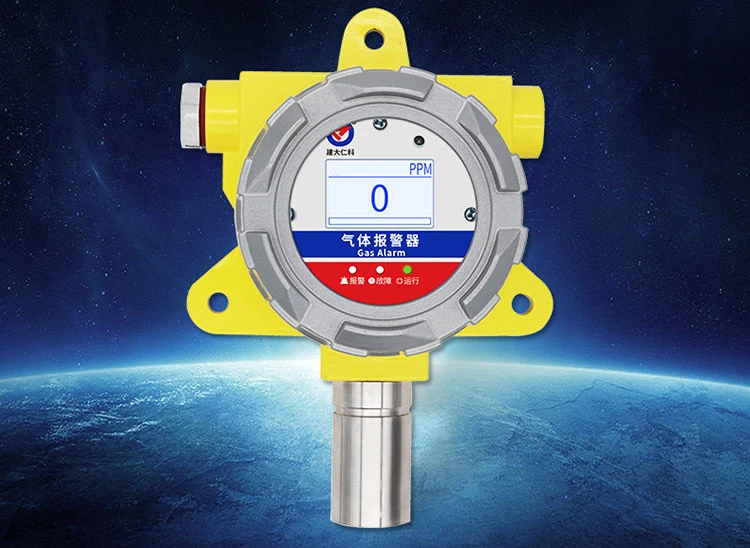

The combustible gas detector is a detector that responds to single or multiple combustible gas concentrations. The combustible gas detector is a point-type gas detection device installed in an explosive and hazardous environment. It converts the on-site combustible gas concentration into an electrical signal and transmits it to the monitoring equipment located in a safe area to achieve the purpose of monitoring the on-site combustible gas concentration. In the process of design and construction, combustible gas detectors should comply with corresponding standards and requirements.
Common combustible gas detectors have three working principles: catalytic combustion type, semiconductor type, and electrochemical type. Three common types of detectors have different working principles:
Catalytic combustion
Using the thermal effect principle of catalytic combustion, the measuring bridge is formed by the pairing of the detection element and the compensation element. Under certain temperature conditions, the combustible gas undergoes flameless combustion on the surface of the detection element carrier and the catalyst, and the carrier temperature rises through it. The internal platinum wire resistance also rises accordingly, which makes the balance bridge out of balance and outputs an electrical signal proportional to the concentration of combustible gas. By measuring the resistance change of the platinum wire, the concentration of the flammable gas can be known. It is mainly used for the detection of flammable gases, with good output signal linearity, reliable index, low price, and no cross-infection with other non-flammable gases.
Semiconductor type
The sensor structure made of semiconductor materials is a metal oxide film deposited on a silicon wafer, and it works by absorbing gas on a heated oxide surface. The oxide surface absorbs the sample gas, which leads to the change of the resistance of the metal oxide, which can be reflected in the concentration change of the sample gas. The sensor surface is heated to a constant temperature between 200-2500°C to increase the reaction rate , To reduce the impact of environmental temperature changes. The semiconductor sensor is very simple and sturdy. It is also very sensitive and has a longer life. It detects low-concentration combustible gases and some toxic gases, such as hydrogen sulfide and carbon monoxide.
Electrochemical
The electrochemical sensor realizes detection by chemical reaction on the surface of the sensor electrode. This kind of detector is an electrochemical reaction type with three electrodes. Each sensor has an electrolyte reaction chamber, and all three electrodes are placed in the electrolyte and wrapped under a gas diffusion membrane.
In order to play a productive role and control environmental pollution, combustible gas alarms are becoming more and more important. And we can choose portable or fixed combustible gas alarm according to the place of use. So, how to choose a portable gas detector or a fixed gas alarm? Let\'s take you to learn more about it in detail:
1. The selection of combustible gas alarms usually needs to be decided according to the workplace. The fixed combustible gas alarms should be selected for long-term leakage detection in general production or storage posts. Others such as maintenance, inspection, emergency monitoring, entry inspection, patrol inspection, etc. Use portable combustible gas alarm.
2. Fixed gas sensor : It is a detector that is used more in industrial installations and production processes. It is more suitable for the continuous, long-term stability and other characteristics required by fixed detection in process and technology. They are mainly installed in places where specific gas may leak. For example, the effective height of sensor installation should be selected according to the specific gravity of the gas.
3. Portable gas detector: The portable combustible gas is small in size, easy to operate, and can be carried to different production sites. The use of new rechargeable batteries allows them to work continuously for nearly 12 hours. Therefore, as this type of instrument, it can be used in various types of The application in factories and health departments is increasing.









Sign in to leave a comment.