
Understanding Water Quality First
Choosing the right industrial membrane is not simple. It depends on your water quality, application, and performance goals. Many buyers focus only on price. That leads to poor decisions. Membranes work under specific conditions. If those conditions are not matched, performance drops quickly.
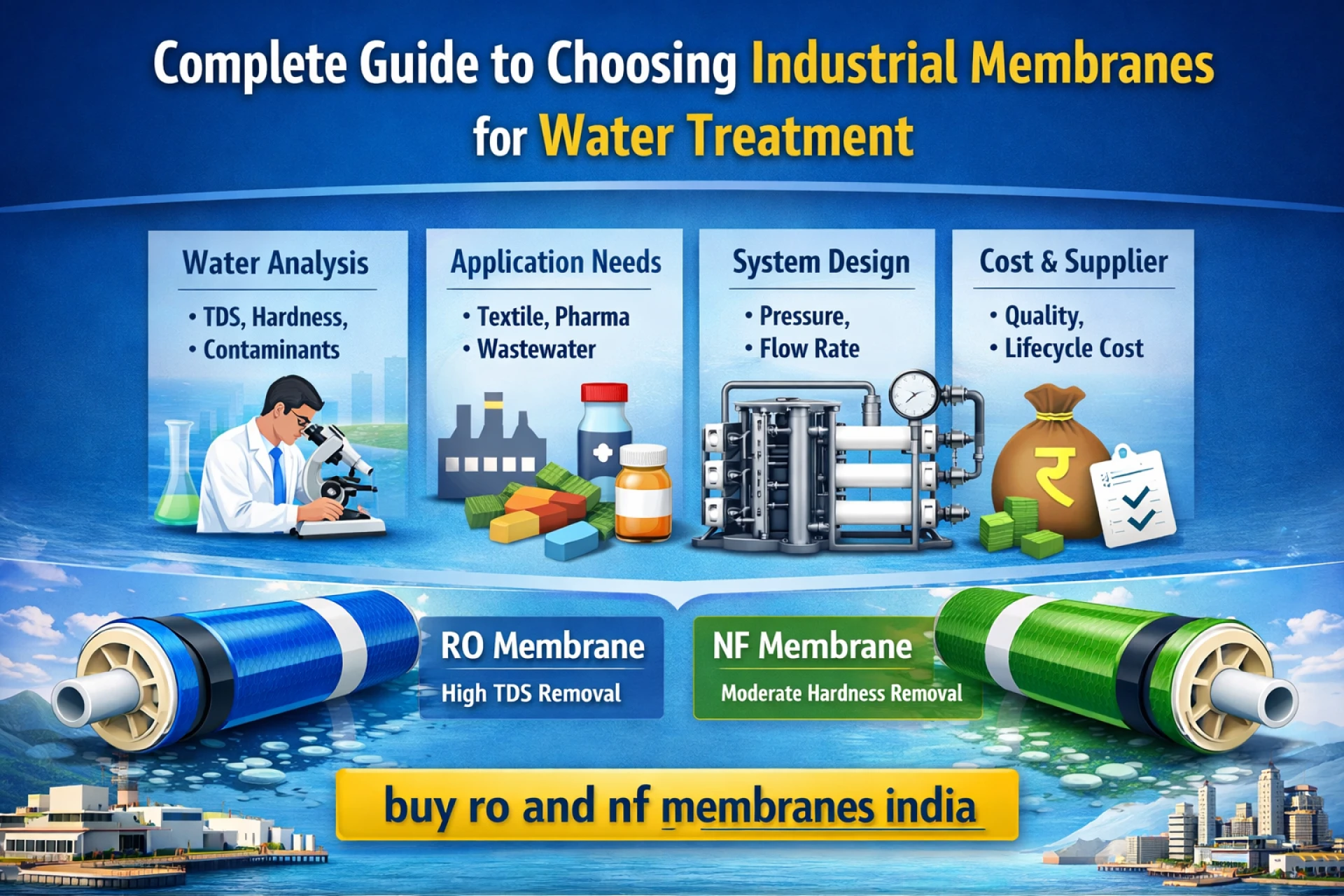
Start with water analysis. This is the most important step. Check TDS, hardness, organic content, and suspended solids. Each parameter affects membrane selection. High TDS usually requires reverse osmosis. Moderate TDS with high hardness may work with nanofiltration. Ignoring this step leads to higher operating costs.
Matching Membrane with Application
Next, understand your application. Industrial use cases vary. Textile, pharma, food processing, and wastewater treatment all need different membrane performance. Some require high purity. Others need selective filtration. You cannot use one membrane for all purposes. Matching the membrane with the application ensures stability and efficiency.
Evaluating System Design and Parameters
System design also matters. Pressure, flow rate, and recovery levels affect performance. A membrane that works well in one system may fail in another. This is why technical specifications must be reviewed carefully. Look at rejection rate, flux, and operating pressure. These define how the membrane will perform in real conditions.
Importance of Pretreatment
Pretreatment is another critical factor. Without proper pretreatment, membranes foul quickly. Suspended solids, scaling salts, and organics damage the surface. This reduces lifespan and increases maintenance cost. A good system always includes filtration, dosing, and conditioning before the membrane stage.
Cost vs Long Term Value
Cost should be evaluated over time. Many buyers choose cheaper membranes to save money upfront. This often leads to frequent replacements and higher energy consumption. A better approach is to calculate lifecycle cost. A slightly expensive membrane with better performance will reduce long term expenses.
Choosing the Right Supplier
Supplier reliability is also important. Consistent quality, technical support, and availability matter. If the supplier cannot provide support, system performance will suffer. Always choose suppliers with proven experience in your industry.
Final Recommendation
If you are planning to buy ro and nf membranes india, take a structured approach. Start with water analysis, match the membrane to your application, and evaluate long term cost. This ensures better performance and lower risk. There is no universal solution in membrane selection. Every system is different, and the right decision comes from data.


Sign in to leave a comment.