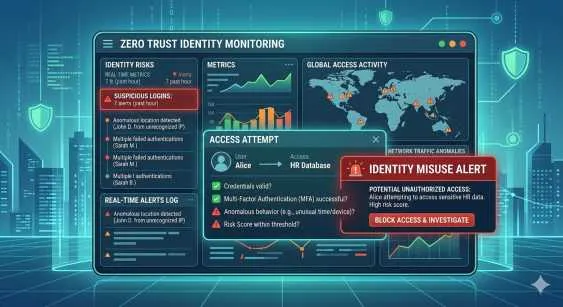

The traditional security perimeter no longer exists. Modern networks distribute resources across cloud environments, remote endpoints, and on-premises infrastructure. This architectural shift requires a fundamental change in how organizations handle access control. The Zero Trust model addresses this reality by operating on a strict principle: never trust, always verify. Every user and device must prove their legitimacy continuously, regardless of their network location.
Implementing a Zero Trust architecture relies heavily on robust identity and access management. When threat actors acquire valid credentials, they can navigate internal systems under the guise of legitimate users. Security operations centers must identify these anomalies immediately to prevent extensive lateral movement and data exfiltration.
Properly configured cybersecurity alerts act as the primary defense mechanism against this specific threat vector. By designing these notifications to analyze behavioral context and access patterns in real time, organizations can identify unauthorized actions rapidly. Establishing this continuous verification pipeline is essential to neutralizing a potential cyberattack before it compromises critical assets.
The Role of Cybersecurity Alerts in Zero Trust
Zero Trust environments generate massive volumes of telemetry data from authentication logs, endpoint states, and network traffic. Raw data alone does not secure an environment. Security teams need automated systems capable of parsing this information to identify explicit indicators of compromise.
Cybersecurity alerts function as the translation layer between raw telemetry and actionable security intelligence. In a Zero Trust framework, these alerts must focus heavily on identity-centric anomalies. If a user authenticates successfully but immediately attempts to access restricted administrative databases outside their normal behavioral scope, the system must flag the interaction. Failing to configure these thresholds accurately leaves the network highly vulnerable to a sophisticated cyberattack.
Key Principles for Designing Effective Detection Mechanisms
Creating an alerting framework that accurately identifies identity misuse requires a systematic approach to data correlation. Security architects must integrate multiple telemetry sources to establish a reliable baseline of normal operations.
Contextual Identity Verification
An alert must provide immediate context regarding the user, the device, and the requested resource. When configuring security information and event management (SIEM) rules, engineers should mandate the inclusion of specific metadata. This metadata includes geographic location, time of access, device compliance state, and the user's historical access patterns. If an executive logs in from a new corporate laptop in London, but their mobile device simultaneously registers an access request from Tokyo, the system must trigger high-priority cybersecurity alerts instantly.
Behavioral Baseline Anomaly Detection
Static rule sets cannot keep pace with dynamic network environments. Organizations must deploy machine learning heuristics to establish behavioral baselines for every network identity. The system learns standard working hours, typical data transfer volumes, and routine application usage. When an identity deviates significantly from this baseline, the platform generates an alert. This method is highly effective for detecting compromised credentials, as threat actors rarely mimic the exact behavioral fingerprint of the original user.
Detecting Identity Misuse in Real Time
Time to detection is the most critical metric during a security incident. Threat actors utilize automated scripts to escalate privileges and map network topologies within minutes of gaining initial access.
Continuous Authentication Mechanisms
Zero Trust mandates that trust is never permanent. Real-time detection relies on continuous authentication protocols that evaluate risk continuously during an active session. If a user attempts to elevate their privileges or access highly sensitive repositories, the system must force a step-up authentication challenge. If the challenge fails, or if the request originates from an unrecognized IP subnet, the platform must terminate the session and dispatch urgent cybersecurity alerts to the incident response team.
Mitigating the Risk of a Cyberattack
Identity misuse often serves as the precursor to a destructive payload deployment, such as ransomware. By catching the early stages of credential abuse, security teams disrupt the kill chain. Rapid isolation of the compromised identity limits the blast radius of the event. A well-designed alerting pipeline ensures that the initial unauthorized access attempt is recognized, contained, and investigated before it evolves into a catastrophic cyberattack.
Minimizing Alert Fatigue for Security Teams
A poorly optimized detection system generates thousands of false positives daily. Alert fatigue occurs when security analysts become overwhelmed by the sheer volume of notifications, leading












Sign in to leave a comment.