
Introduction
Have you ever wondered if artificial intelligence can be “fair”? You’d think a machine wouldn’t have opinions as it’s just code, right? But the truth is, AI can and often does reflect the same biases existing in our society.
Whether you’re watching your favourite show on Netflix, applying for a job, or even just scrolling through social media, AI is quietly shaping what you see and experience.
Businesses rely on AI to automate tasks, analyse data, and make decisions. But if the technology is biased, it can damage trust, lead to unfair treatment, and even hurt a brand’s reputation. On a societal level, AI bias can reinforce discrimination among society, making it harder for us to build a fair and inclusive world.
In this article, we will look at what Ethical AI is, what AI biases are and how we can address them, and promote fairness.
What is Ethical AI?
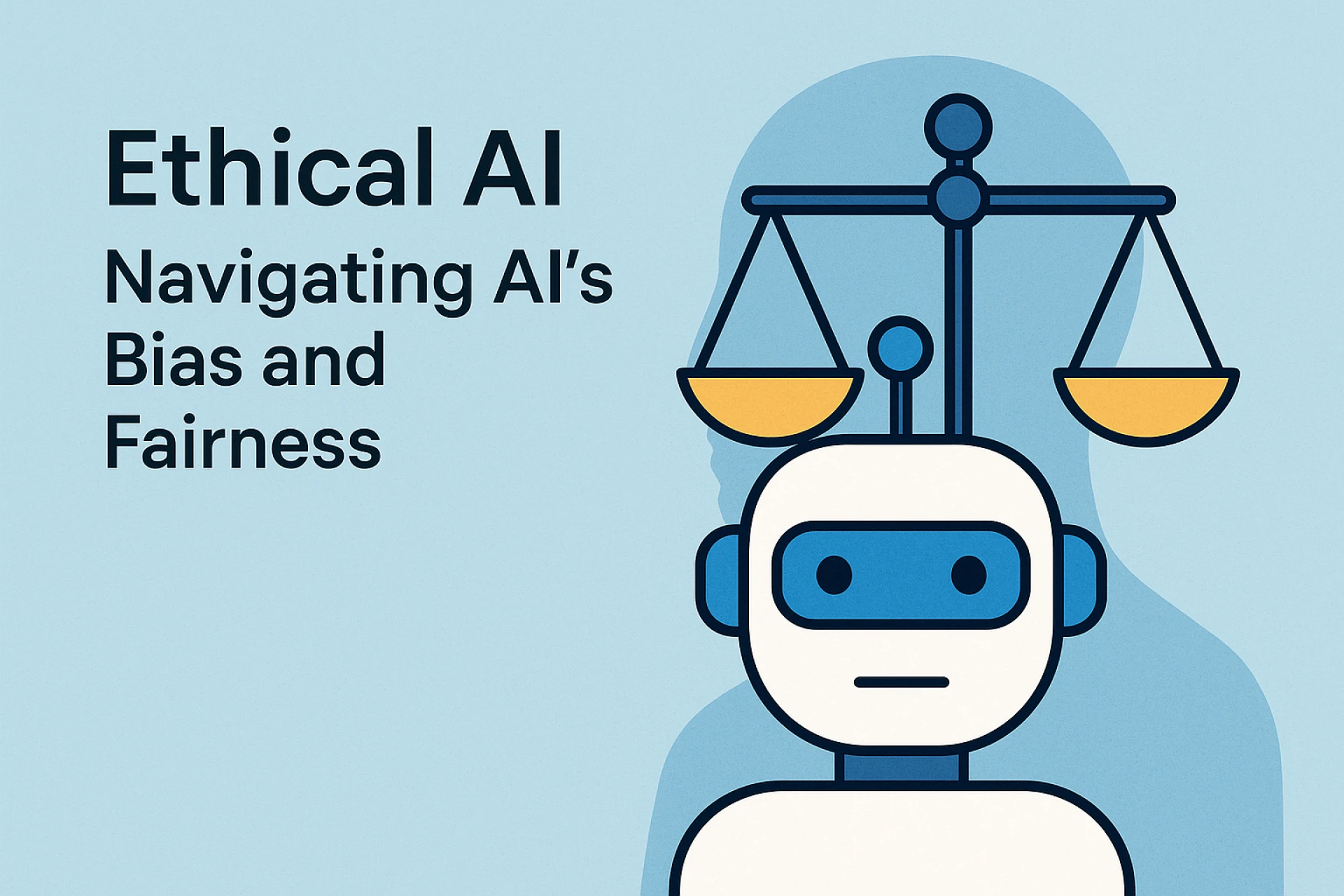
When we talk about Ethical AI, what we are looking at is how we can ensure that AI works for us in a fair, transparent, and responsible manner.
It’s about making sure that when a machine makes a decision, like recommending a product to you or screening a job application, it does so in a way that’s unbiased and transparent.
At its core, Ethical AI is all about making sure AI is:
- Fair: It doesn’t favour one group of people over another.
- Transparent: It’s clear about how it works and why it made a particular decision.
- Accountable: There’s a human who takes responsibility in case something goes wrong.
You might be wondering why this is so important. Imagine you’re applying for a job and an AI system is screening your résumé. If that AI is biased since it was trained to prefer a certain gender over the other, for instance, you might miss out on an opportunity without even knowing why. That’s where Ethical AI comes in, ensuring that technology works for everyone.
Biases in AI: What Are Biases?
Let’s first understand what a bias is.
A bias is a tendency to favour one group over another. We all have personal biases, like preferring certain music or making assumptions about people based on stereotypes.
In terms of artificial intelligence, bias can come in surprising ways. AI systems learn from data we provide in the form of the text we write, the images we post, and the choices we make, and that data often reflects the biases of the people who created it. If an AI is trained on biased data, it can pick up those patterns and repeat them when making decisions.
Biases in AI can happen because:
- Historical Data: If past decisions were unfair, AI might learn those same unfair patterns.
- Limited Data: If certain groups aren’t well-represented in the data, the AI might not learn to treat them fairly.
- Algorithmic Design Choices: Sometimes, an AI can unintentionally favour some outcomes over others because of the way it’s made.
Bias in AI isn’t always intentional, but they have real life consequences, like reinforcing stereotypes and denying opportunities. Understanding this is key to making AI systems fairer.
Navigating Biases and Promoting Fairness: Methods and Strategies to Reduce Bias
So, what can we do to make AI fairer?
- Start with Better Data
- Use diverse datasets that include different genders, races, and backgrounds.
- Clean the data to remove or correct obvious biases.
- Build Fairer Algorithms
- Apply fairness constraints that prevent favouritism.
- Test different models to find balanced outcomes.
- Keep Humans in the Loop
- Regularly audit decisions to catch biased patterns.
- Allow humans to override AI decisions in important cases.
- Embrace Transparency and Accountability
- Use explainable AI to show how decisions are made.
- Document training processes and steps taken to reduce bias.
- Continuous Monitoring and Improvement
- Update training data and monitor AI performance to keep systems fair as society changes.
Reducing bias is not just about technology; it’s about the people building and using it.
Real-World Examples of Ethical AI: Case Studies from India
Example 1: ZestMoney’s Fair Credit Decisions
ZestMoney, an Indian fintech company, uses AI to make credit decisions more inclusive. Instead of relying only on traditional credit scores, which can leave out many people, they look at alternative data like mobile usage and digital payments. This way, even people without a strong credit history have a fair shot at getting loans.
Example 2: Wadhwani AI’s Cotton Pest Management
Wadhwani AI helps farmers manage cotton pests with AI that uses region-specific data. By considering local farming practices and languages, they make sure their system supports all farmers fairly, even those with less digital know-how.
The Future of Ethical AI
We live in an era where technology is moving faster than ever, and the way we build AI today will impact the society we live in tomorrow. So, what does the future of Ethical AI look like?
a) Self-correcting AI
AI systems that can learn and adapt to reduce bias over time. Imagine an AI that notices when its decisions are unfair and adjusts itself to be more equitable. This is already being explored through fairness-aware machine learning algorithms, which allow AI to automatically balance accuracy with fairness.
b)Explainable AI (XAI) Getting Smarter
You’ve probably heard about Explainable AI (XAI), which aims to make AI’s decisions easier for humans to understand. It builds trust and helps us spot potential biases faster. Future XAI tools will be even better at showing us the “why” behind every AI decision.
c)Bias-Detection Tools
These tools are like digital watchdogs that continuously scan AI systems for signs of bias before they cause harm. Companies are already integrating these tools into their development process, and I believe they’ll become a standard practice in the next few years.
Final Thoughts
The purpose of Ethical AI is to make sure that artificial intelligence treats everyone fairly. It should be transparent about how it works and respect people’s rights. Sometimes, bias creeps into AI through the way it learns or in the way it is built. This can affect things in real life, like who gets a job, a loan, or even good healthcare.
This can, however, be fixed by making sure that more diverse data is used while training the AI, building smarter algorithms, and keeping humans involved in the process.
We’re already seeing this happen in India. For example, ZestMoney uses AI to help more people get loans, even if they don’t have a credit score. And Wadhwani AI supports farmers by giving them helpful advice about crop pests, using local data that is relevant to them.
Looking ahead, the future of Ethical AI is bright. With new tools like explainable AI and systems that can catch bias on their own, we’re getting better at making sure AI works for everyone.
To read more about Artificial Intelligence, go to https://workspacetool.com/blog-workspacetool/










Sign in to leave a comment.