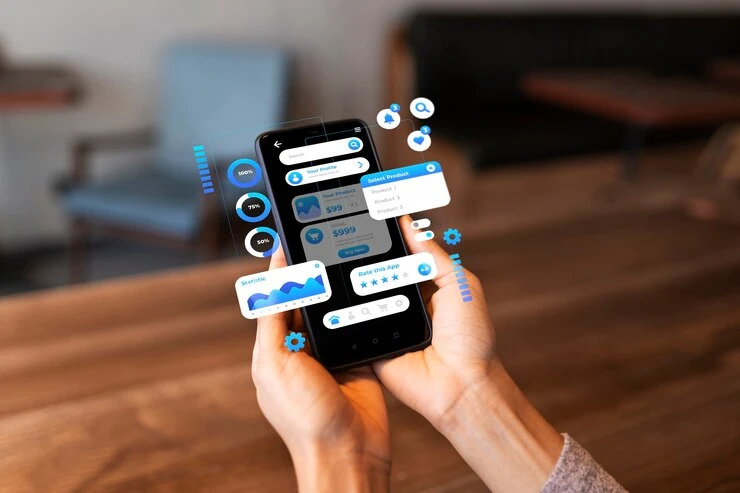

IoT apps are the software applications which connect and control the devices in the IoT (Internet of Things) ecosystem. These applications allow the users to monitor, manage, as well as control the interlinked devices, and this improves overall efficiency. The IoT App features enable the users to talk to industrial machines to home appliances, offering control as well as insight that enhances the user experience.
Key Components of an IoT app
IoT apps are developed from a combination of various key constituents that function harmoniously to drive real-time interaction, automation, as well as the processing of data. The above constituents of the IoT application development services ensure proper working and aids the users to monitor and govern their devices accurately.
Sensors: Sensors serve as the foundation of IoT applications, gathering real-time information from the tangible world. These gadgets measure several environmental factors such as humidity, temperature, pressure, and motion. They transmit this information to the app, allowing it to respond and monitor variables.
Actuators: The actuators are supposed to take physical actions depending on the information fed by the sensors. For example, switching on the air conditioning unit after identifying extreme heat is one of the features of IoT App that employs actuators. Actuators help boost automation through conversion of sensor information into physical-world action.
Cloud hosting: IoT applications rely on the cloud environment to process and store large volumes of information. The cloud provides remote data accessibility and scalability, providing flexibility in processing and managing information from any location and at any time.
Network Integration: Communication protocols like Bluetooth, Wi-Fi, and cellular networks provide smooth information transfer across the cloud and devices. Real-time data exchange ensures the agility and responsiveness of the IoT applications.
UI (User Interface): The user interface assists users to send messages to the application, handle gadgets, and update settings. Simple and intuitive User Interface is of great importance for an IoT consulting company to keep the app productive and ease to use, mostly for non-technical users.
Data Analysis: IoT applications make use of advanced algorithms for the processing of sensor data to deliver novel insights. It helps in taking decisions or providing reports on real-time data for the application.
Security: Because IoT applications deal with sensitive information and connect with multiple platforms, security becomes vital. Proper encryption and communication along with authentication of users assure protection of data against cyber attacks
APIs: APIs help integrate IoT gadgets with external frameworks. This enables the app to interact with 3rd-party services and platforms. They help an IoT consulting company enhance the functionality of the app by encouraging communication with other services.
Edge Computing: Edge computing includes data analysis that happens on devices locally or in close proximity to gadgets, instead of depending solely on cloud platforms. This minimizes latency and improves response times, which is important for real-time applications.
External Integration: Many of the IoT applications integrate with other 3rd-party services. For example, weather apps or smart home systems improve functionality. The integration provided offers a number of additional features and enhances the usefulness of the apps.
What are the essential features of a successful IoT App?
The features of an IoT App shall ensure streamlined processing, security, usability, and performance. They should improve the user experience and optimize the app in a way that meets the diverse requirements of its user base. Let's dive into the key features that every successful IoT app shall have:
Real-Time Analysis:
Identifies and showcases information from gadgets in real-time.
Triggers quick action whenever needed, such as temperature flipping or alarms going off.
Remote Control:
Enables users to control the devices from any corner of the globe.
Improves user convenience and supports voice assistants such as Google Assistant or Alexa.
Data Analytics:
Captures and analyzes data to present insights into performance and usage patterns.
It also fosters power saving and cost reduction, and this makes it one of the prominent features of IoT App.
UI (User Interface):
A user-friendly and intuitive design makes it easier to communicate with devices and their environment.
It should have high accessibility to users from various domains, making navigation easy.
Security Features:
Encryption technologies like multi-factor authentication, and secure communication protocols help protect user information.
It helps IoT apps in safeguarding data against cyber threats and ensures data and device security.
Local Functionality:
With an offline capability, an IoT app can perform without internet and store data locally, which can be synced once the network connection is restored.
One of the most critically important features of an IoT App because it helps handle unstable network connections.
Automation:
This helps in automatizing mundane tasks, like adjusting thermostats or flipping lights on/off
Improves efficiency, saves time, and solves the problem of user communications with devices
Energy Optimization:
It helps streamline power consumption by giving insights to monitor energy consumption.
It minimizes energy consumption, especially in the case of battery-powered gadgets, increasing their life span.
Interoperability with Other Platforms:
It helps integrate 3rd-party services, apps, or smart home solutions to enhance functionality.
It widens the horizon of the IoT applications and builds a more integrated and connected ecosystem.
Personalization:
It helps users in personalizing their app experience, like setting alerts, schedules, and gadget preferences.
It also offers flexibility for adjustment according to individual user requirements and is, therefore, one of the most vital features of an IoT App.
Conclusion:
IoT applications are a great contributor to interconnected devices, the automation of various tasks in sectors, and enhanced real-time monitoring. If developers keep their focus on the most important features, like scalability, user-friendly interfaces, and security, then they can build powerful apps matching the needs of the users.
As much as the technology arena is evolving daily, it's more crucial now than ever before. As the IoT keeps gaining momentum, the apps will play a critical role in enhancing interactions between humans and devices, increase efficiency, and drive innovation within various sectors. Optimizing IoT App features is what businesses are using to reconfigure how work gets done and lived, making tasks routine yet highly accessible and efficient.











Sign in to leave a comment.