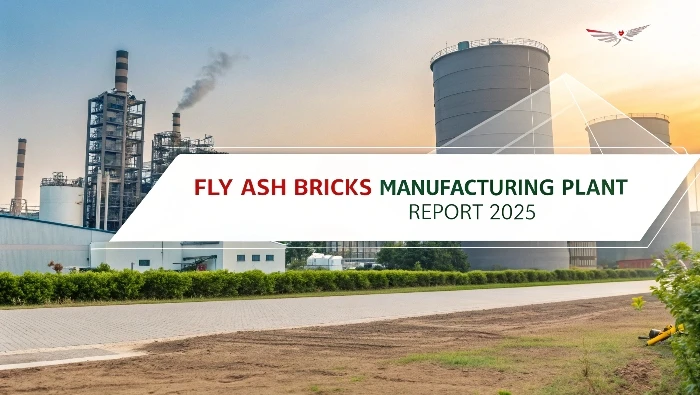

IMARC Group's report, "Fly Ash Bricks Manufacturing Plant Project Report 2025: Industry Trends, Plant Setup, Machinery, Raw Materials, Investment Opportunities, Cost and Revenue," offers a comprehensive guide for establishing a fly ash bricks production plant. The report provides insights into the fly ash bricks plant capital investment, production process, financials, capital investment, expenses, ROI, and more to support informed business decisions.
Fly Ash Bricks Manufacturing Plant Project Report Summary:
• Comprehensive guide for setting up a fly ash bricks manufacturing plant.
• Covers global construction and building materials market trends for 2025.
• Detailed project setup, including unit operations and brick formation processes.
• Raw material and utility requirements.
• Infrastructure and machinery specifications.
• Workforce and staffing requirements.
• Packaging, storage, and transportation logistics.
• Financial aspects: investment opportunities, cost analysis, and revenue projections.
The report also includes:
• Detailed insights into the fly ash brick manufacturing process.
• In-depth project economics and financial metrics.
• Capital investment requirements and funding options.
• Operating expense and income projections.
• Breakdown of fixed and variable costs, direct and indirect expenses.
• Evaluation of ROI (Return on Investment), NPV (Net Present Value), IRR, and break-even point.
• Profit and Loss account analysis.
• A complete roadmap for successfully establishing a fly ash bricks manufacturing unit.
Request for a Sample Report: https://www.imarcgroup.com/fly-ash-bricks-manufacturing-plant-project-report/requestsample
What are Fly Ash Bricks?
Fly ash bricks are eco-friendly building materials made from fly ash, cement, sand, and water. These bricks are known for their high compressive strength, uniform shape, lightweight structure, low water absorption, and durability. They are widely used in residential, commercial, and industrial construction due to their superior performance and lower environmental impact compared to traditional clay bricks.
Fly ash bricks help reduce carbon emissions and support sustainable construction practices by utilizing industrial waste from thermal power plants. Their dimensional accuracy facilitates faster construction, reduced mortar usage, and enhanced structural stability.
Market Trend and Drivers of Fly Ash Bricks:
The fly ash bricks market is driven by rapid urbanization, infrastructure development, and rising demand for eco-friendly construction materials. Government policies promoting fly ash utilization and restrictions on traditional clay brick manufacturing have significantly boosted market growth.
Increasing awareness about sustainable building solutions, expansion of smart city projects, and cost-effectiveness of fly ash bricks further enhance market adoption. Technological advancements in brick-making machinery and automation continue to improve productivity and product quality.
Key Insights Covered in the Fly Ash Bricks Manufacturing Plant Report-
Market Coverage:
• Market trends: green construction, eco-friendly materials, and infrastructure expansion.
• Market segmentation: by brick type, application, manufacturing process, and end-use industry.
• Regional analysis: demand and production trends across major global regions.
• Price analysis: cost trends for fly ash, cement, sand, additives, and packaging materials.
• Impact of COVID-19 on construction supply chains.
• Market forecast and long-term industry outlook.
Speak To An Analyst: https://www.imarcgroup.com/request?type=report&id=14153&flag=C
Key Aspects Required for Setting Up a Fly Ash Bricks Manufacturing Plant-
Detailed Process Flow:
• Product Overview: brick composition, physical properties, and strength characteristics.
• Unit Operations Involved: raw material mixing, batching, molding, pressing, curing, drying, and palletizing.
• Mass Balance and Raw Material Requirements: fly ash, cement, sand, lime, gypsum, and water.
• Quality Assurance Criteria: compressive strength, density, water absorption, efflorescence, and dimensional accuracy.
• Technical Tests: drop tests, strength testing, durability tests, shrinkage testing, and thermal behavior evaluation.
Project Details, Requirements, and Costs Involved:
• Land, Location, and Site Development: land area, accessibility, zoning compliance, and factory layout planning.
• Plant Layout: raw material yard, mixer unit, molding section, curing chamber, drying area, QC lab, and finished goods storage.
• Machinery Requirements and Costs: pan mixers, brick-making machines (manual/automatic/semi-automatic), hydraulic presses, conveyors, batching systems, and curing chambers.
• Raw Material Requirements and Costs: fly ash, sand, cement, gypsum, additives, and packaging materials.
• Packaging Requirements and Costs: straps, pallets, shrink wraps, and labeling materials.
• Transportation Requirements and Costs: logistics for raw materials and distribution of finished bricks.
• Utility Requirements and Costs: power supply, water, compressed air, and waste management systems.
• Human Resource Requirements and Costs: machine operators, skilled laborers, technicians, supervisors, and administrative staff.
Project Economics:
• Capital Investments: land, building construction, machinery purchase, installation, and utilities setup.
• Operating Costs: raw materials, utilities, manpower, maintenance, packaging, and logistics.
• Expenditure Projections: short-term and long-term cost estimates.
• Revenue Projections: earnings from brick sales to construction companies, contractors, and retailers.
• Taxation and Depreciation: applicable tax norms and depreciation schedules.
• Profit Projections: profitability based on production scale and market demand.
• Financial Analysis: ROI, NPV, IRR, and break-even point evaluation.
About Us:
IMARC Group is a global consulting firm that supports investors and entrepreneurs in successfully establishing manufacturing plants. The company provides end-to-end project guidance, including market assessment, feasibility studies, factory setup support, machinery and raw material planning, cost and revenue analysis, and regulatory assistance. With comprehensive insights and practical execution support, IMARC helps clients build efficient, compliant, and profitable production facilities with confidence.
Contact Us:
IMARC Group
134 N 4th St., Brooklyn, NY 11249, USA
Email: sales[@]imarcgroup.com
Tel No:(D) +91 120 433 0800
United States: (+1-201971-6302)











Sign in to leave a comment.