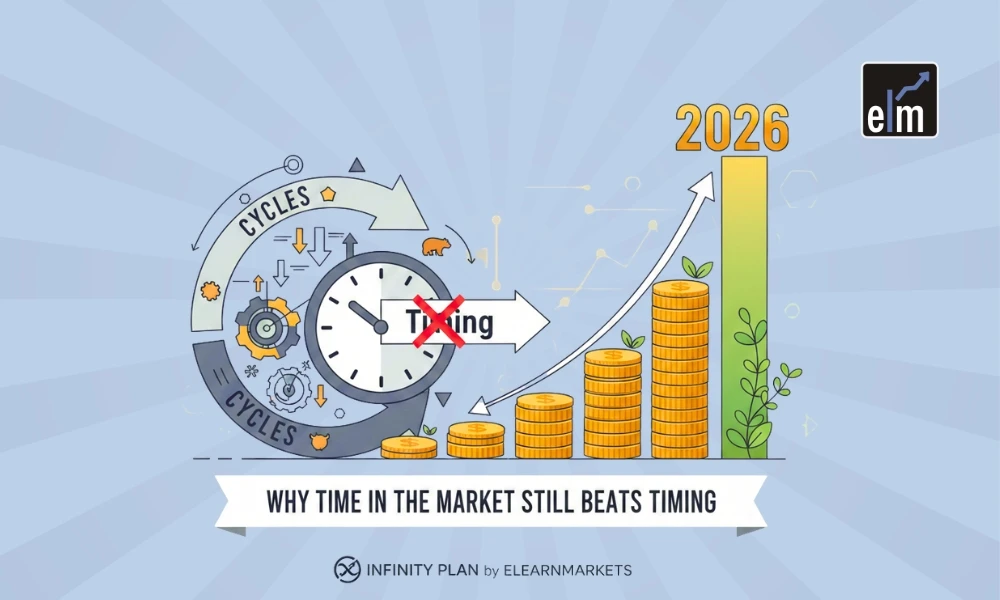

Every time markets dip, the headlines start burning. Every time they rally, the same crowd says they saw it coming.
But here's the thing – almost nobody actually did.
And the ones who silently made wealth over time?
They weren't the ones glued to trading terminals at midnight. They were the ones who stayed invested.
This idea isn't new. But it's also never been more relevant.
In 2026, with global markets still digesting rate cycles, geopolitical shifts, and the AI-driven economic reset, the question isn't whether you should be in the market.
The question is: are you giving yourself enough time inside it?
The Cycle Trap - Why Most Retail Investors Get It Wrong
Market cycles are real. Economies expand, overheat, correct, and recover. That part is predictable - in hindsight. What's not predictable is the exact turning point. And that's where most people go wrong.
Think about this.
Between 2020 and 2022, markets swung wildly - a crash, a roaring recovery, another correction. Investors who tried to time every move often ended up buying high out of FOMO and selling low out of fear.
The ones who simply held quality positions and added during dips?
They came out significantly ahead.
This isn't an argument against understanding cycles. If you're seriously trying to learn stock market dynamics, knowing about business cycles, interest rate sensitivity, and sector rotation is genuinely valuable.
But that knowledge should inform your entry strategy - not replace your patience.
Compounding: The Only Thing That Works While You Sleep
Nothing makes a point like a real example, so let's talk about numbers.
Consider Arjun and Priya, two investors.
Both begin with one lakh rupees.
He misses 10 of the best trading days in a year - which, statistically, tend to cluster around the most volatile periods. Priya just stays invested in a diversified portfolio and adds a fixed amount every month.
After 10 years, who wins? Priya - by a wide margin.
This isn't a made-up scenario. Studies across global markets consistently show that missing even the top 10–20 trading days in a decade can cut your returns by 40–60%.
Compounding doesn't care about your predictions. It only cares about time. The longer your capital is at work, the more it compounds - on returns, on dividends reinvested, and on the unrealized gains that never got cashed out too early.
But Isn't 2026 Different? What About Volatility?
Every year feels like a special case. In the 2008 crash, people said markets would never recover. Post-COVID, experts predicted a lost decade. In 2022, fears of a rate hike dominated. And yet - the Nifty 50 has delivered roughly 12–14% CAGR over the long run, through all of it.
Yes, 2026 has its own variables: slower global growth, sector-specific corrections in overheated AI stocks, and election-linked volatility across several major economies. These are real.
But they are also temporary. The underlying economic engine—corporate earnings, demographic growth in India, and consumption trends—hasn't broken down.
Volatility isn't the enemy. It's actually the mechanism through which patient investors are rewarded. When prices fall, those who stay invested (and, better yet, those who add more) are essentially getting quality assets at a discount.
The Knowledge: Why Learning Matters More Than Luck
Staying invested is the strategy. But staying invested in the right things requires understanding. That's the part most people skip.
There's a big difference between someone who's vaguely aware of the stock market and someone who actually understands how to read a balance sheet, evaluate a business, understand macroeconomic indicators, and think probabilistically about risk.
The second person sleeps better during corrections because they understand what they own and why.
This is exactly why structured stock market learning has become so critical.
Whether you're just starting or looking to sharpen your edge, enrolling in well-designed online stock market courses gives you the framework to make decisions based on logic, not emotion.
Elearnmarkets has made this genuinely accessible.
Their stock market courses online cover everything from the fundamentals to advanced technical analysis, structured in a way that's practical, not just theoretical.
For someone who wants to learn stock market trading with a real understanding of how markets behave, that kind of structured exposure makes all the difference.
The Infinity Plan by Elearnmarkets — Learning Without Limits
Here's where things get interesting for serious learners.
Elearnmarkets offers something called the Infinity Plan, and honestly, for anyone committed to genuinely mastering the markets, it's one of the better investments you can make in yourself.
The Infinity Plan gives you lifetime access to their entire course library.
We're talking about share market courses, trading courses online, courses on technical analysis, fundamental investing, derivatives, commodities, and more, all under a single plan.
You don't have to keep paying separately for every module or worry about subscriptions expiring right when you're in the middle of something important.
What makes it particularly useful is the depth and the range. If you’re learning trading, the usual options are either one-off courses that gather dust or chaotic feeds full of hot takes. The Infinity Plan sits in the better column: it’s a living curriculum.
From placing your first trade to automating a systematic strategy, every module is built to scale with you, with beginner tracks, advanced derivatives deep dives, and sector-specific playbooks when you want to go narrower.
Here’s the simple framework I swear by: Time + Knowledge + Discipline.
- Time: Compound patiently—good positions appreciate over years, not headlines.
- Knowledge: Don't just own a ticker; own the thesis. Learn macro drivers, risk mechanics, and why your strategy should fail sometimes.
- Discipline: rules win. Position sizing, stop logic, post-trade reviews, rinse, and repeat.
You’re not buying a product; you’re buying an evolving library that grows as markets do. Come back next month or next year; the lessons will still be relevant, and your edge will compound.
Discipline: Stick to your process. Markets will test you; they always do. Discipline is what separates the investor who builds wealth from the one who just experiences volatility.
Final Thought
Market timing is attractive because it feels like control.
But the data, history, and the quiet stories of genuine long-term wealth all point in the same direction: time in the market beats timing the market. Every single time, over every meaningful horizon.
The best thing you can do in 2026 — and beyond — is combine that patience with real knowledge. Learn how markets move, how businesses are valued, and how risk is actually managed. Use platforms like Elearnmarkets and their Infinity Plan to build that foundation systematically.
And then let time do the rest.
Markets reward the patient. They always have. The only question is whether you'll be around long enough to collect.
Ready to make learning your edge? Explore the Infinity Plan at Elearnmarkets and start your stock market learning journey today.
Sign in to leave a comment.