
The field of genomics and rare disease research is undergoing a revolutionary shift, as generative AI enables scientists and clinicians to gain deeper insights into genetic disorders. Advanced AI models enable researchers to create gene-sequence simulations that forecast mutations and identify potential treatment targets faster than conventional techniques. The global impact of rare diseases, which affect millions of people, remains under-researched, yet AI-generated insights help researchers address challenges arising from working with limited datasets. The field of genomics research uses generative AI as a vital tool that helps speed up drug development, enhance diagnostic precision, and tailor treatments for patients previously considered untreatable.
How Generative AI Works in Genomics and Rare Disease Research

Benefits of Using Generative AI in Genomics and Rare Disease Research
Generative AI provides several key advantages that are reshaping genomics and rare disease studies:
- Accelerated Research Timelines
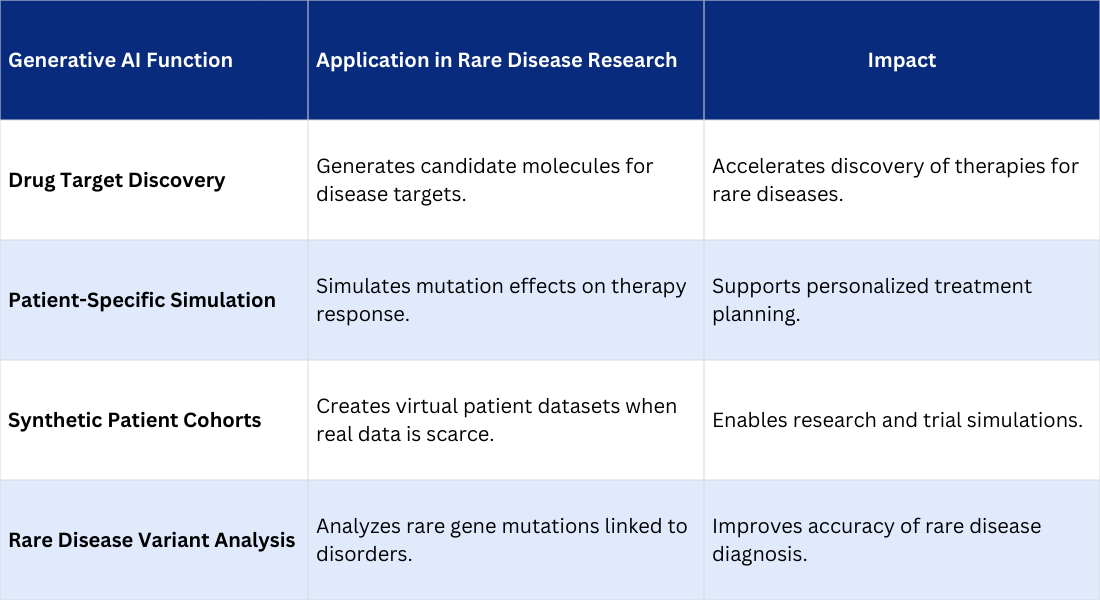
The process of traditional research methods can take multiple years to discover mutations and verify therapeutic targets. The technology of generative AI enables scientists to create gene-sequence simulations that predict mutation effects, while generating new research methods that reduce study duration from years to months.
- Overcoming Data Scarcity
Health researchers face challenges in collecting data for rare diseases that affect only a small number of patients. By generating artificial yet authentic datasets, generative AI provides researchers with the resources to train their machine learning models.
- Enhanced Diagnostic Accuracy
The AI-powered system for variant interpretation detects pathogenic mutations, enabling clinicians to achieve faster, more accurate diagnostic results. The situation becomes urgent because rare diseases lack sufficient knowledge and resources needed for accurate diagnosis.
- Personalized Treatment Planning
Generative AI supports precision medicine by simulating patient-specific genetic responses. The unique genetic profile of each patient enables optimized treatment, boosting success rates while reducing adverse reactions.
- Facilitates Drug Discovery
AI-generated candidate molecules for rare disease targets enable pharmaceutical scientists to investigate potential therapies that would otherwise remain hidden due to low patient numbers.
- Supports Collaborative Research
The AI-generated synthetic data enables institutions to exchange information without violating privacy regulations, thereby promoting international cooperation in rare disease research.
Transform your genomics and rare disease research with cutting-edge AI solutions. Work with experienced professionals who can design and deploy intelligent models for healthcare innovation. Hire Generative AI engineers to start building the next generation of medical breakthroughs.
Real-World Examples and Case Studies
Several organizations are already demonstrating the power of generative AI in genomics and rare disease research:
DeepMind’s AlphaFold
AlphaFold uses artificial intelligence to predict protein structures from genomic data. Its predictions are revolutionizing the understanding of the molecular mechanisms underlying rare genetic disorders, enabling faster diagnostic testing and new drug development.
Insilico Medicine
This biotech company uses generative AI to create new molecules to treat rare diseases, reducing the time required for preclinical research and developing therapeutic ideas that traditional methods cannot achieve.
Orphanet Collaborations
Research on ultra-rare diseases uses generative AI models to produce synthetic patient cohorts for study purposes. The models enable researchers to conduct virtual clinical trial simulations while exploring various treatment options without using real-world patient data.
University Genomics Centers
Several research universities now use transformer-based AI models to interpret whole-genome sequencing data, enabling them to identify disease-causing variants more efficiently while working to improve patient outcomes in rare disease clinics.
Summary
Generative AI in genomics and rare disease research is no longer a futuristic concept; it is an essential tool that accelerates discovery, improves diagnostics, and enables personalized therapies. The AI system meets the specific requirements of rare disease research by generating synthetic data, predicting genetic variants, simulating protein structures, and assisting in the development of new drugs. In 2026, healthcare organizations, research institutions, and pharmaceutical companies will begin adopting generative AI across their research processes and clinical operations. The future of rare disease genomics holds promise, as AI-powered tools will deliver faster diagnostic results and develop more effective treatments that improve patient outcomes.
Also Read: Role of Generative AI In Healthcare











Sign in to leave a comment.