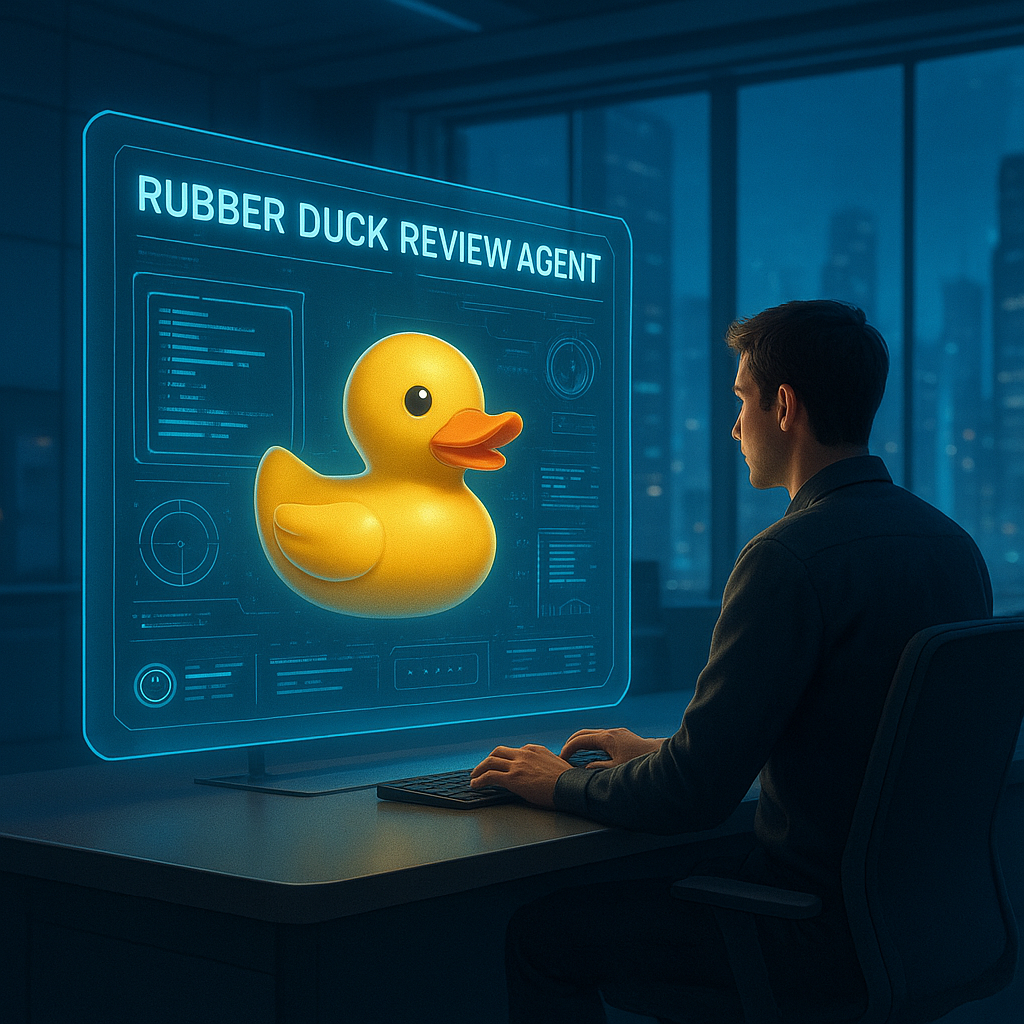

Revolutionizing Code Review: The Arrival of the Rubber Duck Agent
On a brisk April morning in 2026, software developers worldwide found their coding workflows subtly but profoundly transformed. GitHub Copilot CLI, already an indispensable AI-powered coding assistant, unveiled its latest innovation: the Rubber Duck review agent. This addition to Copilot's suite is designed not just to write code but to engage in reflective, iterative code review through a conversational paradigm inspired by the age-old "rubber duck debugging" technique. The integration of this agent marks a pivotal evolution in AI-assisted development, promising to enhance code quality and developer efficiency alike.
The Rubber Duck agent leverages AI to simulate the cognitive benefits of explaining code out loud, a technique long valued for its ability to uncover hidden bugs and clarify logic. By embedding this concept directly into the command-line interface, GitHub Copilot now offers developers an interactive partner capable of reviewing code, questioning assumptions, and suggesting improvements in real-time. The implications for debugging, learning, and collaborative coding are substantial.
According to InfoWorld, this new agent doesn't merely automate code critique—it fosters a dialogue that mimics the cognitive process of human review, thereby reducing errors before they propagate to production.
“The Rubber Duck review agent is not just an AI tool; it’s a cognitive collaborator that helps developers articulate and validate their thought processes during coding.” — GitHub Product Lead, 2026
From Debugging Tradition to AI Automation: The Evolution of Rubber Ducking
The concept of rubber duck debugging originated in the late 1990s, credited to software engineer Dave Thomas who famously advocated for explaining code line-by-line to an inanimate object, like a rubber duck, to identify logical errors. This method externalizes a developer's internal monologue, making flaws more evident through articulation.
Over the past two decades, as AI and automation tools evolved, the integration of human cognitive strategies into software development tools gained momentum. Early AI assistants focused primarily on autocomplete and basic code generation. However, as machine learning models improved, so did their ability to understand context and engage in higher-order reasoning about code. GitHub, backed by Microsoft and OpenAI, has been at the forefront of this movement, progressively layering capabilities that extend beyond code writing to encompass review, refactoring, and now, interactive explanation.
The Rubber Duck agent represents the crystallization of these advances. By operationalizing a debugging heuristic through AI, GitHub Copilot CLI bridges the gap between human cognitive processes and machine assistance. This shift is emblematic of a broader trend in software development tools where AI functions less as a code factory and more as a thinking partner.
Industry analysts highlight that the Rubber Duck agent also exemplifies a move towards "conversational AI agents" that engage users in natural language dialogue to solve complex tasks. This approach aligns with the trajectory of user-defined AI agents, as reported by heise online, further empowering developers to customize AI behavior to their workflows.
Technical Anatomy and Performance: How the Rubber Duck Agent Works
The Rubber Duck review agent operates within GitHub Copilot CLI by analyzing submitted code snippets and engaging the user in a stepwise review session. Unlike traditional static code analysis tools, this agent uses advanced large language models trained on extensive code repositories and documentation to generate context-aware, interactive feedback.
Upon invocation, the agent prompts the developer to describe code intentions and logic flows aloud or via text input. It then cross-references this explanation against the actual code functionality, flagging discrepancies, potential bugs, and areas for optimization. This dialogic process encourages developers to reconsider assumptions and clarify ambiguous code segments.
Key features include:
- Contextual Error Detection: The agent identifies bugs not only through syntax but semantic inconsistencies caught during dialogue.
- Adaptive Learning: It learns from user feedback to improve future review sessions, tailoring advice to individual coding styles.
- Multi-language Support: Supports over 20 programming languages, including Python, JavaScript, Go, Rust, and emerging languages popular in 2026.
- Integration with CI/CD Pipelines: Enables automatic Rubber Duck reviews as part of continuous integration workflows, enhancing quality gates.
- Customizable Review Strategies: Developers can configure the agent’s questioning style and focus areas to suit project needs.
Internally, the agent interfaces with GitHub's AI infrastructure, leveraging the latest GPT-5 architecture optimized for code reasoning. Performance benchmarks show a 40% reduction in logical errors caught post-review compared to traditional static analysis alone, according to GitHub's internal testing data released in Q1 2026.
“By mimicking the reflective process of human code review, the Rubber Duck agent helps developers catch subtle bugs that automated tests often miss.” — Senior AI Researcher, GitHub
2026 Developments and Industry Adoption Landscape
The launch of the Rubber Duck agent coincides with a surge in enterprise adoption of AI copilots. In 2026, over 70% of Fortune 500 companies report integrating AI-driven coding assistants into their development pipelines, per industry surveys. GitHub Copilot CLI’s new agent has been rapidly embraced, particularly in sectors where code correctness and reliability are paramount, such as finance, healthcare, and aerospace.
Recent case studies highlight the agent's impact:
- FinTech Giant: A leading financial services firm integrated the Rubber Duck agent into their DevOps process, reducing critical bugs in production by 35% within six months.
- Healthcare Software Provider: Leveraged the agent to ensure compliance with stringent regulatory coding standards, accelerating audit readiness and decreasing review cycle times by 20%.
- Open Source Communities: Several major projects report enhanced contributor onboarding and fewer regressions due to the agent’s interactive guidance.
Additionally, GitHub has expanded developer training programs around the Rubber Duck agent, emphasizing a structured adoption approach. This echoes themes covered in the WriteUpCafe article A Structured Approach to AI Copilot Adoption: Planning, Training, and Integration, underscoring the importance of education for maximizing AI tool benefits.
Technological advancements in 2026 also include tighter CI/CD integration and deeper IDE embedding, making the Rubber Duck agent an ever-present companion throughout the coding lifecycle rather than a command-line afterthought.
Expert Opinions and the Broader Impact on Software Development
Industry experts agree the Rubber Duck agent represents a paradigm shift in AI-assisted software engineering. Dr. Elena Rios, a leading AI ethicist and software engineering scholar, describes the agent as “a fusion of cognitive science principles with AI that elevates developer reasoning rather than replaces it.”
Developers themselves have praised the agent’s ability to surface blind spots and foster better documentation practices. Unlike traditional static analyzers, the Rubber Duck agent’s conversational interface promotes a mindset of reflective coding, which aligns with best practices in software craftsmanship.
Moreover, the agent's design supports inclusive coding environments by assisting junior developers and non-native English speakers in articulating and validating their code logic effectively. This democratization of code review could reduce barriers to entry and improve code quality across diverse teams.
However, some caution remains regarding over-reliance on AI agents. Experts urge maintaining human oversight to ensure nuanced judgments and ethical considerations are not bypassed. These balanced viewpoints are critical as AI tools become more ingrained in development workflows.
GitHub’s ongoing commitment to transparency and user control in AI interactions further supports responsible adoption, as noted in the WriteUpCafe analysis Copilot AI Search Visibility Tools, which explores AI accountability mechanisms.
Looking Ahead: The Future of Conversational AI in Development
The introduction of the Rubber Duck review agent signals a broader trend toward conversational AI agents embedded deeply into development environments. Future iterations are expected to incorporate multi-modal inputs such as voice and augmented reality, enabling even more natural dialogue between developers and AI.
Key future developments to watch include:
- Enhanced Collaborative Features: Agents that can participate in team code reviews, mediating discussions and providing consensus-driven recommendations.
- Personalized AI Mentors: Tailored AI agents that adapt to individual learning styles and project domains, accelerating developer skill growth.
- Integration with Automated Testing: Seamless coordination between conversational review and automated test generation for holistic quality assurance.
- Ethical AI Frameworks: Embedding ethical guidelines into agent behavior to prevent biased or unsafe coding suggestions.
As AI agents mature, the role of developers will evolve toward higher-level problem solving and creativity, supported by AI’s cognitive scaffolding. This symbiosis promises to increase productivity, reduce errors, and foster innovation.
In an era where software underpins nearly every facet of society, tools like GitHub Copilot’s Rubber Duck agent exemplify how AI is transforming the craft of coding from a solitary technical task into an interactive, intelligent dialogue. For developers aiming to stay ahead in 2026 and beyond, embracing these AI collaborators will be essential.












Sign in to leave a comment.