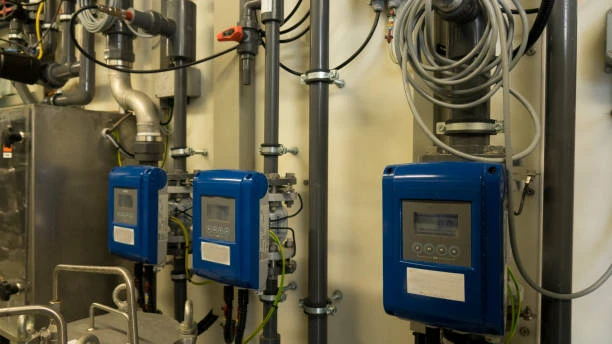

Ultrasonic flow measurement represents one of the most advanced and non-intrusive methods for determining fluid velocity and volumetric flow rate in closed conduits. Unlike mechanical meters that rely on moving parts, Ultrasonic Flow Meters operate using sound waves transmitted through the fluid medium. Among the various ultrasonic measurement principles available, transit time measurement is the most widely adopted technique for clean liquids and gases.
Transit time technology is based on a precise comparison of sound wave travel times in upstream and downstream directions. By analyzing these differences, the system accurately calculates flow velocity without obstructing or altering the fluid stream. This approach offers exceptional reliability, minimal maintenance requirements, and high accuracy across industrial, municipal, and energy applications.
Understanding how Ultrasonic Flow Meters use transit time measurement requires examining the physics of sound propagation, transducer configuration, signal processing, and calibration methodologies.
Understanding the Fundamental Principle of Transit Time Measurement
The Physics Behind Sound Propagation in Flowing Fluids
Transit time measurement relies on the behavior of ultrasonic pulses traveling through a moving fluid. Sound waves propagate at a known speed through a given medium under defined temperature and pressure conditions. When the fluid is stationary, an ultrasonic pulse transmitted between two sensors takes the same amount of time to travel in either direction.
However, when the fluid is flowing, the situation changes. A pulse traveling in the same direction as the flow moves faster relative to the stationary transducer, while a pulse traveling against the flow moves slower. This difference in travel time, though extremely small, is measurable using high-precision electronic timing circuits.
Ultrasonic Flow Meters use this time differential to calculate the average flow velocity along the acoustic path. Since the speed of sound in the fluid is typically much greater than the flow velocity, the measured time difference is very small, often in the nanosecond range. Sophisticated digital signal processing ensures accurate detection and calculation.
The Transit Time Equation
The underlying calculation is derived from the relationship between flow velocity, sound velocity, and path geometry. The difference between upstream and downstream transit times is proportional to the average velocity of the fluid along the ultrasonic beam path. By incorporating pipe diameter and cross-sectional area, the meter converts velocity into volumetric flow rate.
This mathematical foundation ensures that transit time Ultrasonic Flow Meters can achieve high repeatability and accuracy when properly installed and calibrated.
Transducer Arrangement and Signal Transmission
Placement and Orientation of Transducers
Transit time Ultrasonic Flow Meters typically use two piezoelectric transducers mounted on opposite sides of a pipe. These transducers alternately act as transmitters and receivers. The ultrasonic beam is directed diagonally across the pipe, forming a specific angle relative to the flow direction.
The angle is carefully selected to maximize sensitivity to velocity changes while maintaining adequate signal strength. The acoustic path length and angle are key design parameters, as they influence the magnitude of the measured time difference.
Transducers can be installed in clamp-on configurations for non-invasive measurement or integrated into wetted spool pieces for higher accuracy applications. Clamp-on systems are particularly valuable in retrofit installations because they eliminate the need for pipe cutting or process interruption.
Signal Generation and Detection
Each transducer emits a short ultrasonic pulse that travels through the fluid and is received by the opposite transducer. The system precisely measures the time interval between transmission and reception. This process is repeated in both upstream and downstream directions.
Modern Ultrasonic Flow Meters use advanced microprocessors to measure transit times with extremely high resolution. The electronic circuitry compensates for temperature variations and changes in sound velocity to ensure accurate flow calculation.
Signal strength monitoring is also incorporated to detect potential issues such as air bubbles, suspended solids, or improper transducer alignment.
Flow Profile Considerations and Measurement Accuracy
Importance of Flow Conditioning
Accurate transit time measurement depends on a predictable flow profile. Ideally, the fluid velocity should be uniformly distributed across the pipe cross-section. Disturbances caused by elbows, valves, or pumps can create swirl or asymmetry, affecting measurement accuracy.
To mitigate this, installation guidelines specify minimum upstream and downstream straight pipe lengths. In critical applications, flow conditioners may be used to stabilize the velocity profile.
Advanced Ultrasonic Flow Meters may employ multiple acoustic paths to improve accuracy. By sampling different portions of the flow cross-section, multi-path designs provide a more representative average velocity measurement.
Compensation for Temperature and Fluid Properties
The speed of sound in a fluid depends on its density, temperature, and composition. Transit time systems often include temperature sensors or rely on integrated compensation algorithms to adjust for variations in sound velocity.
In liquid applications such as water or hydrocarbons, the speed of sound is relatively stable within a defined operating range. However, in gas applications, greater variability exists, requiring more sophisticated compensation techniques.
Accurate knowledge of pipe dimensions is also essential. Even small deviations in internal diameter can significantly affect volumetric flow calculations. Therefore, precise measurement or manufacturer specifications must be used during configuration.
Advantages of Transit Time Ultrasonic Flow Meters
Non-Intrusive Measurement
One of the most significant advantages of transit time Ultrasonic Flow Meters is their ability to measure flow without introducing obstructions. Since there are no moving parts or flow restrictions, pressure drop is negligible.
This feature makes ultrasonic technology ideal for applications where energy efficiency and minimal maintenance are priorities. The absence of mechanical wear components enhances long-term reliability.
High Accuracy and Repeatability
Transit time systems offer excellent repeatability and high measurement precision, particularly in clean fluid applications. Their digital processing capabilities allow real-time correction for minor disturbances and environmental changes.
When properly installed, high-quality Ultrasonic Flow Meters can achieve accuracy levels comparable to traditional differential pressure or turbine meters, without the associated mechanical limitations.
Applications Across Industries
Water and Wastewater Systems
Municipal water treatment plants widely use transit time Ultrasonic Flow Meters for distribution monitoring and leak detection. Their non-invasive installation simplifies maintenance and system upgrades.
Wastewater applications may require careful evaluation, as excessive solids or air entrainment can attenuate ultrasonic signals. However, for clarified or treated water streams, transit time technology performs exceptionally well.
Oil, Gas, and Energy Sectors
In the oil and gas industry, transit time Ultrasonic Flow Meters are used for custody transfer, pipeline monitoring, and process control. Multi-path configurations provide the accuracy required for fiscal measurement.
Power generation facilities also rely on ultrasonic meters to monitor cooling water, feedwater, and condensate systems. The absence of pressure drop is particularly beneficial in high-volume flow systems.
Advanced Signal Processing and Diagnostics
Digital Filtering and Noise Reduction
Modern systems incorporate digital filtering techniques to remove noise and enhance signal clarity. By analyzing waveform characteristics, the meter can distinguish valid ultrasonic signals from spurious reflections.
This capability ensures stable performance even in challenging environments where vibration or electrical interference may be present.
Built-In Diagnostic Features
Diagnostic tools in Ultrasonic Flow Meters provide real-time monitoring of signal quality, transducer condition, and installation integrity. These features enable predictive maintenance and reduce unexpected downtime.
Operators can detect issues such as coating buildup, coupling degradation in clamp-on systems, or abnormal flow disturbances before they significantly impact accuracy.
Limitations and Considerations
Transit time technology performs best in clean fluids with low particulate content. Heavy solids or high gas entrainment can scatter or absorb ultrasonic energy, reducing signal reliability.
Proper installation remains critical. Incorrect transducer spacing, poor acoustic coupling, or inadequate straight pipe lengths can compromise measurement accuracy.
Despite these considerations, when applied correctly, Ultrasonic Flow Meters using transit time measurement provide one of the most versatile and reliable flow measurement solutions available.
Conclusion: Precision Through Acoustic Timing
Transit time measurement represents a sophisticated application of acoustic physics to industrial flow monitoring. By measuring the subtle difference between upstream and downstream ultrasonic pulse travel times, Ultrasonic Flow Meters determine fluid velocity with exceptional precision.
The absence of moving parts, minimal pressure loss, and advanced digital processing make this technology highly attractive across multiple industries. With proper installation, calibration, and maintenance, transit time Ultrasonic Flow Meters deliver long-term accuracy, operational efficiency, and dependable performance in both liquid and gas applications.
Through precise timing and intelligent signal analysis, these instruments transform the simple propagation of sound into a powerful tool for modern flow measurement.










Sign in to leave a comment.