
If your lawn looks like a worn-out welcome mat, you’re not alone. Patchy grass, spongy soil, and roots that just won’t dig deep—these things don’t just happen overnight. And no, watering it twice a week isn’t solving the real issue. It’s the soil. It’s the roots. It’s all the stuff going on under the grass that makes the biggest difference.
Most property owners think lawn care is just mowing and edging. But improving the health of your yard actually starts from below the surface. A professional lawn care contractor focuses on exactly that—restoring what’s beneath your feet to help everything on top thrive. Let’s break it down without making your brain hurt.
Why Soil Health Matters for Lawn Performance
If the soil is bad, the grass will struggle—plain and simple. Healthy lawns are built on dense, nutrient-rich soil that supports steady root development.
Poor Soil Leads to Weak Growth
Compacted, dry, or unbalanced soil won’t absorb water or nutrients properly. Roots become shallow, and grass can’t withstand drought, pests, or foot traffic. This leads to more stress, more weeds, and more work to keep it green.
Lawn Services Help Restore Microbial Balance
Quality lawn care doesn’t just add fertilizer and hope for the best. It introduces organic material, aerates dense ground, and supports microbial life—all of which help roots access oxygen, minerals, and moisture more efficiently.
Fun Fact #1: Healthy soil contains more living organisms in a teaspoon than people on the planet.

How Aeration Boosts Root Penetration
Aeration is one of the most effective methods for unlocking better soil structure. Without it, your roots are stuck working with concrete.
What Aeration Actually Does
- Removes small plugs of soil to ease compaction
- Opens up channels for air, water, and nutrients
- Allows roots to grow downward instead of spreading sideways
Surface vs. Deep Root Systems
- Shallow roots increase risk of browning, thinning, and stress failure
- Deep roots retain moisture better and recover faster from heat or foot traffic
Fun Fact #2: Roots grow deeper in aerated soil by as much as 40% compared to untreated lawns.
The Role of Lawn Fertilization in Soil Chemistry
Fertilization is more than “feeding the grass.” It's about balancing the soil’s ecosystem so that everything—from roots to microbes—works in sync.
Matching Nutrients to Soil Type
Soil testing reveals which nutrients are missing and which are overabundant. Targeted fertilization corrects these imbalances and promotes steady root expansion instead of spiking quick, weak top growth.
Over-Fertilizing Backfires
Dumping nitrogen without a plan can burn roots and damage beneficial organisms. Professional lawn care services use calibrated applications based on timing, soil needs, and root development cycles.

Understanding the Microbial Life Beneath the Lawn
Soil isn’t just dirt—it’s a living system. And the roots rely on it to stay strong.
The Microbiome Drives Soil Health
Fungi, bacteria, protozoa, and worms all work together to break down organic matter, release nutrients, and create porous, oxygenated pathways. When this system breaks, root growth slows dramatically.
Compost and Organic Material Support the Ecosystem
Topdressing with compost, applying bio-stimulants, and avoiding synthetic-heavy routines keep the soil’s life thriving, which improves both the health and appearance of the turf above it.
Comparing Reactive Lawn Maintenance vs. Root-Driven Lawn Care
There’s a major difference between surface care and foundation care. One treats symptoms. The other solves problems.
Table: Surface Fixes vs. Soil-Based Lawn Care
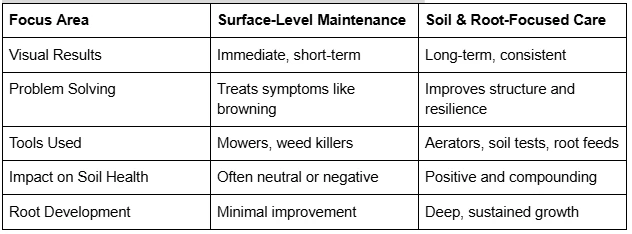
Reactive lawn maintenance creates a cycle of chasing visible issues. Root-focused care builds resilience from the ground up—literally.
Why Root Growth Determines Lawn Strength
Stronger roots equal stronger lawns. That’s not just feel-good science—it’s practical lawn care logic.
Deeper Roots Create Drought Resistance
Lawns with deep root systems require less watering and handle dry conditions far better. The grass pulls moisture from lower levels of the soil instead of relying on daily irrigation.
Strong Roots Crowd Out Weeds
Thick root networks dominate space in the soil, making it harder for weeds to establish. The best weed control is often a healthy, dense lawn that leaves no room for intruders.
Organic Lawn Care and Soil Enrichment
More property owners are turning to natural lawn care methods not just for the environment, but for long-term soil stability.
Why Organic Methods Work Long-Term
Organic materials break down slower, feeding microbes and enriching soil over time. This builds structure and sustains growth without chemical burn or leaching.
Compost Teas and Natural Amendments
Biological soil treatments like compost teas, humic acid, and mycorrhizal fungi promote natural symbiosis between roots and soil organisms. These treatments go deeper than any quick fix.
Conclusion
Healthy lawns aren’t built on fancy tools or flashy fertilizers. They’re built from the ground up—starting with good soil and strong roots. That’s where professional landscaping and lawn care service really shines: improving soil conditions so your lawn isn’t just green but strong, stable, and able to handle anything the weather or weeds throw at it.
Good lawn care isn’t about a perfect look one weekend a month. It’s about soil that breathes, roots that dig deep, and turf that holds its own. If the lawn is struggling, chances are the roots are too shallow and the soil’s too tired. The fix starts underneath.
FAQs
How does lawn care improve root growth?
By loosening compacted soil, adding nutrients, and encouraging microbial life, lawn care services help roots grow deeper and stronger. This leads to more resilient turf.
What are signs of poor soil health in a lawn?
Thin grass, water pooling, slow growth, and high weed presence often indicate compacted or nutrient-deficient soil. Proper testing and treatment are key to restoring it.
Why is aeration important for soil and root systems?
Aeration allows air, water, and nutrients to reach deeper into the ground. It breaks up compaction and creates pathways for roots to expand.
Can over-fertilization harm the lawn?
Yes. Too much fertilizer can burn roots and disrupt the microbial balance in the soil. This leads to weaker root systems and patchy growth.
What’s the difference between organic and synthetic soil treatments?
Organic treatments feed soil biology and improve long-term health. Synthetic products often focus on fast results but may degrade soil quality over time.
Reviewer: Sophie Williams looked over this post and brought 7 years of field experience to her suggestions, helping ensure the content stays relevant to business owners and practical for everyday use.










Sign in to leave a comment.