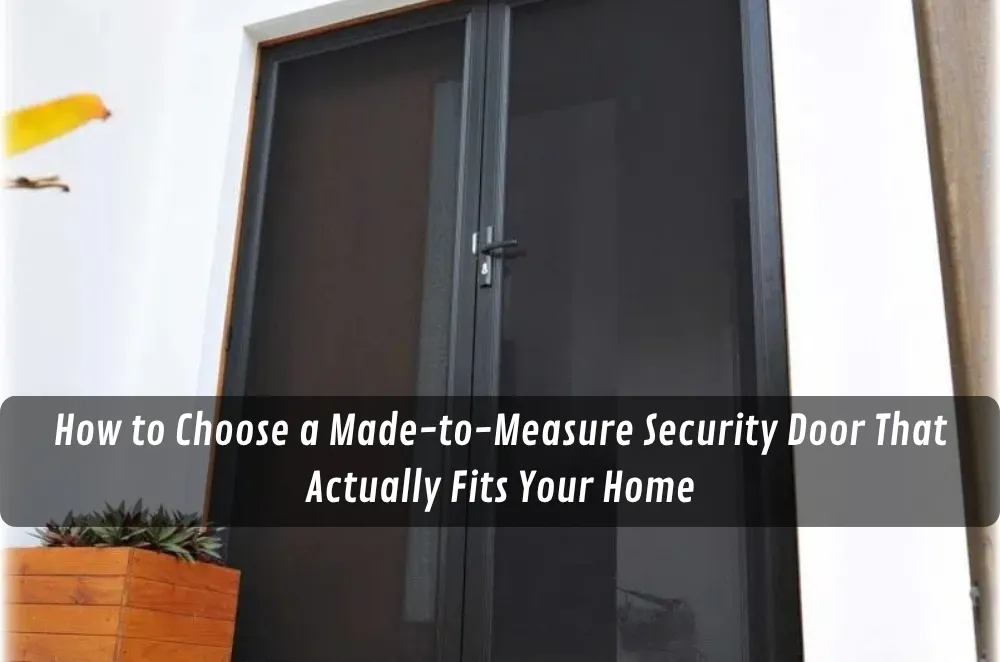

A security door is one of those upgrades that feels straightforward until the questions start stacking up: Will it suit the opening, still let air through, and not make the front of the house feel like a bunker? In real homes, those three things rarely line up by accident.
In Sydney, the “right” answer usually sits between comfort and protection, heat, humidity, salty air in some pockets, curious pets, and entryways that aren’t as square as they look from the footpath. That’s why made to measure security screen door solutions tend to win out: they’re built around the opening you actually have, not the opening you wish you had.
A made-to-measure approach can solve most of the common pain points, but only if the decision is based on how the door will be used day-to-day, not just how it looks in a product photo. Get the fit and hardware right, and the rest gets easier.
What “made-to-measure” really means (and what it doesn’t)
Made-to-measure means the door is specified to your opening and the way your entry operates: clearances, swing direction, lock height, hinge position, and how the frame meets brick, render, timber, tile, or an existing jamb.
It doesn’t automatically mean “stronger” on its own.
The real value is in the details people don’t notice until they’re wrong, gaps, rattles, a sticky latch, a door that scrapes the threshold, or a closer that turns every exit into a wrestling match.
If you’ve ever had a door that almost shuts properly, you already know how fast “almost” becomes annoying.
Decision factors that matter more than the brochure
1) Entry geometry and traffic flow
Start with movement before materials.
Hinged doors need the right clearance so they don’t clip a wall, planter, balustrade, or handrail, and the hinge side matters more than most households expect. If there are stairs close to the threshold, outward swing can be tricky in ways that don’t show up on a quick glance.
Sliding options can be brilliant for tight entries, but only if the tracks and run lines are compatible and you can keep them clean enough to stay smooth. If the entry is a main “through door” for prams, mobility aids, or armfuls of groceries, ease of use is part of security, because a door that’s annoying will get left open.
2) Mesh and frame choices: durability, corrosion resistance, and upkeep
Not all mesh is equal, and “best” depends on exposure and lifestyle.
Some households want maximum airflow and a clear view out, especially on front doors that catch breezes. Others want more privacy from the street without sacrificing ventilation, which is a very different design brief.
If you’re nearer coastal air, finishes and corrosion resistance stop being optional, and maintenance habits suddenly matter. It’s worth being honest here: if rinsing or wiping down is unlikely to happen, choose a setup that tolerates real life rather than demanding constant care.
3) Hardware quality: locks, hinges, closers, and child safety
Security doors often fail in the boring parts.
Look at how the lock feels when you close it with one hand, because that’s how it’ll be used most of the time. Hinges should feel tight and stable, and the latch should engage without you having to “lift the door” or slam it to get it to catch.
If you need a door closer, check whether it will slam, pinch fingers, or fight the main door when both are open. For households with kids, think about how the door can be secured while still allowing airflow and supervision, rather than relying on a one-size-fits-all approach.
4) Visibility versus privacy (without turning it into an aesthetic battle)
Many people assume they must choose between “see out” and “be private,” but there’s a spectrum.
Some configurations prioritise clearer sightlines from inside, which can feel more welcoming at the threshold. Others soften the view from the street while still letting light in, which is often what people actually want on busy roads or corner blocks.
The right answer depends on the entry angle, street exposure, and how the front door is used, quick deliveries, family coming and going, or a spot to chat without opening the house up completely.
5) Installation fit: where good products can still go wrong
Even a well-specified door can underperform if installation doesn’t respect the building realities.
Out-of-square openings, uneven thresholds, shifting timber, and tired brickwork all affect how the door sits and how reliably it latches. A made-to-measure job is usually about matching the door to the “truth” of the opening, not the idealised rectangle we all imagine.
If it helps to see what a fitted job typically includes before booking anything, ScreenGuard measuring checklist can be a useful reference when listing your openings, swing direction, and hardware preferences.
Common mistakes homeowners make
The most common mistake is buying on looks first and trying to “make it work” later.
A design can be perfect on paper and still clash with swing direction, handle position, threshold height, or the way the main door opens. The result is usually a door that feels fiddly, fine when you’re showing it off, frustrating when you’re carrying groceries.
Another frequent issue is underestimating how not-square older entries can be, especially where frames have shifted over time. A door that’s a few millimetres out can rattle, bind, or refuse to latch smoothly, and that defeats the whole point.
People also forget to design around daily use.
Pets lean on mesh, kids push doors hard, and busy households want the “ventilation position” to be easy and repeatable. If the door is hard to latch, it’ll be left ajar; if it’s hard to open, it won’t be used.
Finally, a lot of households ignore maintenance reality in Sydney conditions, then feel surprised when performance drops.
If you won’t realistically keep tracks clean or rinse off grime, choose materials and configurations that are forgiving.
Operator Experience Moment
I’ve seen plenty of “security door regret” that had nothing to do with the product and everything to do with fit and routine. One hinge clearance not checked properly, or a lock height that clashes with how people actually enter, can turn a solid door into a daily irritation. When the spec matches the way the home runs, the door fades into the background, in the best way.
A simple 7–14 day plan to get it right
Day 1–2: Watch your entry in action.
Note who uses it, how often, and what gets carried through (kids, pets, prams, deliveries), plus whether airflow is a daily need or an occasional nice-to-have.
Day 3–4: Audit the opening properly.
Confirm swing direction, clearance, threshold height, and whether the frame looks square and structurally sound, then write down anything that looks “off” rather than trusting memory.
Day 5–7: Decide your priority stack.
Rank what matters most, airflow, privacy, appearance, corrosion resistance, low maintenance, child/pet durability, because the best choice is usually a trade-off, not a unicorn.
Day 8–10: Shortlist configurations that match the opening.
Choose styles that suit the movement and space constraints first, then refine mesh/privacy and finish once the fundamentals are locked in.
Day 11–14: Pressure-test the boring parts.
Ask how the latch engages, how the hinges hold alignment, whether a closer is needed, and how the security door behaves alongside the main door when both are open.
Local SMB mini-walkthrough: a Sydney household scoping the job
Walk the entry at three times: morning light, afternoon heat, and evening foot traffic.
Stand where visitors stand and check what can be seen into living areas.
Measure the opening at top, middle, and bottom, and note any uneven threshold or frame twist.
Confirm whether the door must swing inward or outward based on stairs, pathways, and handrails.
List household realities: pets, kids, deliveries, and whether the door will be used for daily ventilation.
Choose materials and finishes based on exposure, especially if the home catches coastal air.
Book a measure-and-quote once priorities are clear, so the specification matches the real opening.
Practical Opinions
Fit and hardware matter more than patterns.
If maintenance won’t happen, pick a setup that forgives neglect.
Privacy is a design decision, not a security compromise.
Key Takeaways
- Made-to-measure is mainly about fit and function, not automatic “extra security.”
- Start with swing direction, clearance, and traffic flow before choosing materials.
- Mesh, frame, and finish should match Sydney exposure and realistic upkeep habits.
- Hardware and installation details decide whether the door feels solid every day.
- The best outcome is a door that supports ventilation and routine without friction.
Common questions we hear from businesses in Sydney, NSW, Australia
Q1) Do made-to-measure security doors take longer than standard sizes?
Usually, yes, because the door is specified to the opening and the chosen hardware and finish. A practical next step is to measure the opening at multiple points (top/middle/bottom) and note swing direction and handle height so quoting is faster. In Sydney, older terraces and post-war homes often have quirky frames, so “standard size” assumptions can backfire.
Q2) Is a security door still worth it if the front entry is under cover?
It depends on how the entry is used and whether airflow is a daily priority. A useful next step is to track for a week how often the main door is left open for ventilation and whether the security door would become the default “open” setting. In many Sydney suburbs, covered entries still get wind-driven rain and grime, so finishes and hardware quality still matter.
Q3) Should households prioritise privacy mesh or clearer visibility?
In most cases, it comes down to street exposure and how comfortable people feel at the threshold. The next step is to stand at the footpath and check sightlines into living areas, then decide what level of privacy feels right before looking at designs. Sydney streets vary a lot, busy roads and corner blocks often lean toward more privacy than quiet cul-de-sacs.
Q4) Can an existing main door stay, or does everything need to be replaced?
Usually, the existing main door can stay if the frame is sound and the clearances work. A practical next step is to check whether the main door binds, sags, or has uneven gaps, because those issues can affect how a security door sits and latches. In Sydney, timber frames that have shifted with age are common, so a fit-first approach avoids nasty surprises.












Sign in to leave a comment.