

Even in today’s automation-driven world, the need for accurate data remains non-negotiable. This article explores why accuracy in data entry is still vital, the risks of overlooking it, and how businesses can strike the right balance by partnering with reliable data entry companies or choosing to outsource data entry services.
In a time when automation is transforming how we work, it’s easy to assume that manual tasks like data entry are a thing of the past. But here’s the catch no matter how advanced technology is, your systems are only as smart as the data they’re fed.
While machines can process information at lightning speed, they can’t fix inaccurate inputs, and that’s where human-verified data entry services come in. Whether you’re running an eCommerce business, managing real estate or healthcare records, or working with large volumes of financial data, the accuracy of that data still determines your success.
Why Data Accuracy Still Matters
Let’s break it down: accurate data is the backbone of every critical business decision you make.
From generating financial reports to analyzing customer behavior, clean and accurate data ensures that your insights are reliable. If your records are riddled with typos, duplicates, or missing information, your entire decision-making process could be built on shaky ground.
And it’s not just about strategy accuracy affects your day-to-day operations too. Poor data entry can lead to incorrect shipments, billing errors, compliance issues, or even legal complications in regulated industries.
That’s why even in this era of digital tools and automation; businesses still heavily rely on trusted data entry companies to maintain the integrity of their databases.
The Rise of Automation, But It’s Not Perfect
Yes, automation is everywhere, and it’s incredibly useful. AI tools can sort through mountains of data in seconds. Scanning software can extract text from documents quickly. But what happens when a scanned document is smudged, the formatting is inconsistent, or fields are missing?
That’s where automation alone falls short. It often lacks the context and critical thinking that human eyes bring to the table. And in industries like ecommerce, healthcare, real estate, law, logistics, and finance, even a minor error can have serious consequences.
That’s why many companies choose to outsource data entry to experienced teams who can combine technology with human verification to ensure every record is clean, accurate, and ready for use. Articles like 5 Data Entry Errors Fixed by Automation highlight how technology helps reduce mistakes, but accuracy still demands human oversight.
Where Human-Verified Data Entry Makes the Difference
There are specific scenarios where automation struggles and where skilled human data entry specialists shine:
· Handwritten Documents: Machines often misinterpret handwritten text, especially if the writing isn’t clear or consistent. Human annotators can decipher these nuances accurately to avoid costly errors.
· Inconsistent Formatting: Automated systems can struggle with varied document layouts or irregular data entries. Humans excel at identifying patterns, correcting discrepancies, and standardizing data across diverse sources.
· Industry-Specific Nuances: Specialized terminology in fields like healthcare, legal, or finance often requires trained eyes to interpret and categorize correctly, ensuring data relevance and compliance.
· Complex Data Integration: When combining data from multiple sources or systems, human experts can verify accuracy, resolve conflicts, and ensure seamless integration tasks that often confuse automated tools.
In all these cases, relying solely on automation could lead to costly errors. That’s why companies looking for dependable outcomes often turn to data entry outsourcing a smart way to combine efficiency with accuracy.
The Risks of Inaccurate Data Entry
Here’s what can go wrong when you neglect data accuracy:
· Bad Decisions: Poor data leads to misleading analytics, which can derail your business strategy.
· Lost Revenue: Billing errors, shipment mistakes, and missed opportunities due to incorrect information can hit your bottom line.
· Reputation Damage: Customers notice mistakes especially when they impact service or personalization.
· Compliance Issues: In industries like finance or healthcare, incorrect records can mean serious legal or regulatory trouble.
The solution? Partnering with experienced data entry service providers who understand how critical clean data is and who know how to get it right.
Types of Data Entry Projects That Benefit from Outsourcing
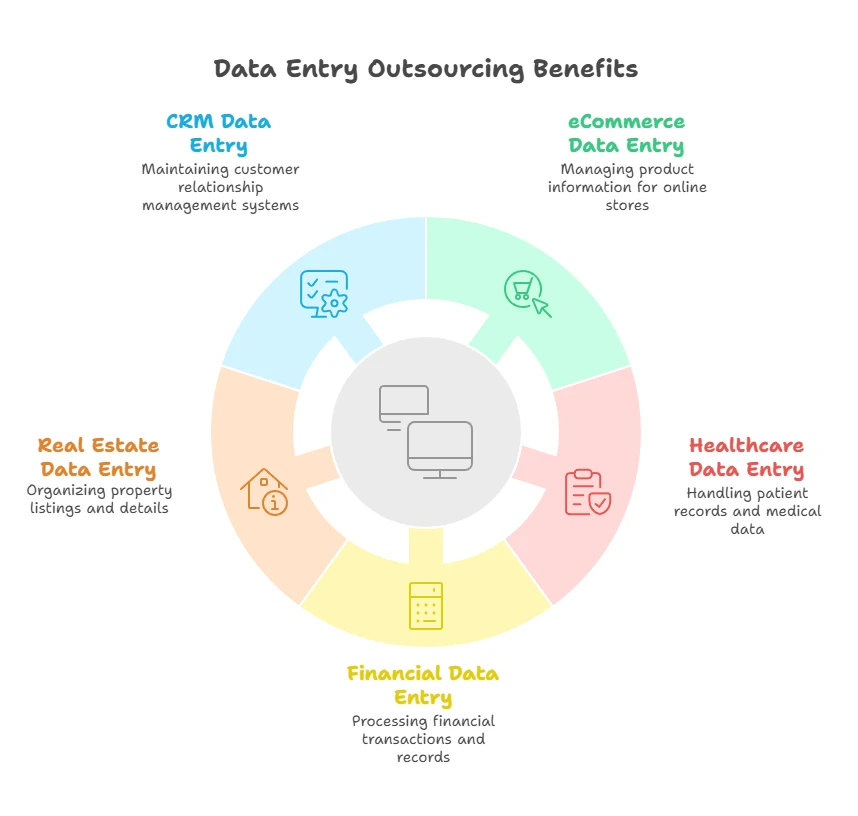
Data entry outsourcing isn’t a one-size-fits-all solution, it’s both versatile and scalable. Businesses across industries can gain significant advantages by outsourcing data entry projects like the following:
· eCommerce Product Data Entry: Involves entering and updating product details such as names, SKUs, specifications, images, pricing, and descriptions across online platforms. Accurate and consistent data ensures better user experience, inventory accuracy, and improved search visibility on marketplaces.
· Healthcare Data Entry: Requires precise transcription of patient records, diagnostic information, insurance details, and billing data. Accuracy is critical for compliance with healthcare regulations, maintaining patient safety, and ensuring timely claims processing.
· Financial Data Entry: Includes processing invoices, receipts, bank statements, tax documents, and purchase orders. Errors in financial data can lead to costly compliance issues or reporting mistakes, so precision is key.
· Real Estate Data Entry: Covers property listings, legal documents, lease agreements, mortgage details, and client contact information. Accurate data entry ensures smooth transactions, reliable reporting, and better property management workflows.
· CRM Data Entry & Cleansing: Involves entering, organizing, and routinely updating customer contact information, purchase history, and engagement records. Clean CRM data helps sales and marketing teams personalize outreach and improve conversion rates.
Outsourcing data entry service providers bring not only the workforce but also the domain experience required to handle these tasks with care and consistency.
Striking the Right Balance: Automation + Human Accuracy in Data Entry Services
The best approach? Use automation where it makes sense, but don’t eliminate the human factor especially when accuracy is non-negotiable.
When you outsource data entry to professionals, you’re not just paying for people to type. You’re investing in trained experts who understand data structure, context, and quality standards. Many top-tier data entry companies offer blended solutions automated tools for speed and human validation for precision.
This hybrid model allows businesses to process large volumes of data quickly without compromising on quality, making it the most reliable route forward in today’s fast-paced, data-driven world.
Conclusion
Automation is a powerful tool, but it’s not a magic wand. If the data going into your systems isn’t accurate, the results won’t be either.
That’s why accurate data entry services are still essential for business. Whether you handle data in-house or outsource data entry to a trusted provider, the goal is the same: clean, accurate, and usable data that powers better decisions and seamless operations.
So, while the world may be going digital, one thing hasn’t changed accuracy still wins.









Sign in to leave a comment.