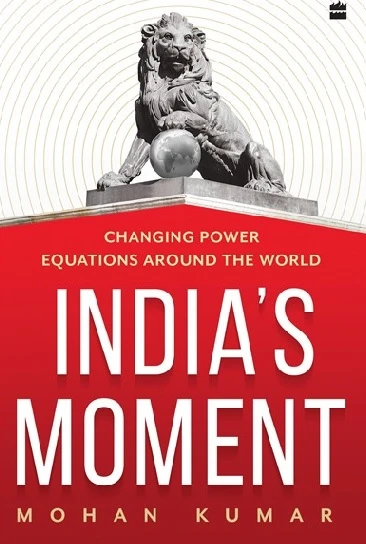

In a rapidly evolving global landscape, India's role and influence on the international stage have become increasingly significant. Mohan Kumar's illuminating book, "India’s Moment: Changing Power Equations around the World," offers an insightful exploration of India's diplomatic journey and its evolving stance in the realm of international politics and government. This article will delve into the key themes and analyses presented in the book, highlighting India's transformation from a perceived "naysayer" to a proactive global partner.
Negotiating India's Place in the World
At the heart of Mohan Kumar's book lies the fundamental question of how India engages with the world. As a seasoned diplomat who represented India in various international forums over three and a half decades, Kumar delves into the complexities of India's role in global diplomacy. He confronts a prevailing perception that, despite being recognized as skilled negotiators, Indian diplomats often appear as tough customers in multilateral negotiations. The book aims to unravel the factors that have shaped India's approach to international diplomacy.
India's Pursuit of National Interests
Kumar aptly acknowledges that, like any nation, India seeks to protect its national interests in the international arena. While India's stance in negotiations may sometimes appear formidable, it is rooted in its pursuit of safeguarding its interests and advancing its objectives. The book delves into the intricate dynamics of international diplomacy and highlights how India navigates the fine line between protecting its interests and collaborating with the global community.
Unique Aspects of Indian Diplomacy
One of the book's key strengths is its exploration of the unique aspects of Indian diplomacy. Kumar provides valuable insights into the factors that differentiate India's approach to multilateral negotiations. These aspects reflect the nation's rich history, diverse culture, and complex geopolitical position. Understanding these nuances is essential for comprehending India's role in shaping international agreements and policies.
India's Evolution as a Global Partner
A central thesis of Kumar's work is India's gradual transition from being perceived as a "naysayer" to becoming a genuine partner in critical multilateral negotiations. This transformation mirrors India's growing political, economic, and strategic influence in the global arena. The book outlines how India's evolving positions on various international issues reflect its aspirations to be a leading global power capable of actively shaping global norms and policies.
A New Paradigm in Global Diplomacy
Kumar's book also underscores the evolving nature of global diplomacy and how India is positioned to play a pivotal role in shaping this new paradigm. As the world faces a myriad of complex challenges, from climate change and global health crises to economic disparities and security concerns, India's proactive engagement is increasingly crucial. The nation's commitment to multilateralism and collaboration with other countries underscores its dedication to finding global solutions.
A Shifting Power Equilibrium
In the 21st century, the global power equilibrium is undergoing a profound shift, and India's ascent is emblematic of this transformation. Kumar's book highlights India's growing political, economic, and strategic clout, which has elevated it from a regional actor to a global influencer. This shift is not merely symbolic; it signifies India's capability to influence and contribute to global rule-setting, governance, and policy formulation.
The Promise of a Fuller Transformation
While India's journey from a perceived "naysayer" to a genuine partner is remarkable, the book emphasizes that this transformation is an ongoing process. Kumar suggests that India's full transformation is yet to be realized and that it will be more substantial when achieved. As India continues to strengthen its global position, it can fulfill its manifest destiny of becoming a leading global power capable of shaping international norms and rules.
India's Diplomatic Leadership
At the core of India’s diplomatic success is its leadership and the expertise of its diplomats. The book underscores the importance of skilled negotiators and policymakers in shaping India's diplomatic strategy. Effective leadership is crucial in navigating the complexities of international politics and government, as well as in balancing India's diverse domestic constituencies with its international obligations.
Conclusion: A New Era Dawns
In conclusion, "India’s Moment: Changing Power Equations around the World" by Mohan Kumar is a compelling exploration of India's role in the evolving global landscape. It offers a nuanced perspective on India's diplomatic journey, its challenges, and its aspirations as a global influencer.
As the world faces unprecedented challenges and opportunities, India's proactive engagement and evolving diplomatic approach are pivotal. The book reinforces the idea that India is on the verge of a new era, one where it actively participates in shaping global policies and governance. It is a testament to India's resilience, adaptability, and commitment to democratic values in the realm of international politics.
In a world marked by uncertainty and change, "India’s Moment" serves as an essential guide for understanding India's influence, its diplomatic finesse, and its pivotal role in reshaping global power equations. Mohan Kumar's book is a must-read for anyone interested in international politics and government affairs, as it sheds light on the evolving dynamics of global diplomacy in the 21st century.








Sign in to leave a comment.