
3D Billboard Content and Anamorphic Content Creation Strategies That Overcome Consumer Doubt
Skepticism is the default position of the modern consumer.
Walk into any retail space, scroll through any social feed, open any email—your audience approaches with armor on. They've heard the promises before. They've seen the tricks. They know marketing when they see it, and most of it feels designed to exploit them rather than serve them.
But something interesting happens when you stop trying to convince people and start inviting them to discover.
The gap between traditional marketing and immersive experiences isn't about flashier visuals or louder messages. It's about shifting from persuasion to revelation. It's about moving from "let me tell you why this is great" to "let me show you something you've never experienced before."
The Trust Deficit Your Audience Starts With
Think about the last time you made a major purchase. Not a coffee or a shirt—something that mattered. A car. A home. Furniture for your new place. An investment in yourself.
You didn't buy from the first person who pitched to you. You researched. You compared. You probably visited multiple locations or checked reviews from people you'd never met. You were searching for proof that the promise matched reality.
Now multiply that skepticism across every category. Your customer approaching a real estate decision is facing mountains of brochures making identical claims. Your target audience evaluating a new product is swimming in influencer testimonials that all sound purchased. Your market segment has learned, through painful experience, that what they're told rarely matches what they experience.
This is the world immersive experiences are built to overcome.
Traditional marketing asks people to imagine. "Picture yourself enjoying this beach view." "Imagine how smooth your morning would be with this product." Imagination is abstract. It's easy to dismiss. It's not real.
Immersive experiences eliminate the guesswork. They replace imagination with experience. They move you from "this could be nice" to "I felt it, and it was undeniable."
When Real Estate Dreams Became Real Estate Conviction
The Panvel micro-market in Mumbai represents a specific kind of challenge. The land was available. The vision was compelling. But the future hadn't arrived yet.
A buyer in 2023 couldn't walk to the airport that was planned but not built. Couldn't drive to the sea link that existed only in architectural drawings. Couldn't experience the lifestyle that would materialize in 2025 or 2026. They had to trust in something invisible, and trust—as we've established—is in short supply.
How do you make the invisible tangible?
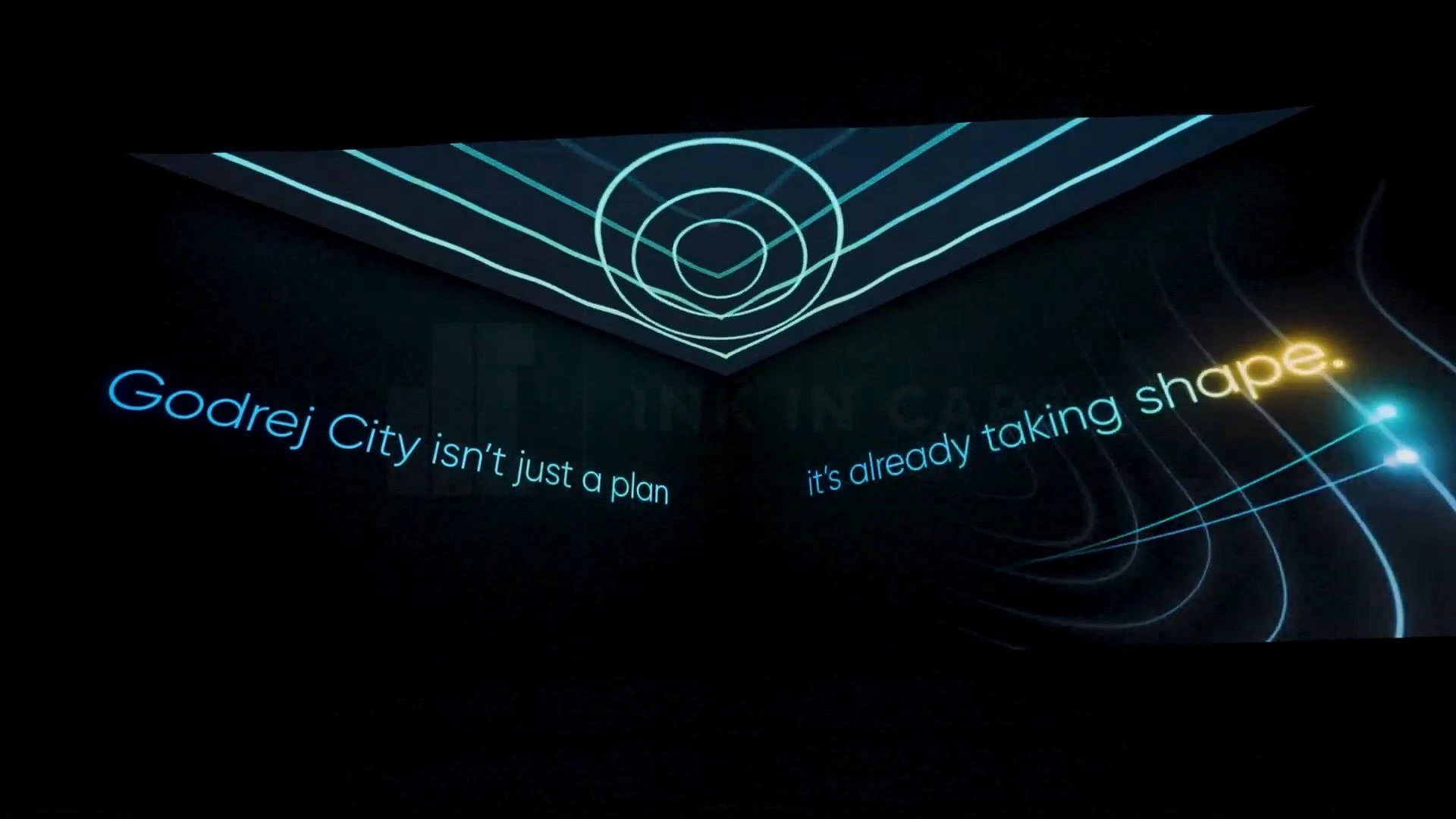
Godrej Properties' answer was architectural storytelling combined with spatial technology. Rather than trying to convince skeptics with words or even renderings, they created a structured journey that built conviction through narrative architecture.
The experience unfolded in acts:
Act One: Trust Building Through History — Visitors first experienced Godrej's track record. Previous projects that had been delivered, that had succeeded, that had proven the company's ability to execute. This wasn't about the new project yet. It was about establishing credibility.
Act Two: Grounding in Present Reality — The experience shifted to the current state of construction. Visitors saw actual progress. Real towers rising. Concrete proof that this wasn't a fantasy—it was in motion.
Act Three: The Conviction Moment — This is where immersive 3D animation services converged with spatial design in remarkable ways. Using anamorphic content creation, infrastructure that didn't yet exist was made visible and present. The future airport didn't just appear on a screen—it seemed to emerge into the room itself. The sea link didn't feel like a projection—it felt like something you could almost touch.
By the time visitors reached this third act, their skepticism had been addressed. Their trust had been established. And their imagination had been replaced by something far more powerful: direct sensory experience.
The Business Outcome:
Processing over 5,400 visitors monthly through a sales experience that converts imagination into measurable intent. Every interaction captured, every preference recorded, every hint of interest documented and delivered to the sales team while the visitor's conviction was still active.
This isn't optimizing the sales process. This is fundamentally reimagining how trust is built in the decision-making journey.
When a New Product Category Needed to Break Through Category Fatigue
The consumer goods space is particularly brutal. Categories become commodified. New products are announced constantly. The market experiences what researchers call "ad fatigue"—the point where repeated messaging actually decreases engagement rather than increasing it.
Oral-B's launch of their premium rechargeable toothbrush line faced this exact problem. The market was numb. Announcements blended together. Even genuine innovation struggled to cut through.
The Approach: Make the Unboxing the Story
Most brands bury the unboxing experience—it's something that happens in private, a 30-second moment between purchase and first use. Oral-B flipped this.
Across Delhi, Gurgaon, Jaipur, Bangalore, and Mumbai, massive structures became displays of the unboxing experience itself. Using projection mapping technology, 45-foot walls transformed into giant windows into the moment of discovery. Packaging was shown peeling back at impossible scale. Features materialized as if from nowhere. The experience wasn't "here's our product"—it was "experience the moment of discovering our product."
But the genius wasn't just in the physical scale. It was in the parallel digital experience.
An advanced markerless AR filter was built for Instagram. The same unboxing experience was made mobile. Users could pull out their phones, point them at themselves or their environment, and watch the product reveal itself to them personally. Influencers documented their reactions. Everyday users shared their discoveries. The experience became shareable, repeatable, and distributed.
What Made This Effective:
- The unboxing is the premium moment – People crave the sensation of discovery
- Scale and intimacy together – Massive public displays amplified by personal mobile experiences
- Shareable by design – Each person who experienced it became a storyteller
- Sensory layering – Audio, visual, and interactive elements combined
- Distribution across channels – Meeting people where they already are
The result wasn't a product launch. It was a cultural moment where a toothbrush brand managed to make dental care feel exciting. Skeptics weren't convinced by features. They were moved by the experience of discovery itself.
The Luxury of Emotion: Pampers and the Mother's Journey
Not all immersive experiences need cutting-edge technology. Some need empathy.
When Pampers approached their premium line launch, they understood something crucial: their audience wasn't making rational decisions. Mothers purchasing premium diapers are making choices rooted in love and protection. They're making decisions about their children's wellbeing. Skepticism exists, but it's paired with deeper motivation—the desire to give their baby the best.
The Experience Strategy:
Rather than listing features or touting absorbency percentages, the immersive environment was designed to communicate understanding. The color palette—luxurious teal, white, and gold—signaled that this brand elevated the category beyond functional necessity into something aspirational.
The content featured mothers and babies, not abstract concepts. The voice-over wasn't a salesperson but a conversation that honored the intelligence and care of the audience. Using 3D animation services and anamorphic content creation, the experience communicated features through storytelling rather than specification.
The technical execution was flawless. Massive LED displays (30x15 feet and 30x30-foot floor display) synchronized with precision. The anamorphic content was calibrated such that attendees experienced not just visual elements but an environment that felt completely intentional and expertly designed.
But the deepest impact came from something less tangible: the feeling that a brand understood the emotional weight of motherhood. That feeling, when combined with technological excellence, created something remarkable. Attendees didn't want to leave. They experienced what marketing researchers call "time distortion"—the sensation that an experience was shorter than it actually was because engagement was so complete.
That's the moment when skepticism transforms into loyalty.
The Emerging Pattern: Technology as an Honesty Tool
There's a counterintuitive truth worth exploring: immersive technology, when used effectively, actually increases trust rather than decreasing it.
Why? Because it's harder to lie in an immersive environment. When you're inviting someone to experience something directly rather than telling them about it, you're removing the translation layer where dishonesty often hides.
A brochure can spin. A rendering can be misleading. But when someone stands in an immersive environment and experiences spatial relationships, scale, and integration with their own presence, the experience becomes difficult to deny or reinterpret.
This is why 3D billboard content and anamorphic content creation are becoming essential tools—not because they're flashy, but because they make claims verifiable through direct experience.
The Skeptic's Final Test: Turning Experience Into Action
Here's where many brands lose the plot. They create an amazing immersive experience, and then they don't know what to do with the moment of highest engagement.
Godrej's brilliance was recognizing that peak engagement—when skepticism had finally dissolved and conviction was highest—was the exact moment to capture intent. Interactive systems documented every preference. QR codes synced sessions to phones. The sales CRM received real-time updates.
The technology facilitated not just engagement but measurement. Not just experience but conversion.
This is the evolution of immersive marketing: it's not separate from sales. It's not distinct from business metrics. It's integrated such that the moment of highest emotional engagement is simultaneously the moment of highest clarity for the sales team about what this specific person cares about.
What This Means for Brands Facing Skeptical Audiences
Your customer's skepticism isn't a bug to work around. It's an indicator that they care. They're protecting themselves because the decision matters.
Immersive experiences built thoughtfully don't overcome skepticism through manipulation. They overcome it through honest revelation. They invite people to experience and discover rather than asking them to imagine and believe.
Whether you're selling real estate, launching products, or building emotional brand connections, the principle remains: give people something to experience, not just something to think about.
The brands winning in this environment understand that attention is precious and skepticism is rational. They don't fight either. They build experiences so genuinely valuable that skeptics become believers, not because they were persuaded, but because they couldn't deny what they experienced.
The question isn't whether your audience is skeptical. They are. The real question is: are you ready to build an experience honest enough to overcome that skepticism?
Every day you spend trying to convince people through traditional messaging is energy you could be spending showing them something undeniable. Let's explore what immersive experience strategies could mean for breaking through the skepticism in your specific market. The brands that win aren't the ones with the best stories—they're the ones brave enough to make their stories directly experiential.










Sign in to leave a comment.