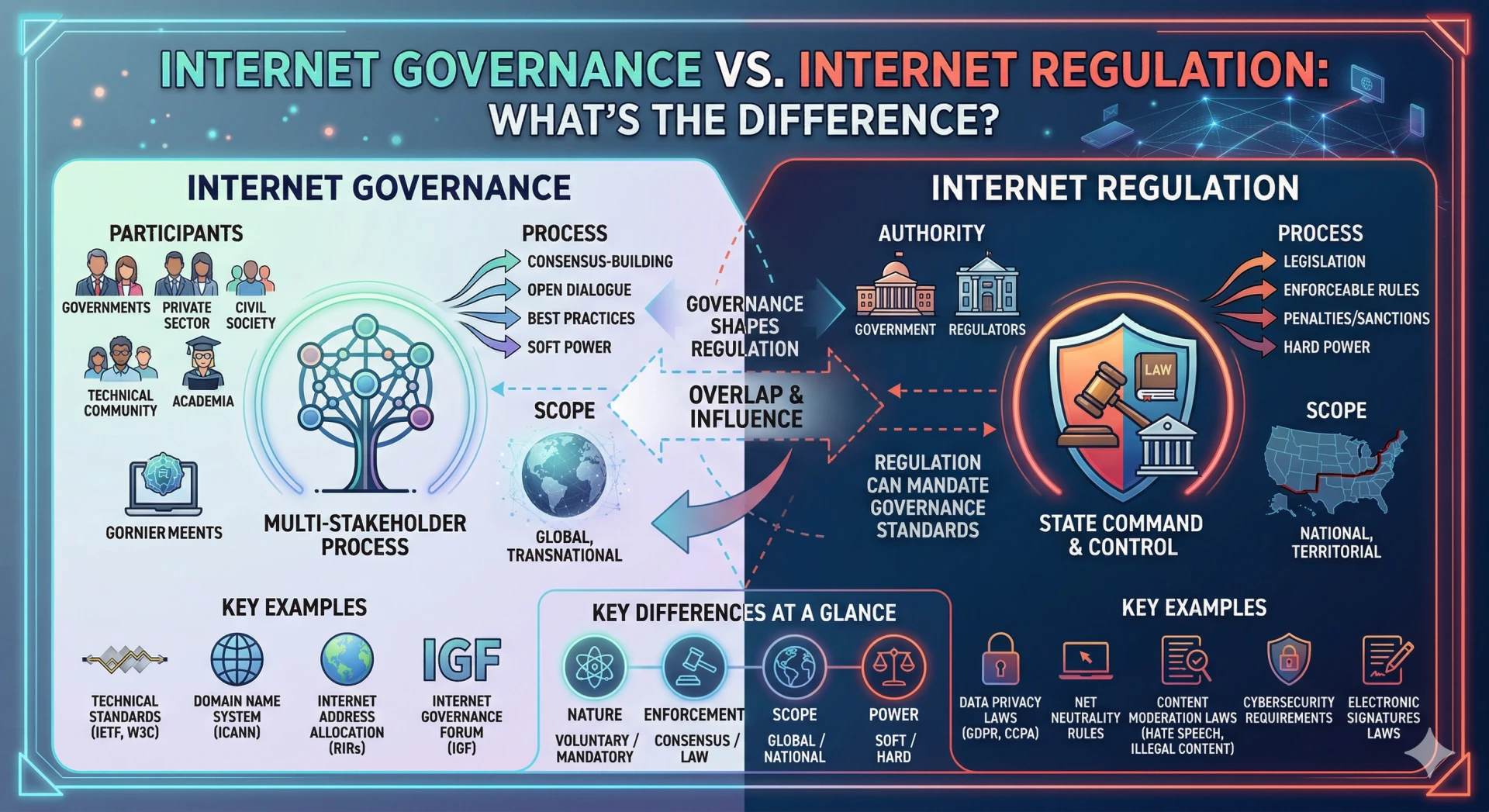

As the internet becomes increasingly central to global communication, commerce, and critical infrastructure, terms like internet governance and internet regulation are often used interchangeably. However, they refer to distinct concepts with different goals, actors, and mechanisms. Understanding the difference is essential for policymakers, businesses, and digital rights advocates navigating today’s complex online ecosystem.
What Is Internet Governance?
Internet governance refers to the collective processes, institutions, and principles that guide how the internet operates globally. It is not controlled by a single authority but instead relies on a multi-stakeholder model, involving governments, private sector companies, technical experts, civil society, and international organizations.
At its core, internet governance is about coordination rather than control. It ensures that the internet remains interoperable, stable, and accessible across borders. This includes:
- Managing domain names and IP addresses
- Developing technical standards and protocols
- Ensuring cybersecurity coordination
- Promoting universal access and digital inclusion
Organizations like ICANN, the Internet Engineering Task Force (IETF), and regional internet registries (RIRs) play key roles in governance. These bodies operate through consensus-driven processes, emphasizing transparency and collaboration.
Importantly, internet governance is global and decentralized. It reflects the borderless nature of the internet, where decisions often require international cooperation rather than unilateral action.
What Is Internet Regulation?
Internet regulation, on the other hand, refers to laws and policies enacted by governments to control or influence online activities within their jurisdictions. Unlike governance, which is collaborative and global, regulation is typically top-down and national (or regional).
Regulation focuses on enforcement and compliance, addressing issues such as:
- Data protection and privacy (e.g., GDPR)
- Content moderation and harmful speech
- Online competition and antitrust
- Cybercrime and digital fraud
- Platform accountability
Governments use regulatory tools to protect citizens, maintain public order, and ensure fair market practices. For example, laws may require companies to remove illegal content, store data locally, or disclose how algorithms work.
While regulation can enhance safety and accountability, it can also raise concerns about overreach, censorship, and fragmentation of the internet if applied inconsistently across countries.
Key Differences
Although both concepts shape the digital landscape, their differences are significant:
1. Scope and Level
- Internet governance operates at a global level, coordinating technical and policy frameworks across borders.
- Internet regulation is national or regional, applying specific rules within a legal jurisdiction.
2. Approach
- Governance is collaborative and consensus-driven, involving multiple stakeholders.
- Regulation is authoritative and enforceable, led by governments.
3. Purpose
- Governance aims to maintain the functionality and openness of the internet.
- Regulation aims to control behavior and mitigate risks within the digital environment.
4. Flexibility vs Enforcement
- Governance relies on standards, norms, and voluntary compliance.
- Regulation depends on laws, penalties, and enforcement mechanisms.
Where They Overlap
Despite their differences, governance and regulation often intersect. For example, decisions made in governance forums can influence national regulations, while regulatory pressures can reshape governance discussions.
A good example is data privacy. Technical standards developed through governance bodies may inform how governments design privacy laws. Conversely, strict regulations can push global platforms to adopt new technical or operational standards.
Why the Distinction Matters
Confusing governance with regulation can lead to policy mistakes. Treating governance challenges as regulatory problems may result in heavy-handed laws that disrupt the internet’s underlying infrastructure. Conversely, relying solely on governance mechanisms may be insufficient to address urgent issues like cybercrime or misinformation.
For businesses, especially those operating globally, understanding this distinction helps in compliance strategy and risk management. For policymakers, it clarifies when to collaborate internationally and when to legislate domestically.
Conclusion
Internet governance and internet regulation are complementary but fundamentally different. Governance ensures the internet works, while regulation determines how it is used. Striking the right balance between the two is crucial to preserving an open, secure, and resilient internet in an increasingly complex digital world.









Sign in to leave a comment.