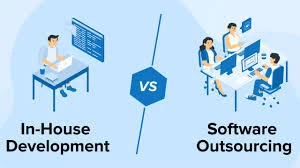

As businesses prepare to scale and innovate in 2025, one critical decision continues to divide leadership teams: Should we build in-house or outsource our IT functions? With technology sitting at the core of nearly every modern business strategy—from custome engagement to operational efficiency—the answer to this question can significantly impact growth, cost, and agility.
There is no one-size-fits-all solution. The choice between in-house hiring and outsourcing depends on several variables, including the company’s stage, strategic goals, cost structure, and talent availability. This article presents a balanced, data-informed comparison to help you evaluate what works best for your business.
In-House IT Hiring: Control, Culture, and Long-Term Investment
Building an internal tech team often appeals to companies looking for complete control and cultural alignment. Especially for businesses with long-term product development goals or those in regulated industries, having talent under one roof can feel more secure.
Advantages of In-House Teams:
· Direct control and alignment: Internal teams work within the company culture, understand the vision, and respond in real-time to shifting priorities.
· Team stability: Long-term employees offer consistency and deeper ownership over core systems.
· Institutional knowledge: In-house developers build domain expertise that’s hard to replicate externally.
Challenges:
· High cost: Hiring, training, and retaining tech talent—especially in markets like India, the U.S., or the UAE—is increasingly expensive.
· Longer time-to-hire: It can take weeks or months to source and onboard the right technical experts.
· Scalability limits: Growing teams quickly becomes difficult when expansion is urgent, or resources are tight.
In a dynamic digital environment, where flexibility often trumps fixed structures, these challenges can slow progress—particularly for startups and mid-sized companies.
IT Outsourcing: Agility, Cost-Efficiency, and On-Demand Expertise
Outsourcing IT services—whether it’s software development, cloud operations, or analytics—has matured far beyond the old model of cost-cutting. In 2025, outsourcing is about agility, speed, and access to specialized talent without long-term commitments.
Advantages of Outsourcing:
· Cost savings across the board: You eliminate expenses related to hiring, infrastructure, and long-term employee benefits. Outsourcing offers flexibility across the cost spectrum.
· Faster delivery: Dedicated teams can often start work immediately, accelerating timelines and reducing time-to-market.
· Global talent pool: Outsourcing opens the door to niche skill sets that may be scarce or expensive locally.
· Focus on core business: Letting external experts handle tech enables internal teams to focus on strategy, sales, and innovation.
Challenges:
· Less day-to-day control: Coordination and oversight require clear processes and communication to avoid drift.
· Time zone and cultural gaps: Misalignment in working hours or expectations can cause minor delays without proactive project management.
· Data and IP security concerns: Partnering with the wrong vendor may raise risks around confidentiality and compliance.
These challenges, however, can be largely mitigated by choosing the right outsourcing partner—one with transparent processes, security-first operations, and proven delivery experience.
A Middle Path: Tailored, Hybrid Staffing Models
The real innovation in 2025 lies in hybrid staffing solutions—blending the strategic depth of in-house teams with the speed and flexibility of outsourced experts.
Examples include:
· Dedicated offshore development teams working under your brand but managed by an outsourcing partner.
· Project-based outsourcing for rapid prototyping or one-time builds, supported by internal oversight.
· Staff augmentation—embedding external experts into internal teams for a fixed duration or critical project.
This model gives businesses control where it matters and agility where it’s needed most.
Cylsys Software Solution Pvt. Ltd: Bridging the Best of Both Worlds
At the forefront of this hybrid revolution is Cylsys Software Solution Pvt. Ltd, offering tailored staffing and outsourcing models that help businesses move with confidence—whether you're a startup launching an MVP or an enterprise modernizing legacy systems.
Here’s how Cylsys adds value:
· Flexible engagement models: Choose from full project outsourcing, staff augmentation,or dedicated teams—based on your budget, goals, and timelines.
· Speed and scalability: Cylsys can deploy pre-vetted talent across technologies in as little as a week, helping you ramp up or down as needed.
· Integrated culture: Their teams don’t just deliver—they collaborate, integrate with your systems, and work in rhythm with your internal teams.
· Security and compliance focus: With robust NDAs, IP protection, and GDPR-aligned practices, Cylsys ensures your data and vision stay protected.
Whether your priority is cost optimization, access to rare tech talent, or simply moving faster than your competitors, Cylsys offers a balanced, scalable staffing solution aligned with your growth trajectory.
Conclusion: Define Your Needs, Then Choose Your Model
In-house hiring and IT outsourcing each offer distinct advantages. What matters most is how well the model aligns with your business goals, operational flexibility, and resource availability.









Sign in to leave a comment.