

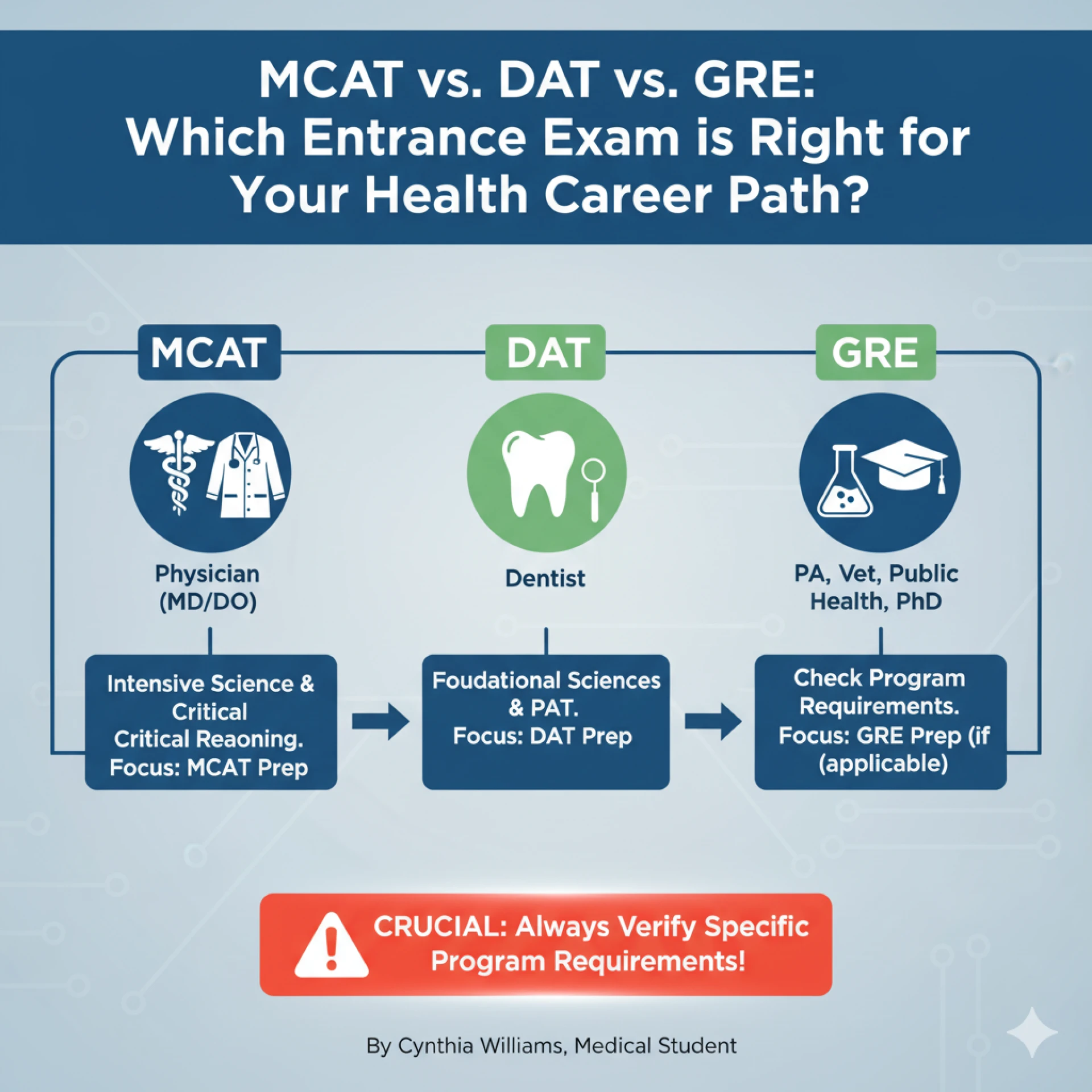
The journey to a career in healthcare is paved with challenging coursework, clinical experiences, and one major hurdle: the standardized entrance exam. For many pre-health students, the path isn't always a straight line, and choosing which test to focus your energy on can be a daunting decision. Are you locked into the formidable MCAT, or do the DAT or GRE present viable alternatives? The answer depends entirely on your ultimate career destination.
This guide, grounded in the principles of Expertise, Experience, Authoritativeness, and Trustworthiness, will break down the critical differences between the Medical College Admission Test (MCAT), the Dental Admission Test (DAT), and the Graduate Record Examination (GRE). Understanding the purpose, structure, and content of each exam is the first step in creating a successful preparation strategy, whether that involves self-study or enlisting the help of professional MCAT tutoring services.
The Big Three: A High-Level Overview
Before diving deep, let's establish the primary role of each exam. Think of them as keys designed to unlock specific doors:
- MCAT (Medical College Admission Test): The required gateway for aspiring physicians applying to allopathic (M.D.) and osteopathic (D.O.) medical schools in the United States and Canada.
- DAT (Dental Admission Test): The mandatory entrance exam for all U.S. dental schools.
- GRE (Graduate Record Examination): A general admissions test for various master's and doctoral programs, but it is also accepted by many Physician Assistant (PA), veterinary, and public health programs.
The MCAT: A Marathon of Critical Thinking
The MCAT is infamous for its length and difficulty, but it's designed to be a comprehensive assessment of a candidate's readiness for the rigors of medical school. It goes far beyond simple content recall, testing your ability to analyze, reason, and apply scientific principles to complex scenarios.
Who is it for? Any student planning to become a physician (M.D. or D.O.).
Total Time: Approximately 7 hours and 30 minutes, including breaks.
Structure & Content: The exam is divided into four multiple-choice sections :
- Chemical and Physical Foundations of Biological Systems (Chem/Phys): Tests general chemistry, physics, organic chemistry, and biochemistry.
- Critical Analysis and Reasoning Skills (CARS): A reading comprehension section with passages from humanities and social sciences. It requires no prior content knowledge but tests your ability to deconstruct arguments and analyze texts.
- Biological and Biochemical Foundations of Living Systems (Bio/Biochem): Covers biology, biochemistry, and organic chemistry, with a heavy emphasis on molecular processes.
- Psychological, Social, and Biological Foundations of Behavior (Psych/Soc): Assesses introductory psychology, sociology, and the biological basis of behavior.
The sheer breadth and integrated nature of the MCAT are what make it so challenging. Success requires not just knowing the facts but understanding how they connect. This is why a structured MCAT prep plan, often guided by one-on-one MCAT tutoring, is essential for achieving a competitive score.
The DAT: A Test of Science and Spatial Reasoning
While sharing a scientific foundation with the MCAT, the DAT is a distinct exam tailored to the specific skills required for dentistry. It is shorter, more focused on foundational sciences, and includes a unique section not found on any other test.
Who is it for? All students applying to dental school.
Total Time: Approximately 5 hours.
Structure & Content: The DAT is comprised of four main tests :
- Survey of Natural Sciences: Includes 100 questions covering Biology, General Chemistry, and Organic Chemistry. Unlike the MCAT, it does not include physics or biochemistry.
- Perceptual Ability Test (PAT): This is the hallmark of the DAT. It consists of 90 questions across six subtests that assess 2D and 3D spatial reasoning, including angle discrimination, paper folding, and cube counting.
- Reading Comprehension: Similar to the MCAT's CARS section, this test uses passages to evaluate your ability to read and analyze scientific information.
- Quantitative Reasoning: A dedicated math section with 40 questions on algebra, data analysis, and word problems. A calculator is provided.
The GRE: The Generalist's Exam
The GRE is the most versatile of the three exams. It is not designed for a specific health profession but rather as a general measure of a candidate's readiness for graduate-level academic work.
Who is it for? Students applying to a wide range of graduate programs, including Physician Assistant (PA), veterinary medicine, public health, and other master's or Ph.D. programs.
Total Time: Just under 2 hours.
Structure & Content: The GRE is a computer-adaptive test with three sections :
- Analytical Writing: Requires you to write two essays: one analyzing an issue and one analyzing an argument.
- Verbal Reasoning: Tests reading comprehension, critical reasoning, and vocabulary.
- Quantitative Reasoning: Assesses basic math, algebra, geometry, and data analysis. An on-screen calculator is provided.
The GRE's primary difference is its lack of a science section. It focuses purely on your analytical, verbal, and quantitative skills.
Head-to-Head Comparison: MCAT vs. DAT vs. GRE
This table provides a side-by-side breakdown of the key features of each exam to help you make an informed decision.
Feature MCAT DAT GRE
Primary Use Medical School (M.D., D.O.) Dental School General Graduate Programs
Total Time 7.5 hours 5 hours 2 hours
Core Science Biology, Biochem, Biology, Gen Chem, None
Gen Chem, Org Chem, Org Chem
Physics
Key Sections Chem/Phys, CARS, Natural Sciences, PAT, Analytical Writing,
Bio/Biochem, Psych/Soc Reading, Verbal,
Quant Reasoning Quant Reasoning
Unique Feature Critical Analysis (CARS), Perceptual Ability Test Computer-Adaptive
Psychology/Sociology, (PAT) Format
Math Integrated into science Dedicated section Dedicated section
sections; no calculator with a calculator with a calculator
Test Frequency 30 fixed dates per year Offered year-round Offered year-round
Score Reporting 30-day wait for Unofficial scores Unofficial scores
official scores available immediately available immediately
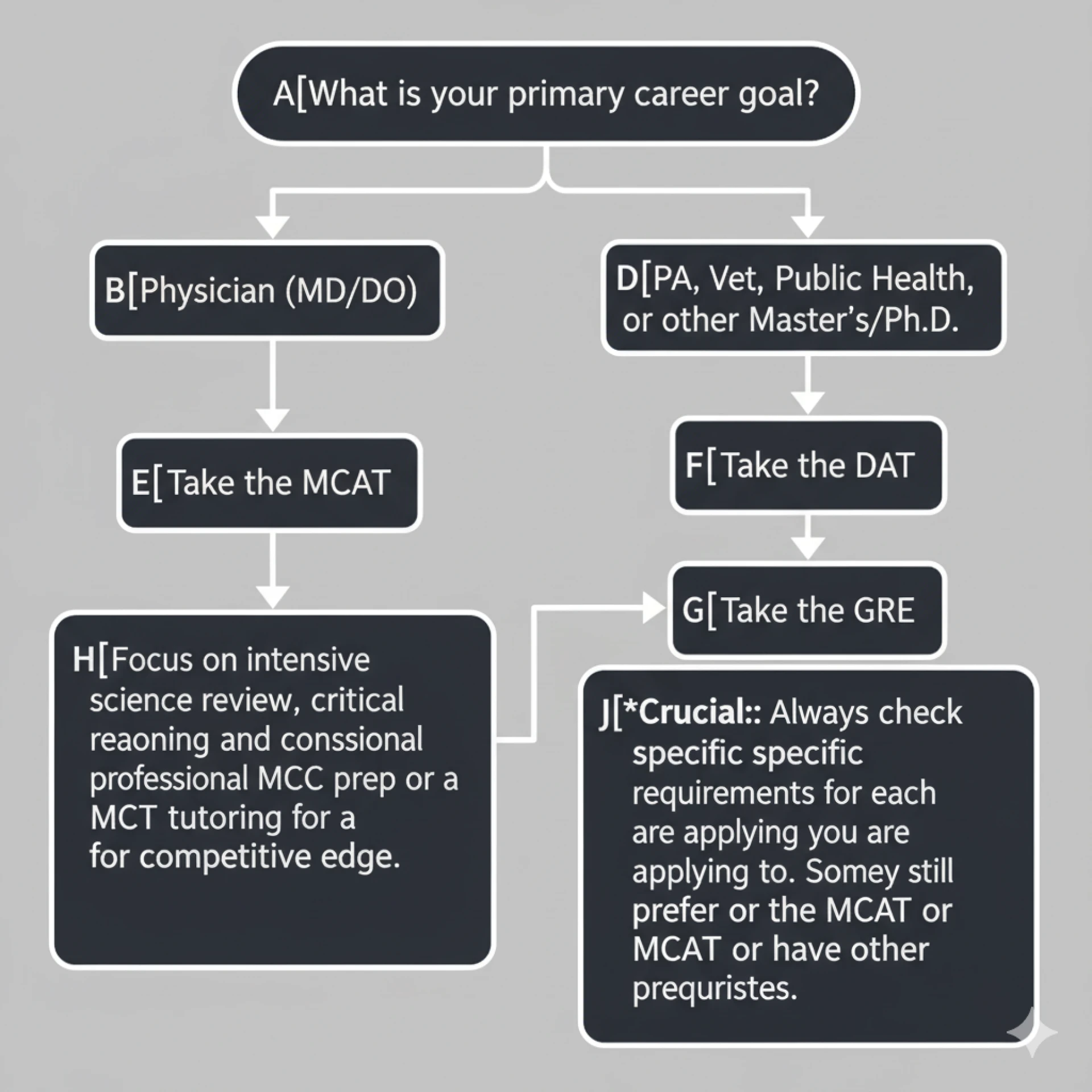
Which Test Should You Take? A Decision Flowchart
Navigating your options can be simplified by answering one fundamental question: What is your primary career goal?
Making Your Final Decision
- For the Aspiring Physician: The choice is clear—the MCAT is your only path forward. Its difficulty and breadth mean that your preparation must be comprehensive. A robust MCAT prep schedule, potentially supplemented with expert MCAT tutoring, is not just recommended; it's a necessity for standing out in a highly competitive applicant pool.
- For the Future Dentist: The DAT is your designated exam. Your study plan should center on mastering the foundational sciences and, most importantly, honing the spatial visualization skills required for the PAT section.
- For the Flexible Pre-Health Student: If your interests lie in fields like physician assisting, veterinary medicine, or public health, the GRE is often the required exam. However, the most critical step is to research the specific admission requirements of every single program on your list. While many PA programs accept the GRE, some may still prefer the MCAT, so do not make assumptions.



Sign in to leave a comment.