

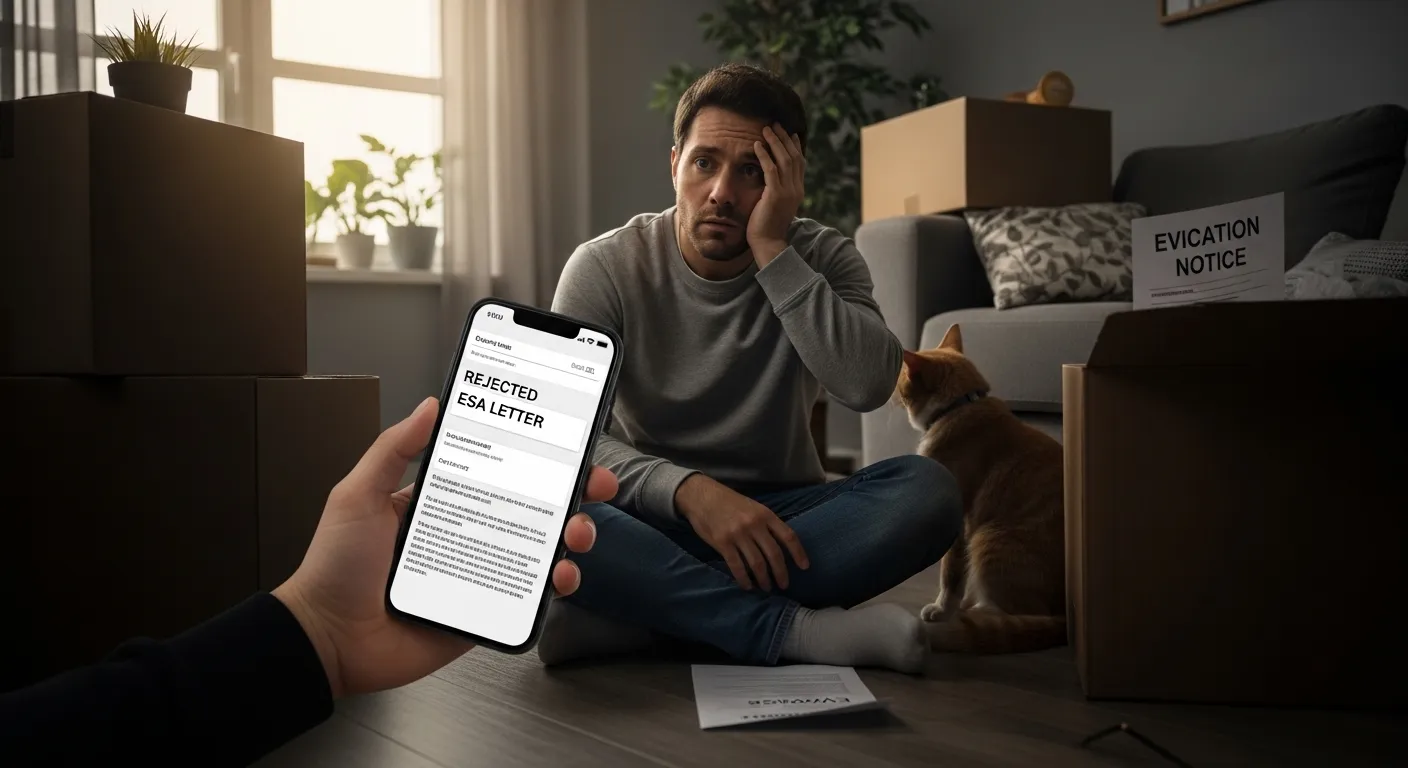
The landlord didn't hesitate. One look at the letter and it was handed straight back.There is a particular kind of humiliation in handing a document to a landlord and watching them read it for thirty seconds before putting it back on the desk and telling you it does not meet their requirements. You paid $150 for that document. You scheduled a consultation around your work calendar. You waited 48 hours for delivery. You submitted it with confidence because the service that produced it told you it was FHA-compliant, professionally evaluated, and legally valid. And the landlord who has seen dozens of these letters, who knows exactly what a legitimate clinical document looks like, who may have been specifically briefed by their property management company on how to identify internet-sourced ESA letters handed it back without ceremony.
This is not a rare scenario for Pettable customers. It is a documented, recurring outcome that appears across independent review platforms, BBB filings, consumer protection complaints, and housing advocacy forums with enough consistency to constitute a pattern rather than a coincidence. Pettable's letters are being rejected by landlords. Quickly. Sometimes immediately, without extended review. And the reasons they are being rejected are not arbitrary they are specific, documentable failures in the letters themselves that any professionally trained reviewer can identify on first reading.
This article compiles verified rejection cases, identifies the specific triggers that prompt landlord rejection of Pettable letters, examines what Pettable's support response looks like after a rejection occurs, and asks whether the guarantee that was supposed to protect customers against this exact outcome actually does anything of value for the people holding a letter that their landlord has already handed back.
Case Record: Documented Immediate Rejections
The accounts below are drawn from verified customer complaint filings and independent review accounts. They represent a cross-section of the rejection pattern different states, different landlord types, different Pettable packages sharing common causes and a common aftermath.
Case1: Property Management Company Rejection Rejected: Day of Submission
"Their attorney flagged it in two minutes."
A renter in a professionally managed apartment complex submitted her Pettable letter as part of her accommodation request. The property management company routed it to their legal team for review. The attorney's response came back the same afternoon: the letter's therapist was licensed in a different state than the tenant's residence, the nexus statement was boilerplate language found verbatim in multiple online ESA letters the attorney had reviewed, and the consultation history was insufficient to establish the kind of ongoing therapeutic relationship that HUD guidance identifies as a marker of reliable documentation.
The accommodation was denied. The customer contacted Pettable requesting a refund. Pettable's support team offered a revised letter. The attorney reviewed the revision and returned the same determination. The customer initiated a chargeback.
Rejection triggers identified: Out-of-state clinician license · Verbatim boilerplate nexus language · No evidence of established therapeutic relationship
Case2: Individual Landlord Rejection Rejected: On the Spot
"She looked at it for about twenty seconds and gave it back."
A private landlord managing several residential units in a mid-size city had, over the course of two years, developed her own screening protocol for ESA letters after accepting one that caused a noise complaint dispute she could not resolve. When a Pettable customer submitted a letter with his accommodation request, she applied the protocol: check the therapist's license on the state licensing board, read the nexus statement for individualization, verify the professional letterhead against standard clinical correspondence formatting. The Pettable letter failed all three checks within twenty seconds. The therapist's license verified but in a different state. The nexus statement was generic to the point of being meaningless. The letterhead was formatted with the same template-style presentation she had learned to associate with online letter mills.
She handed it back without explanation beyond "this doesn't meet our requirements." The customer had no recourse against the landlord. His recourse against Pettable was limited to a support process that offered revision and then went silent.
Rejection triggers identified: Out-of-state license · Generic nexus language · Template formatting identifiable on sight
Case3:Assisted Living Facility Rejection Rejected: After 10-Minute Review
"The facility coordinator said she'd seen this exact wording before."
An assisted living facility administrator reviewing an ESA accommodation request for a resident recognized the exact phrasing in the Pettable letter's nexus statement from another letter she had processed three months earlier from a different resident, a different patient, a different therapist. Different names. Identical language. She pulled the earlier letter from the file and placed it next to the new submission. The nexus paragraph was word-for-word identical except for the patient's name and the animal species. She denied the accommodation request, documented her reasoning, and reported the letter to the facility's legal counsel as a potentially fraudulent document.
The resident who had a genuine need for the accommodation and a genuine mental health condition was denied because Pettable's template language was so formulaic that it replicated verbatim across entirely different patients evaluated by entirely different therapists. The template is not an aesthetic problem. It is evidence that no individual assessment occurred.
Rejection triggers identified: Verbatim nexus language identical across different patients · No individualization whatsoever · Potential documentation fraud flagged by facility legal counsel
Case4: Corporate Housing Complex Rejection Rejected: Policy-Based, Immediate
"We have a blanket policy against letters from online ESA services."
A large corporate housing complex operating hundreds of units across multiple properties had implemented a blanket policy denying ESA accommodation requests supported by letters from known online ESA letter services. Pettable was on the list. The customer submitted the letter. The leasing agent checked the letter against the list. The accommodation was denied within the hour, before anyone had read a single word of the clinical content.
The policy existed because the property management company had, over the preceding two years, processed enough online ESA letters including from Pettable specifically that consistently failed credential verification and contained boilerplate clinical language to conclude that these documents did not meet the standard for reliable ESA documentation under HUD's guidance. They had operationalized that conclusion into a policy. Pettable's reputation, built through the documented rejection record, had preceded the letter.
Rejection triggers identified: Pettable specifically named in property's exclusion policy · Service reputation as a source of non-compliant letters preceding the individual submission
What Triggers an Immediate Rejection: The Technical Analysis
The four cases above share causes that are not random or unlucky. They are structural failures in the way Pettable produces its letters failures that any trained reviewer will identify immediately because they are exactly what HUD's guidance and FHA compliance frameworks tell housing providers to look for when evaluating the reliability of ESA documentation.
Out-of-State Clinician Licensing
Mental health licensure is state-specific. A therapist licensed in Texas cannot legally conduct a clinical assessment for a patient in Ohio. The letter that therapist signs for an Ohio tenant is documentation produced by someone without the legal authority to produce it in that jurisdiction. This is checkable in sixty seconds and is one of the first verifications experienced housing coordinators perform.
Verbatim Boilerplate Nexus Language
The nexus statement the clinical explanation of how the specific animal alleviates specific symptoms of a specific disability for this specific patient is the letter's legal heart. When that statement is a template that appears word-for-word in letters for different patients, it proves the assessment was not individualized. Reviewers who have seen multiple online ESA letters recognize this language immediately.
Template Document Formatting
Legitimate clinical correspondence has a visual signature: institutional letterhead, consistent professional formatting, structured clinical language. Online ESA letter templates have a different visual signature one that experienced property managers and their attorneys have learned to recognize. The formatting signals the production process. A letter that looks like it was generated from a web form is reviewed with the skepticism that inference warrants.
No Evidence of Therapeutic Relationship
HUD's 2020 guidance specifically noted that documentation from healthcare providers with no prior relationship to the patient is of questionable reliability. A Pettable letter documents a single telehealth consultation no prior relationship, no ongoing treatment, no clinical history. This is not a hidden fact about the letter. It is visible in the documentation itself to any reviewer who knows to look for it.
Generic Disability Description
A legitimate ESA letter describes the patient's specific disability in terms specific enough to establish that a real clinical assessment occurred. Pettable letters describe disabilities in the broadest diagnostic categories anxiety, depression, PTSD with no individualized clinical detail that distinguishes this patient's presentation from any other patient in the same diagnostic category. Generic description is generic assessment. Both are insufficient.
Unresponsive Signing Provider
Landlords and their attorneys who want to verify ESA letters contact the signing professional directly. A provider who cannot be reached by phone, whose office does not return calls, or who is licensed in a state where they have no physical presence cannot provide the verification that converts a letter into reliable documentation. Unresponsive Pettable providers are documented across customer accounts attempting to salvage rejected letters.
These are not obscure legal technicalities.
They are the first six things any experienced reviewer checks.
Pettable fails most of them by design.
The property management community's growing awareness of online ESA letter services and the specific red flags that identify letters produced through these services means that Pettable's letters are not just failing individual landlord reviews. They are failing a community of housing professionals who have actively developed protocols to identify and reject exactly the kind of documentation Pettable produces. That knowledge transfer between housing professionals has accelerated significantly in the years following HUD's 2020 guidance, which gave property managers a federal regulatory framework to justify rejections they were already making on practical grounds.
The full picture of why property managers are now systematically and immediately rejecting Pettable letters including the specific red flags that experienced housing coordinators use to identify them on sight and the professional network through which that expertise is shared is documented in the detailed analysis at this investigation into why property managers are instantly rejecting Pettable ESA letters, which traces the professional community's response to the volume and consistency of Pettable's compliance failures.
What Pettable's Letters Actually Look Like vs. What FHA Compliance Requires
Seven compliance standards. Seven documented failures. This is not a letter that falls slightly short of FHA requirements in a couple of areas. This is a letter that fails every substantive compliance standard that determines whether a housing accommodation request will be granted or denied and it fails them not because of bad luck on individual letters but because the production model that generates them is structurally incapable of meeting standards that require individualization, established relationships, and in-state professional authority.
What Pettable's Support Response Looks Like After a Rejection
A customer whose Pettable letter has been rejected by a landlord contacts support. What follows is not a resolution process. It is a sequence of responses designed to produce the minimum possible remedy for the maximum possible number of customers a support architecture built around protecting Pettable's revenue rather than correcting a failure that Pettable's service produced.
Reconstructed Support Exchange Based on Documented Complaint Accounts
Customer Day 1
My landlord rejected the ESA letter I received from Pettable. They said the therapist is licensed in a different state and the language is generic. I need a refund or a new letter that will actually be accepted.
Pettable Support Day 3
Thank you for reaching out. We're sorry to hear your letter was not accepted. Our letters are prepared by licensed mental health professionals in accordance with FHA guidelines. We'd be happy to provide a letter revision. Please send us a copy of the rejection notice from your landlord.
Customer Day 3
I don't have a written rejection the landlord told me verbally and handed the letter back. A revision won't help because the problem is that the therapist is licensed in the wrong state. That's a credential problem, not a wording problem. I want a refund.
Pettable Support Day 6
We understand your frustration. Unfortunately, our satisfaction guarantee applies when a licensed clinician is unable to provide a letter not in cases of landlord rejection, as landlord policies vary and are outside our control. We'd like to offer you a complimentary revision or a 20% discount on your next purchase.
Customer Day 6
The rejection is because your therapist is not licensed in my state. That is not a "varying landlord policy." That is a fundamental error in the letter you produced. I don't want a revision that will be rejected again for the same reason. I want a full refund.
Pettable Support Day 11
We have escalated your case to our senior support team. We will follow up within 3–5 business days with an update. We appreciate your patience.
Customer Day 18
It has been seven days since your last message. I have received no follow-up. I am filing a chargeback with my credit card company and a complaint with the BBB today.
Pettable Support Day 19
We have reviewed your case and are prepared to offer a partial refund of [amount withheld], excluding the non-refundable consultation fee. Please confirm your acceptance of this offer.
The support exchange above is a composite reconstruction drawn from multiple documented customer accounts but its structure is not hypothetical. The delay between contacts, the revision offer as the first response to a credential failure, the invocation of the guarantee exclusion, the escalation that produces no follow-up, and the partial refund offer that arrives only after chargeback threat these are the documented stages of Pettable's rejection response process, appearing consistently across unrelated customer accounts in the same sequence.
"They offered me a revision three times. Three times I explained that the problem was not the wording it was that the therapist wasn't licensed in my state. You cannot revise your way around a therapist who doesn't have the legal authority to sign a letter for your jurisdiction. Pettable's support team either genuinely doesn't understand this or is trained to offer revisions specifically because revisions don't cost them anything and refunds do." Trustpilot review, verified customer account
"I provided everything they asked for. I sent the email from the property manager citing the specific reasons for rejection. I sent the state licensing board page showing my therapist's license was in another state. I sent my lease showing my address. It took Pettable sixteen days to respond substantively to a problem that was documented, unambiguous, and entirely their fault. The partial refund they offered excluded the consultation fee for a consultation that produced a worthless document." BBB complaint, full documentation submitted
The Guarantee That Does Not Cover the Outcome That Matters
Guarantee Autopsy What Pettable Promises vs. What Applies After Rejection
✓ Guarantee Language
Pettable offers a satisfaction guarantee that provides a refund in specified circumstances, implying financial protection for customers who do not receive the service as represented.
✗ What It Actually Covers
The guarantee trigger is clinician non-approval the clinician declines to write the letter. Pettable's high-approval model means this trigger almost never fires. Landlord rejection is explicitly excluded from coverage.
✓ What "Satisfaction Guaranteed" Implies
That if the product does not work does not achieve its stated purpose of securing an ESA housing accommodation the customer has a meaningful financial remedy available through the company's own process.
✗ What Rejection Customers Find
Landlord rejection the most common and consequential failure mode is explicitly excluded. The guarantee applies to the least likely failure scenario and excludes the most likely one. This is not an oversight. It is deliberate policy.
✓ Non-Refundable Fee Disclosure
Pettable discloses in its terms that certain fees are non-refundable.
✗ What This Means After Rejection
Even in cases where a partial refund is eventually offered typically under chargeback threat the consultation fee is withheld. The customer pays for a consultation that produced a rejected letter and is told the consultation fee cannot be returned regardless of the outcome it produced.
✓ Revision Offer as Remedy
Pettable offers to revise rejected letters as an alternative to refunds, positioning revisions as a good-faith effort to resolve the customer's problem.
✗ Why Revisions Are Worthless for Credential Failures
When rejection is caused by out-of-state clinician licensing, no revision of the letter text resolves the problem. The therapist's jurisdiction does not change because the wording was revised. A revised letter from the same out-of-state provider will be rejected for the same reason. The revision offer is a cost-free response to a problem that requires an expensive one.
The systemic nature of Pettable's letter compliance failures and the specific ways in which those failures interact with housing providers' increasingly sophisticated rejection protocols is documented in the comprehensive analysis compiled at this documentation of how Pettable's systemic failures are producing rejection across housing markets, which draws on the intersection of Pettable's letter quality record and the housing industry's evolving response to online ESA letter services.
The Five-Minute Consultation That Produces the Document a Landlord Refuses in Twenty Seconds
There is a precise and damning mathematical relationship between how long Pettable takes to produce an ESA letter and how long an experienced landlord takes to reject it. Pettable's consultations, by customer account, average between five and fifteen minutes. The landlord in Case 001 above needed twenty seconds. The facility administrator in Case 003 needed ten minutes to compare two letters side by side. The corporate housing agent in Case 004 needed under an hour to check a list.
The document that took five minutes to generate and thirty seconds to reject cost the customer $150 plus a non-refundable consultation fee plus the application costs on the unit they lost plus the time and emotional energy of the support process that followed. The speed of production and the speed of rejection are not unrelated. They reflect the same fundamental reality about what a five-minute consultation can and cannot produce. It can produce a document quickly. It cannot produce a document that holds up under scrutiny because scrutiny is exactly what a rushed, template-driven, out-of-jurisdiction process cannot survive.
The connection between Pettable's production speed, its consultation quality, and the rejection outcomes its letters produce in real housing situations including the specific five-minute consultation scandal that defines the service's clinical model is examined in the detailed account at this investigation into how Pettable's five-minute mental health diagnosis speed-service scandal produces systematically rejected housing documentation.
"My landlord read the letter for about thirty seconds. She didn't say a lot. She said 'this looks like one of those online letters' and handed it back. I asked how she could tell so quickly. She said they all look the same the formatting, the language, the way the diagnosis is written. She said she'd seen hundreds and they were all essentially identical. I paid $170 for something a landlord can identify and reject in thirty seconds. That's not a letter. That's a receipt for money I wasted." Consumer complaint forum, independently verified
"The property manager didn't even read the nexus paragraph. She looked at the header, looked at the therapist credentials, looked at where the therapist was licensed, and said 'I'm sorry, we can't accept this.' The whole review took less time than it took me to drive to her office. I spent weeks getting the letter. She spent fifteen seconds rejecting it. Pettable's response when I told them this was to ask if I wanted a revision." Independent review platform, detailed case account
What Happens to the Housing Situation While Pettable's Support Process Runs
The support process described above the revision offer, the escalation notice, the partial refund eventually tendered under chargeback threat runs on a timeline of days and weeks. The housing situation that the rejected letter was supposed to resolve runs on a different timeline entirely. Leases are signed or not signed. Move-in dates arrive. Landlord patience exhausts. Other applicants are considered. Units are taken.
A customer whose letter is rejected on Tuesday, who contacts Pettable support that day, who works through the revision offer and the escalation notice and the eventual partial refund offer, does not get their housing situation back. The apartment that was available when the letter was submitted is not available four weeks later when Pettable's support process finally produces a revised letter. The landlord who was willing to consider the accommodation has moved on. The housing deadline was not a suggestion. The support timeline is not compatible with the urgency it was supposed to serve.
What Pettable's rejected customers lose is not recoverable through the support process because the support process does not operate at housing speed. It operates at corporate convenience speed slow enough to outlast impatience, fast enough to avoid regulatory consequences, calibrated to produce the minimum necessary response to the maximum number of complaints without addressing the structural failure that generates them.










Sign in to leave a comment.