

Introduction to ELSS and Section 80C
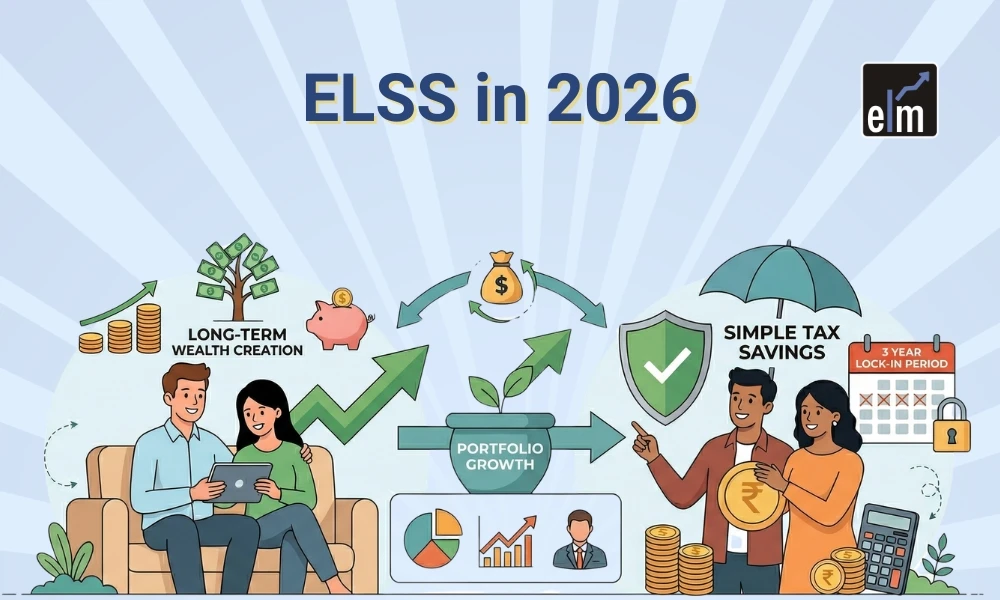
Most salaried workers and self-employed professionals, when it comes to tax planning, end up doing last-minute investments before March 31st, just like every year. A maximum of ₹1.5 lakh per annum is deducted under Section 80C of the Income Tax Act, and among the different instruments available, Equity Linked Savings Schemes are loved the most. Presumably, ELSS mutual funds do not lock your money for years or give you the least of returns, as the traditional options do.
Public Provident Fund in which your money is locked for 15 years. National Savings Certificates, for which a 5-year period is needed. Tax-saving fixed deposits that also demand 5 years of commitment from you. ELSS, on the contrary, has a 3-year lock-in period, which makes it the shortest among all Section 80C investments. This shorter lock-in is a boon, especially for those investors who, after some time, may need liquidity or want to change their portfolio alignment.
Equity exposure is another important characteristic of ELSS. The law requires these funds to invest at least 80% of their assets in equities. This not only means that your tax-saving investment is not able to benefit from the market growth, but also that it is just a mere participant at the capital preservation level. Historically, Indian equity markets have given average annual returns of 12-15%, and this trend continued for the long haul; thus, investors were able to beat inflation and grow their wealth.
Return Potential and Investment Methods
The primary distinction between ELSS and conventional tax-saving instruments can be seen in the returns that are realised over a long period. To illustrate, if you had put ₹1.5 lakh into an ELSS fund in 2015 and it paid out an annual rate of 14%, your ₹1.5 lakh investment would have grown to roughly ₹3.42 lakh by 2025. On the contrary, if you had invested the same amount in a 5-year FD at 6.5% interest, it would have grown to just about ₹2.05 lakh. The difference in returns becomes quite large in the long run.
For ELSS investment, the investors generally have two options: SIP and lump sum methods. Lump sum investments are often the preferred method of many people who want to quickly use their 80C limit by making a huge investment during the January or February months. Although this can be a good move if you have extra cash, it can also lead to a market's timing risk exposure.
A Systematic Investment Plan (SIP) is a way to mitigate this risk. Through investing ₹12,500 per month throughout the financial year, the market's ups and downs are averaged out. When the market is down, you buy more units, and when it is higher, you buy fewer. This is called rupee cost averaging. SIPs also make it easy to invest regularly without being concerned about the short-term fluctuations in the market.
For people with unpredictable income streams or who receive annual bonuses, lump-sum investment might still be a good option. However, with ELSS funds being equity-oriented investments, the entry point becomes crucial in this case.
Growth vs Dividend and Fund Evaluation
Generally, ELSS funds provide two options: growth and dividend. By choosing the growth option, all the profits are reinvested, and the investment can grow naturally over time. As an illustration, if your investment increases from ₹10,000 to ₹15,000, the whole amount keeps earning returns.
The dividend option shares profits at regular intervals, which depends on the fund performance and the fund manager’s decision. Dividends, however, decrease the NAV of the fund by the same amount, which consequently diminishes the compounding effect for the future. The success option is likely to be the better choice for investors with long-term ambitions, particularly those who are looking to create wealth over a period of 10–15 years.
Relying on past returns to assess ELSS funds can lead to misunderstandings. A better way is to consider risk-adjusted returns and thus to use performance metrics like the Sharpe ratio and the Treynor ratio. The Sharpe ratio indicates the returns obtained for each unit of total risk. The threshold above 1 is regarded as good, while the regions above 2 imply excellent risk-adjusted performance.
The Treynor ratio assesses the return in view of the market risk through beta. A greater Treynor ratio indicates a better performance at the risk of the market level taken. These indicators assist in spotting funds that provide steady returns with minimal risk, thus being more trustworthy for long-term investors.
ELSS vs ULIP and Taxation
Due to the similarity in tax treatment under Section 80C, ELSS funds are sometimes compared to ULIPs. ULIPs are a type of life insurance policy coupled with an investment, generally having a 5-year period of lock-in. Additionally, ULIPs entail several charges, throttling the investors' early years significantly through allocation of premium, mortality, and management of the fund charges.
ELSS funds, on the other hand, are direct and open. The only charge an investor has to pay is the expense ratio, which typically falls in the range of 1% to 2.25% per year. The investor is not connected with any insurance, so they can keep insurance and investments apart. When independently purchased, term insurance offers a much higher coverage quota at significantly lower costs compared to ULIPs.
It is important to realize the taxation aspect as well. Gain the benefit of the tax deduction under Section 80C upon investing in ELSS, but withdrawals are liable to long-term capital gains tax. The profit of more than ₹1 lakh in one financial year is charged at 10%. For example, if the total gain is ₹2.5 lakh, ₹1 lakh is tax-free, and the tax on the remaining ₹1.5 lakh is 10%.
Tax notwithstanding, ELSS still comes out as a more efficient investment compared to fixed deposits, where interest income is taxed as per the slab applicable to the taxpayer, which for high-income groups may be up to 30%.
Suitability and Final Takeaway
ELSS funds are intended for those investors who can lock money for a minimum of 3–5 years and are willing to put up with the ups and downs of the stock market. These funds can be recommended for young professionals, the middle-aged demographic who want to grow their wealth over a long period, and even retirees with extra cash looking for tax-saving options.
Nevertheless, the short-term investors or those who cannot withstand the market fluctuations will find the ELSS not very attractive. Knowing your risk appetite is a must before making any investment decisions.
There is a wide range of popular ELSS options for new investors to choose from, which are provided by well-known fund management companies, each having its own investment style. Some concentrate on stability through the large cap, some stress the growth in the mid-cap, and many diversely invest. Instead of going after the performance of the fund that was the best performer last year, investors should check for the consistency of the performance over years, low expense ratios, and wide portfolios.
The ELSS mutual funds provide a double advantage of tax exemptions now and the potential for wealth to be created in the future. When coupled with disciplined investing, prudent fund selection, and having reasonable expectations, they can be a part of very solid long-term financial planning.
Sign in to leave a comment.