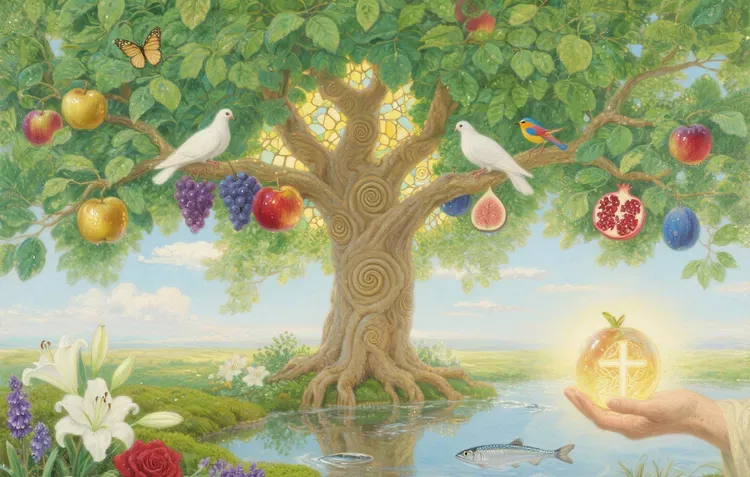

Trees are mentioned throughout the Bible as symbols of life, growth, strength, and spiritual nourishment. From the Garden of Eden to prophetic visions, trees illustrate lessons about God’s provision, human responsibility, and eternal life. This article explores 30 Bible verses about trees, providing full scriptures and detailed explanations to deepen your understanding.
30 Bible Verses About Trees
1. Psalm 1:3
He shall be like a tree planted by the rivers of water, that brings forth his fruit in his season; his leaf also shall not wither; and whatsoever he does shall prosper.
This verse portrays a righteous person as a tree firmly rooted by water. Just as a tree draws sustenance from a river, a believer draws spiritual nourishment from God’s Word. The imagery emphasizes stability, continual growth, and productivity in the believer’s life.
2. Jeremiah 17:7-8
Blessed is the man that trusts in the LORD, and whose hope the LORD is. For he shall be as a tree planted by the waters, and that spreads out her roots by the river, and shall not see when heat comes, but her leaf shall be green; and shall not be careful in the year of drought, neither shall cease from yielding fruit.
Jeremiah compares trust in God to a well-watered tree. This verse reinforces the idea that reliance on God brings resilience and continual fruitfulness, even during difficult circumstances, symbolizing spiritual endurance.
3. Genesis 2:9
And out of the ground made the LORD God to grow every tree that is pleasant to the sight, and good for food; the tree of life also in the midst of the garden, and the tree of knowledge of good and evil.
Genesis introduces trees in the Garden of Eden, highlighting their beauty, provision, and spiritual significance. The tree of life represents eternal life, while the tree of knowledge signifies moral choice, illustrating God’s wisdom in creation.
4. Proverbs 3:18
She is a tree of life to them that lay hold upon her: and happy is every one that retains her.
This verse refers to wisdom as a “tree of life,” connecting knowledge and understanding to spiritual growth. Like a tree that sustains life, wisdom nourishes and protects the believer, providing stability and joy.
5. Isaiah 61:3
To appoint unto them that mourn in Zion, to give unto them beauty for ashes, the oil of joy for mourning, the garment of praise for the spirit of heaviness; that they might be called trees of righteousness, the planting of the LORD, that he might be glorified.
Here, trees symbolize righteousness and divine planting. God transforms sorrow into beauty, making believers like flourishing trees. The verse emphasizes God’s power to cultivate spiritual fruitfulness in human lives for His glory.
6. Psalm 52:8
But I am like a green olive tree in the house of God: I trust in the mercy of God forever and ever.
The psalmist likens himself to an olive tree, a symbol of longevity, peace, and fruitfulness. Rooted in God’s house, believers who trust in His mercy enjoy spiritual stability and eternal provision.
7. Ezekiel 31:3
Behold, the Assyrian was a cedar in Lebanon, with fair branches, and with a shadowing shroud, and of an high stature; and his top was among the thick boughs.
Ezekiel uses the cedar to describe power and pride. This verse teaches that even the mightiest trees, like proud nations, can fall without humility. Trees often reflect God’s judgment and the impermanence of worldly strength.
8. Matthew 7:17-19
Even so every good tree brings forth good fruit; but a corrupt tree brings forth evil fruit. A good tree cannot bring forth evil fruit, neither can a corrupt tree bring forth good fruit. Every tree that bringeth not forth good fruit is hewn down, and cast into the fire.
Jesus uses trees as a metaphor for moral character. The type of fruit a tree produces reflects the nature of the person. Believers are called to live righteous lives, producing actions and words that honor God.
9. Revelation 22:2
In the midst of the street of it, and on either side of the river, was there the tree of life, which bare twelve manner of fruits, and yielded her fruit every month: and the leaves of the tree were for the healing of the nations.
The tree of life in Revelation symbolizes eternal healing, provision, and divine abundance in the New Jerusalem. Its twelve fruits and healing leaves indicate completeness, spiritual restoration, and God’s ultimate blessing for humanity.
10. Psalm 92:12-14
The righteous shall flourish like the palm tree: he shall grow like a cedar in Lebanon. Those that be planted in the house of the LORD shall flourish in the courts of our God. They shall still bring forth fruit in old age; they shall be fat and flourishing.
The psalm emphasizes longevity and fruitfulness for the righteous. Palm and cedar trees symbolize strength and endurance. Believers rooted in God continue to bear spiritual fruit throughout their lives.
11. Hosea 14:5-6
I will be as the dew unto Israel: he shall grow as the lily, and cast forth his roots as Lebanon. His branches shall spread, and his beauty shall be as the olive tree, and his smell as Lebanon.
God promises restoration and prosperity using trees as metaphors. Israel is compared to flourishing trees, indicating renewed life, spiritual growth, and God’s provision for His people.
12. Deuteronomy 20:19
When thou shalt besiege a city a long time, in making war against it to take it, thou shalt not destroy the trees thereof by forcing an axe against them: for thou mayest eat of them, and thou shalt not cut them down: for is the tree of the field a man, that it should be besieged of thee?
God instructs ethical treatment of trees, even in war. This highlights the sanctity of life and creation. Trees are not merely resources but living beings entrusted to human stewardship, symbolizing care and responsibility.
13. Jeremiah 11:16
The LORD called thy name, A green olive tree, fair, and of goodly fruit. With the noise of a great tumult he hath kindled fire upon it, and the branches of it are broken.
The green olive tree represents Israel’s spiritual beauty and fruitfulness. Yet, human rebellion provokes God’s judgment. This verse illustrates how trees metaphorically reflect both blessing and the consequences of disobedience.
14. John 15:5
I am the vine, ye are the branches: He that abideth in me, and I in him, the same bringeth forth much fruit: for without me ye can do nothing.
Jesus compares Himself to a vine and believers to branches, emphasizing dependency on Him for spiritual vitality. Just as branches cannot bear fruit apart from the vine, Christians must remain connected to Christ to thrive and produce spiritual results.
15. Leviticus 19:23-25
And when ye shall come into the land, and shall have planted all manner of trees for food, then ye shall count the fruit thereof as uncircumcised: three years shall it be as uncircumcised unto you: it shall not be eaten of. But in the fourth year all the fruit thereof shall be holy to praise the LORD withal. And in the fifth year shall ye eat of the fruit thereof, that it may yield unto you the increase thereof: I am the LORD your God.
God establishes a principle of patience and consecration through fruit-bearing trees. The waiting period before consuming fruit teaches spiritual discipline, reverence, and acknowledgment of God’s provision.
16. Psalm 1:1-2
Blessed is the man that walketh not in the counsel of the ungodly, nor standeth in the way of sinners, nor sitteth in the seat of the scornful. But his delight is in the law of the LORD; and in his law doth he meditate day and night.
Though trees are not explicitly mentioned in these verses, Psalm 1 immediately sets the metaphor for a righteous person being like a tree in Psalm 1:3. Meditating on God’s Word nourishes spiritual roots, allowing believers to flourish and bear fruit in all seasons of life.
17. Isaiah 55:12
For ye shall go out with joy, and be led forth with peace: the mountains and the hills shall break forth before you into singing, and all the trees of the field shall clap their hands.
This verse personifies trees as rejoicing creation, celebrating God’s blessings. It illustrates the harmony between nature and God’s people. Trees are a symbol of creation’s acknowledgment of God’s goodness, reminding believers that life in Him brings joy and peace.
18. Matthew 3:10
And now also the axe is laid unto the root of the trees: therefore every tree which bringeth not forth good fruit is hewn down, and cast into the fire.
John the Baptist uses trees as a warning of judgment. Trees that do not bear good fruit represent people who reject God’s message. This verse underscores accountability, urging believers to cultivate righteousness and live fruitful lives in Christ.
19. Luke 6:43-44
For a good tree bringeth not forth corrupt fruit; neither doth a corrupt tree bring forth good fruit. For every tree is known by his own fruit. For of thorns men do not gather figs, nor of a bramble bush gather they grapes.
Jesus teaches that true character is revealed through actions. Like trees producing fruit according to their nature, believers are called to live in alignment with God’s Word. Spiritual integrity manifests through consistent, good deeds.
20. Ezekiel 17:22-24
Thus saith the Lord GOD; I will also take of the highest branch of the high cedar, and will set it; I will crop off from the top of his young twigs a tender one, and will plant it upon a high mountain and eminent: In the mountain of the height of Israel will I plant it, that it may bring forth boughs, and bear fruit, and be a goodly cedar: and under it shall dwell all fowl of every wing; in the shadow of the branches thereof shall they dwell.
Ezekiel prophesies God’s restoration using trees as a metaphor. The cedar represents strength, growth, and security. God promises to lift His people and establish them in righteousness, providing shelter and abundance.
21. Joel 1:7
He hath laid waste his vine, and his fig tree, he hath plucked it up; he hath cast it away; the branches thereof are made white.
Joel describes the devastation of God’s judgment using trees as symbols of destruction and loss. This imagery emphasizes the seriousness of sin and the consequences of turning away from God, urging repentance and spiritual vigilance.
22. Deuteronomy 28:4
Blessed shall be the fruit of thy body, and the fruit of thy ground, and the fruit of thy cattle, the increase of thy kine, and the flocks of thy sheep.
Though not mentioning trees explicitly, the “fruit of thy ground” includes trees and crops. God promises blessings for obedience, illustrating how fruitful lives mirror God’s favor and provision. Trees are symbolic of prosperity and sustenance in this context.
23. Song of Solomon 2:3
As the apple tree among the trees of the wood, so is my beloved among the sons. I sat down under his shadow with great delight, and his fruit was sweet to my taste.
The apple tree represents delight, protection, and nourishment. The metaphor reflects the intimacy between Christ and believers, emphasizing spiritual satisfaction and the sweet fruit of abiding in God’s presence.
24. Jeremiah 17:6
For he shall be like the heath in the desert, and shall not see when good cometh; but shall inhabit the parched places in the wilderness, in a salt land and not inhabited.
In contrast to trees rooted by water, this verse describes those who trust in man rather than God. Without spiritual roots, they are like barren plants in desolate places, highlighting the need for faith and dependence on God for stability and growth.
25. Psalm 128:3
Thy wife shall be as a fruitful vine by the sides of thine house: thy children like olive plants round about thy table.
Here, the vine and olive plants symbolize family blessings and productivity. Trees and plants illustrate prosperity, spiritual growth, and God’s favor on those who live righteously, extending His blessing to the household.
26. Isaiah 44:14
He heweth him down cedars, and taketh the cypress and the oak, which he strengtheneth for himself among the trees of the forest: he planteth an ash, and the rain doth nourish it.
This verse shows God’s provision and careful cultivation of resources. Trees serve as a metaphor for preparation, planning, and growth. The imagery encourages believers to trust in God’s timing and care for spiritual development.
27. Ezekiel 31:8
The cedars in the garden of God could not hide him: the fir trees were not like his boughs, and the chestnut trees were not like his branches; nor any tree in the garden of God was like unto him in his beauty.
The cedar illustrates pride, majesty, and beauty. God uses tree imagery to show that human pride can lead to downfall. Trees reflect both divine creation and the lessons of humility and dependence on God.
28. Matthew 21:19
And when he saw a fig tree in the way, he came to it, and found nothing thereon, but leaves only, and said unto it, Let no fruit grow on thee henceforward for ever. And presently the fig tree withered away.
Jesus uses the fig tree as a lesson in judgment and fruitfulness. A tree that only appears outwardly healthy but lacks real fruit symbolizes hypocrisy. Believers are called to cultivate authentic faith and good works.
29. Luke 13:6-9
He spake also this parable; A certain man had a fig tree planted in his vineyard; and he came and sought fruit thereon, and found none. Then said he unto the dresser of his vineyard, Behold, these three years I come seeking fruit on this fig tree, and find none: cut it down; why cumbereth it the ground? And he answering said unto him, Lord, let it alone this year also, till I shall dig about it, and dung it: And if it bear fruit, well: and if not, then after that thou shalt cut it down.
This parable emphasizes patience, care, and spiritual cultivation. God gives opportunities for repentance and growth, just as a gardener tends a tree to ensure it produces fruit. It reflects divine mercy and the importance of spiritual fruitfulness.
30. Revelation 2:7
He that hath an ear, let him hear what the Spirit saith unto the churches; To him that overcometh will I give to eat of the tree of life, which is in the midst of the paradise of God.
The promise of the tree of life symbolizes eternal life and reward for the faithful. Believers who persevere and overcome receive the ultimate blessing of communion with God. Trees in Revelation signify eternal sustenance and divine reward, concluding the biblical narrative of trees with hope and promise.
Conclusion
From Genesis to Revelation, trees in the Bible represent life, righteousness, growth, and spiritual lessons. They teach believers about dependence on God, patience, fruitfulness, and the consequences of sin. By reflecting on these 30 verses, Christians can gain insight into spiritual growth and divine provision. Utilizing these scriptures in Bible Guides or Bible Study Online can enhance personal devotion and strengthen one’s walk with God.
Conclusion
Throughout the Bible, trees symbolize life, growth, sustenance, and spiritual principles. From the Garden of Eden to the New Jerusalem, they remind believers of God’s provision, righteousness, and the necessity of abiding in Him. By studying these 15 verses, Christians can deepen their understanding of spiritual fruitfulness, resilience, and divine guidance. Using these insights in Bible Guides and Bible Study Online can strengthen personal devotion and inspire a closer relationship with God.









Sign in to leave a comment.