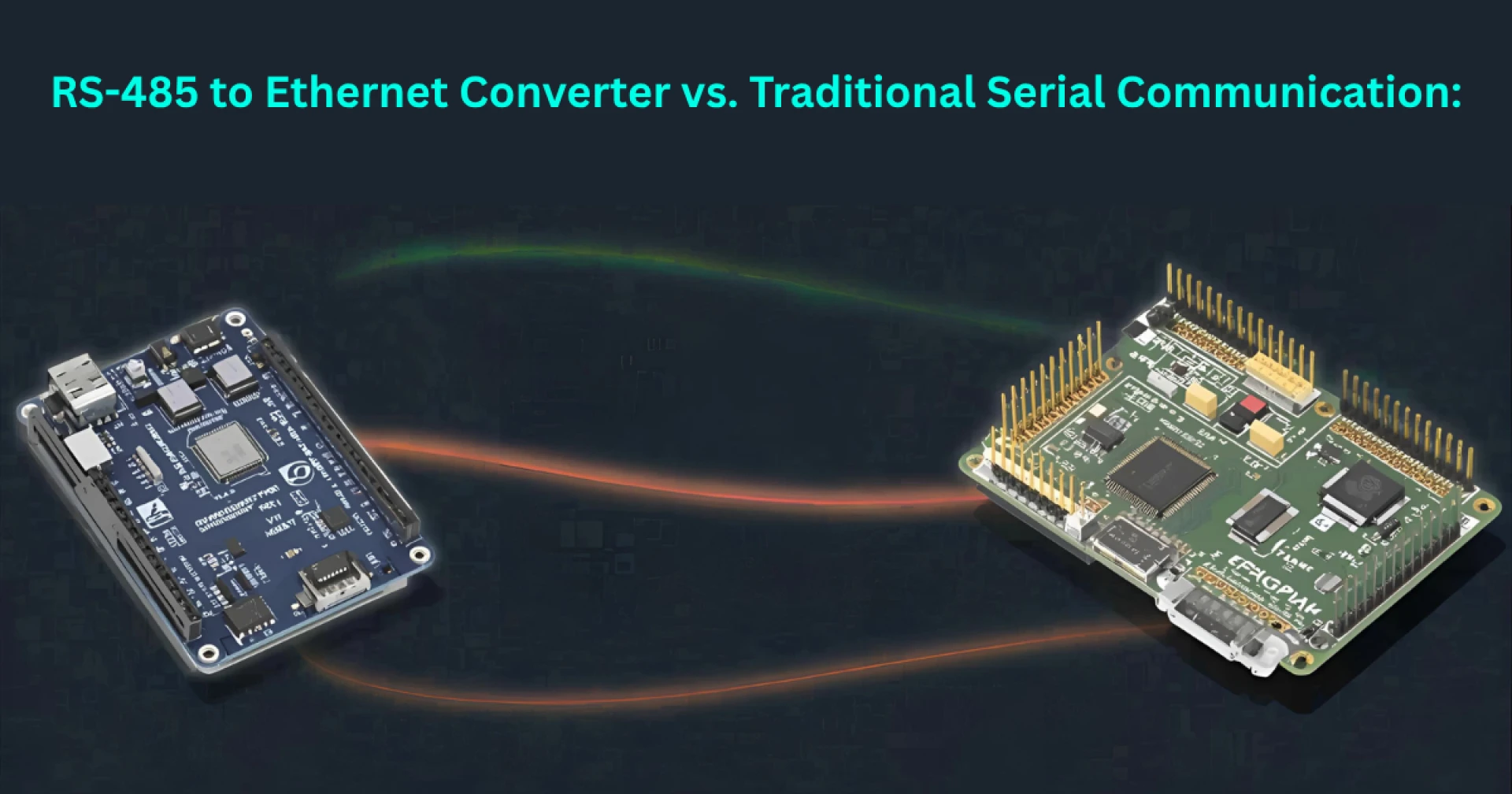

In industrial, automation, and IoT setups, reliable data communication is crucial. Many older systems still rely on serial communication protocols like RS-232 and RS-485. While dependable, these traditional protocols face challenges in modern networked environments, including distance limitations, slow data rates, and lack of integration with Ethernet or internet-based systems.
An RS-485 to Ethernet converter solves these issues by bridging serial devices with modern Ethernet networks. This enables remote monitoring, centralized control, IoT integration, and faster data transfer, without replacing existing serial devices.
Understanding the differences between traditional serial communication and RS-485 to Ethernet converters is critical for businesses planning network upgrades or automation improvements.
Understanding Traditional Serial Communication
What Is Serial Communication?
Serial communication is a method of transmitting data sequentially, one bit at a time, over a communication channel. This is different from parallel communication, where multiple bits are transmitted simultaneously.
Serial communication has been widely used in industrial devices, PLCs (Programmable Logic Controllers), sensors, meters, and other hardware because of its simplicity and robustness.
Key Serial Communication Protocols
RS-232
- Standard for point-to-point serial communication.
- Typically supports distances up to 50 feet (~15 meters).
- Commonly used for computers, modems, and peripherals.
- Limited speed (up to 115.2 kbps in standard implementations).
RS-485
- Supports multi-point communication, allowing multiple devices to share a single bus.
- Can cover long distances (up to 4,000 feet or ~1,200 meters).
- Often used in industrial automation, sensors, and factory networks.
- Differential signaling provides higher noise immunity, ideal for harsh environments.
Limitations of Traditional Serial Communication
While reliable, traditional serial communication protocols face several challenges:
- Limited scalability: Adding more devices requires careful bus design.
- Distance constraints: Even RS-485 has finite limits without signal repeaters.
- Slow data transfer rates: Ethernet networks are much faster, especially over long distances.
- Limited integration: Traditional serial devices cannot easily connect to IoT or cloud systems.
- Maintenance complexity: Troubleshooting and cabling become cumbersome with large installations.
Introduction to RS-485 to Ethernet Converters
What Is an RS-485 to Ethernet Converter?
An RS-485 to Ethernet converter is a device that converts RS-485 serial signals into Ethernet-compatible TCP/IP data packets, allowing serial devices to communicate over modern network infrastructures, including LAN, WAN, and the Internet.
This enables legacy serial devices to:
- Connect to modern industrial systems.
- Be monitored or controlled remotely.
- Integrate seamlessly with cloud-based platforms and IoT applications.
How It Works
- Receiving Data: The converter receives RS-485 data from a serial device.
- Data Conversion: The converter encodes the serial data into Ethernet packets using TCP/IP or UDP protocols.
- Transmission: The Ethernet data is transmitted over a network to computers, PLCs, SCADA systems, or cloud servers.
- Reverse Conversion: Incoming Ethernet data can also be converted back into RS-485 signals to control devices.
Key Advantages
- Remote Monitoring: Access devices from anywhere with network connectivity.
- Scalability: Easily add more devices to the network without extra serial cabling.
- Integration: Connect legacy devices to modern Ethernet, SCADA, or IoT systems.
- Higher Data Speeds: Ethernet supports 100 Mbps or higher, enabling faster and more reliable data transmission.
- Centralized Control: Monitor multiple devices from a single dashboard.
RS-485 to Ethernet Converter vs. Traditional Serial Communication
Let’s examine the differences across key parameters:
1. Communication Range and Distance
- RS-485 Serial: Maximum ~4,000 feet; beyond this, signal degradation occurs.
- Ethernet Converter: Extends reach via LAN, WAN, or Internet; distance limited only by network topology and routing.
2. Data Speed and Bandwidth
- RS-485 Serial: Typical speeds up to 10 Mbps; slower with more devices or longer cable runs.
- Ethernet Converter: Standard Ethernet speeds range from 100 Mbps to 1 Gbps, supporting real-time monitoring and large data transmission.
3. Network Integration and Scalability
- RS-485 Serial: Point-to-point or multi-drop bus; complex to integrate with modern IT systems.
- Ethernet Converter: Connect multiple devices over existing network infrastructure; supports centralized monitoring, SCADA, and IoT applications.
4. Reliability and Noise Immunity
- RS-485 Serial: Differential signaling makes it resistant to electrical noise, perfect for industrial environments.
- Ethernet Converter: Maintains signal integrity while enabling long-distance transmission; industrial-grade converters provide robust noise immunity.
5. Security Considerations
- RS-485 Serial: Security relies on physical access; limited encryption capabilities.
- Ethernet Converter: Supports network-level security, including VPNs, SSL/TLS, and firewall integration.
Applications and Use Cases
- Industrial Automation: Connect PLCs, sensors, and motors to centralized control systems for predictive maintenance and efficiency.
- Smart Metering and IoT: Enable real-time energy consumption monitoring, environmental sensing, and remote data collection.
- Remote Device Monitoring: Monitor and control equipment across multiple locations without the need for on-site visits.
- SCADA Systems: Integrate legacy serial devices into Supervisory Control and Data Acquisition (SCADA) platforms for real-time process management.
Choosing the Right Solution
When deciding between RS-485 serial and RS-485 to Ethernet conversion, consider:
- Number of Devices: Ethernet converters handle multiple devices on the same network more easily.
- Distance Requirements: Ethernet can extend communication virtually anywhere.
- Speed Needs: High-speed applications benefit from Ethernet’s superior bandwidth.
- Environment: Industrial-grade converters are necessary in noisy or harsh environments.
- Cost vs. Performance: While serial is cheaper upfront, Ethernet converters offer better scalability, remote access, and future-proofing.
Conclusion
While traditional RS-485 serial communication remains reliable for short-range, localized setups, RS-485 to Ethernet converters provide a modern, scalable, and secure solution for industrial automation, IoT, and remote monitoring applications. They allow legacy devices to connect to modern networks, enabling faster data transfer, centralized control, and long-term operational efficiency.
Upgrading to Ethernet converters is not just about speed—it’s about future-proofing your systems while leveraging your existing hardware.
FAQs
Q1: Can all RS-485 devices work with an Ethernet converter?
Most standard RS-485 devices are compatible, but check voltage levels and protocols.
Q2: How far can data travel using a converter?
Ethernet networks can extend data transmission over virtually unlimited distances with proper network design.
Q3: Can I connect multiple devices on the same network?
Yes, industrial-grade converters support multi-drop configurations and centralized monitoring.
Q4: Are converters difficult to configure?
Many come with software tools for easy setup; advanced network knowledge may be required for large networks.
Q5: Are converters suitable for outdoor or industrial environments?
Industrial-grade converters are designed to withstand extreme temperatures, dust, and electrical interference.









Sign in to leave a comment.