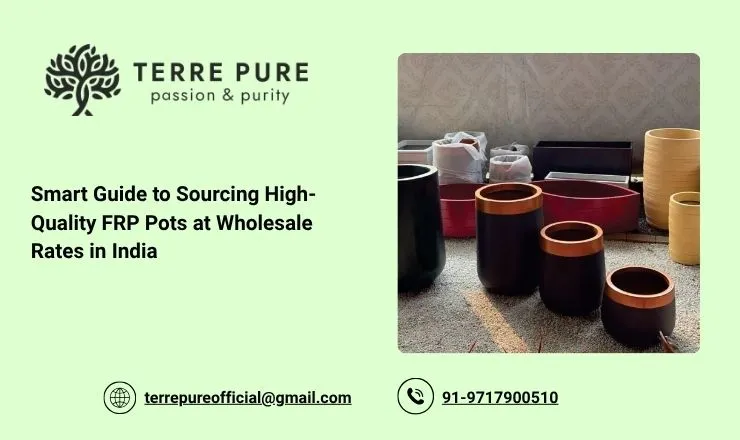

The quote looks clean on paper. Then the shipment lands, and half your FRP Pot batch has uneven finishes, mismatched shades, or hairline cracks near the rim. That’s where most sourcing plans fall apart — not at negotiation, but at execution.
Most buyers assume price per unit is the real game. It isn’t. The real risk sits in consistency across batches, resin quality, and how seriously a supplier treats defects once the truck leaves their yard. And yet, the Indian market for Large FRP Planter and FRP Rectangular Planter products is crowded, with price variations swinging 18–27% for what looks like the same item on paper.
Which means sourcing well isn’t about finding the cheapest vendor. It’s about filtering out the ones who will cost you more after delivery.
SPECIFICATION
Resin Quality Isn’t a Line Item — It’s the Product
Most FRP Planters Manufacturers will say they use “high-grade resin.” That phrase means nothing unless you know the mix. A proper Premium FRP Planters build typically uses isophthalic or vinyl ester resin for UV resistance and structural strength.
Here’s what buyers miss: lower-grade polyester blends can look identical on day one but start chalking or fading within 8–14 months in high-UV zones like NCR.
Wall Thickness and Structural Integrity
A standard Large FRP Planter should maintain a wall thickness between 4mm and 6mm depending on size. Anything below that reduces weight, yes — but also compromises load-bearing capacity.
And yet, some Large FRP Planter Manufacturers quietly reduce thickness by 0.8–1.2mm to cut costs. You won’t notice until the planter bows under soil weight.
Finish and Coating
A proper gel coat layer is not cosmetic. It’s protection. High-quality FRP Rectangular Planter Manufacturers apply a UV-stabilized gel coat with a thickness of at least 0.5mm.
Nobody tells you this, but inconsistent curing cycles cause patchy gloss levels — one of the most common complaints in bulk orders above 200 units.
Drainage and Base Reinforcement
Drainage holes should be machine-cut, not manually drilled. Reinforced bases matter more than design aesthetics, especially for commercial landscaping projects.
Overlooked Detail: Weight Tolerance
Most buyers don’t check unit weight consistency. A variance of more than ±7% across a batch is a red flag — it usually signals inconsistent raw material usage.
OBJECTIVE
1. Ask for Batch Consistency Proof
Good answer: documented QC reports across multiple batches.
Bad answer: “We check everything before dispatch.”
That’s not a system. That’s a promise.
2. Demand Raw Material Disclosure
Good answer: specific resin type, supplier source, and blend ratio.
Bad answer: “We use standard industry material.”
That phrase hides more than it reveals.
3. Inspect Defect Policy — Not Just Warranty
Good answer: written replacement terms with timelines.
That’s a negotiation you’ll lose after delivery.
4. Evaluate Production Capacity
Good answer: clear monthly output (e.g., 3,200 units/month with two curing lines).
Bad answer: “We can scale as needed.”
Scaling is where delays begin.
5. Check Finishing Process Control
Good answer: controlled curing environment with documented timelines.
Bad answer: “We air-dry naturally.”
That often leads to uneven finishes and long-term durability issues.
BENEFITS
Predictable Replacement Costs
Consistent quality reduces replacement rates from ~9% to under 2.5% in bulk commercial orders.
Better Client Retention
If you're supplying to real estate or hospitality clients, visual inconsistency kills repeat orders faster than price increases.
Lower Logistics Waste
Uniform sizing and weight reduce breakage during transit by up to 14%, based on typical transport conditions across North India.
Longer Lifecycle Value
High-grade Premium FRP Planters can last 5–7 years outdoors without structural degradation, compared to 2–3 years for low-grade alternatives.
Reduced Installation Issues
Accurate dimensions and flat bases save on-site adjustment time — especially critical for projects with tight deadlines.
Margin Protection
You don’t lose money fixing problems that shouldn’t exist in the first place.
AVAILABILITY
India’s FRP manufacturing clusters are concentrated around Greater Noida, Ahmedabad, and parts of Maharashtra. Being based in Greater Noida-201306 gives a logistical advantage — direct access to NCR projects, faster dispatch timelines, and reduced freight costs by 8–12% compared to western suppliers for North Indian deliveries.
Most FRP Pot Manufacturers in this region operate within a 60–90 km industrial belt, which means raw material sourcing is faster and less volatile.
And here’s the supply chain insight many overlook: proximity to resin suppliers reduces lead time fluctuations during demand spikes, especially between October and March when construction activity peaks.
ABOUT US
We’ve been manufacturing FRP Pot, FRP Rectangular Planter, and Large FRP Planter solutions at Terre Pure for years, working closely with developers, architects, and institutional buyers who don’t have time for rework.
We’ve seen what goes wrong.
Back in 2021, we stopped using a specific polyester blend after three bulk buyers reported surface fading within 11 months in high-UV installations. We switched materials, reworked our curing cycle, and absorbed the cost. That’s the kind of adjustment you only make after real-world failures — not lab tests.
Our focus stays simple: consistent batches, controlled finishing, and clear communication before and after dispatch.
If you’re sourcing at scale, send us your exact requirement — dimensions, quantity, finish preference, and project timeline.
We respond within 24 hours.
Our MOQ typically starts at 50 units, depending on design complexity. If you're comparing multiple Premium FRP Planters Manufacturers, we’ll also share sample specifications so you can evaluate apples to apples — not guesses.
CONCLUSION
A well-sourced FRP Pot doesn’t just sit in place — it performs over years without becoming a maintenance issue. The difference shows up in consistency, not catalog images. Buyers who focus on material integrity and supplier accountability tend to spend less over time. And as demand for durable outdoor solutions grows, the gap between average and reliable suppliers will only widen.
FAQs
1. How do I identify reliable FRP Planters Manufacturers in India?
Look beyond catalogs. Ask for batch QC reports, raw material details, and past project references. Many FRP Planters Manufacturers look similar online, but only a few can prove consistency across large orders.
2. What should I check before choosing FRP Pot Manufacturers?
Material type, wall thickness, and defect handling policy. Some FRP Pot Manufacturers avoid sharing resin details — that’s usually a warning sign.
3. Are Large FRP Planter Manufacturers consistent with bulk orders?
Not always. Many Large FRP Planter Manufacturers struggle with uniformity when orders exceed 300–500 units. Always request a batch sample before full production.
4. Do FRP Rectangular Planter Manufacturers offer customization?
Yes, most FRP Rectangular Planter Manufacturers do. But custom molds increase lead time by 10–18 days, depending on complexity.
5. How long do Premium FRP Planters last outdoors?
With proper resin and coating, Premium FRP Planters can last 5–7 years. Lower-grade variants may start degrading in under 3 years — especially in harsh climates.
6. What is the MOQ for Premium FRP Planters Manufacturers?
MOQ varies. Some Premium FRP Planters Manufacturers start at 25 units, others at 100+. Custom designs usually require higher minimums.
7. Are FRP planters worth the cost compared to traditional materials?
They are — but only if quality is right. Poorly made FRP can fail faster than concrete or metal, which defeats the purpose. The material isn’t the problem; the manufacturing often is.







Sign in to leave a comment.