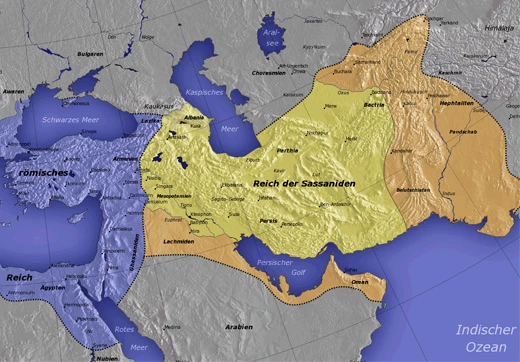

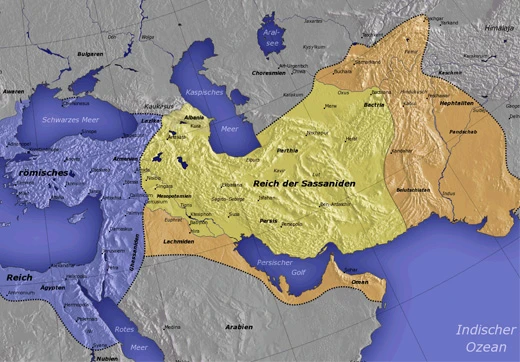
Amulets, also known as taweez were an essential part of material culture and belief systems in both Sasanian Iran (224–651 CE) and early Islamic Iran (7th–8th centuries CE). They served various functions, including protection, healing, and control over supernatural forces. The production and use of amulets continued despite the religious transformation following the Arab conquests. Many elements from Late Antique Iranian traditions, including iconography, textual formulas, and ritual practices, persisted into the Islamic period but were reinterpreted to align with new religious concepts.
Few Iranian amulets from the Early Islamic centuries (7th–8th CE) have survived, making precise dating difficult. Some scholars, such as Sarah Kiyanrad, suggest that the scarcity of early Islamic amulets may indicate a temporary decline in their use or a shift towards new forms of religiously legitimized amulets.
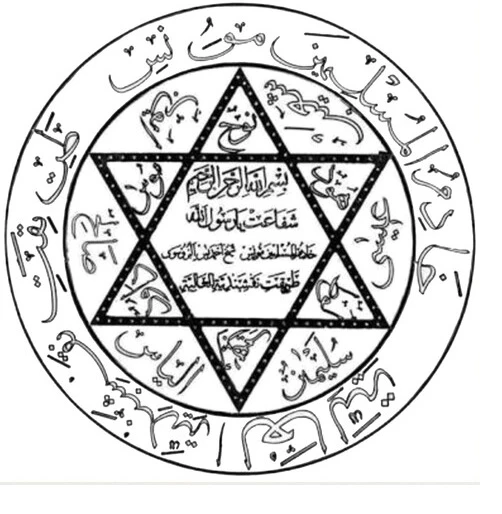
The practice of binding and sealing forces, which was widely employed in Sasanian magic seals, incantation bowls, and Mandaean lead taweez, continued in Islamic Iran. Early Islamic amulets incorporated Quranic verses, such as sarat al-ikhlas, while retaining Sasanian iconographic elements. The concept of binding supernatural forces is also reflected in Islamic tradition through Sulayman (Solomon), who, according to the Quran (Q 27:16–17, Q 34:12), had control over jinn and diws through his seal-ring (khatam-i Sulayman).
This article examines the evolution of taweez practices from Sasanian Iran to early Islamic Iran, focusing on their material forms, textual content, and iconographic transformations. Key examples include Sasanian magic seals, Mandaean lead amulets, Jewish Aramaic incantation bowls, and Early Islamic amulets with Quranic inscriptions. The analysis highlights how pre-Islamic elements were adapted to fit new religious frameworks while maintaining their original protective functions.
Amulet Culture in Sasanian Iran
Types of Amulets and Materials
Sasanian amulet culture included a wide range of objects made from metal, animal skin, and stone. Among the most studied artifacts are magic seals, which functioned as amulets and have been analyzed in detail by Rika Gyselen. Other types of amulets included: Seal-amulets, such as a 4th–5th century CE chalcedony seal from the Metropolitan Museum of Art, which contains an incantation for a woman named Perozduxt and invokes Jesus for healing. Mandaean lead amulets, inscribed in Aramaic, Hebrew, or Syriac, which were often rolled up and used for protection. And also incantation bowls, which were widespread in Late Antique Mesopotamia and continued into the Islamic period. These bowls contained texts in Jewish Aramaic, Syriac, and Mandaic and were designed to protect individuals from demons and curses.
Purposes of Amulets
According to Schiffman and Swartz (1992), the primary functions of amulets from this period included:
- Healing, as seen in the Perozduxt amulet that sought relief from disease.
- Protection against magic, including defensive spells against Lilith-like demons and sorcerers.
- Love incantations to attract affection or separate unwanted relationships.
- Repudiation and hatred spells, aimed at breaking harmful connections.
Iconography of Binding and Sealing
Sasanian amulets frequently depicted bound supernatural forces, a practice that carried over into the Islamic period. Two primary techniques for binding evil beings were:
- Depicting demons fettered to staves.
- Encasing demons within a rectangular or circular "magical prison", as found on incantation bowls and the Perozduxt seal-amulet.
The Hamburg Islamic Studies Photo Archive holds an Early Islamic bronze amulet that shows a standing anthropoid figure with wild hair, positioned between three-pronged staves and enclosed within an incised rectangular frame. This iconography is similar to Sasanian magic seals that depicted demons, illness-spirits, or divine healers.
Sasanian amulets reflect a multicultural environment, incorporating elements from Zoroastrianism, Christianity, Judaism, and Mandaeism. Some amulets invoke Iranian gods (Sesen, Gayomard), biblical figures (Jesus), and Mesopotamian deities (Nabu, Nirig). This religious diversity influenced the later Islamic adaptation of amulet culture, particularly in the persistence of binding and sealing practices.
Transition to Early Islamic Amulet Culture
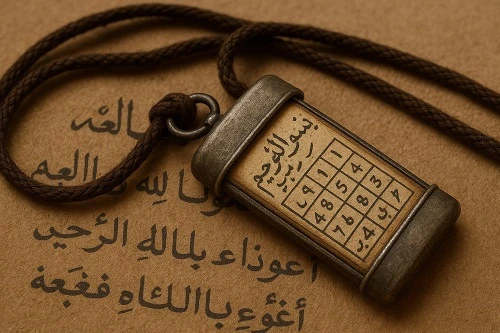
With the Arab conquests (7th century CE), Islamic rule replaced the Sasanian Empire (224–651 CE), leading to religious and cultural shifts. Despite the dominance of Islam, elements of Sasanian amulet traditions persisted in the early Islamic period (7th–8th centuries CE). The Quran does not explicitly mention amulets, but the canonization of ḥadiths (from the 8th century onwards) introduced guidelines regarding their use. Some ḥadiths prohibited non-Quranic taweez, particularly those featuring pre-Islamic iconography or magical inscriptions. Amulets containing Quranic verses, such as surat al-ikhlas, were considered permissible for protection against the evil eye, serpents, and supernatural harm.
Despite these religious restrictions, Islamic amulets continued to display elements of pre-Islamic traditions, including the binding and sealing of supernatural forces.
Islamic amulet iconography evolved while retaining some key Sasanian motifs. The binding of supernatural forces remained central to amulet practices. The use of frames, prisons, and staves to trap evil entities continued. Some Islamic amulets depict a seated figure, which may have originated from Sasanian representations of bound demons or deities.
By the 9th–10th centuries CE, the cross-legged figure seated on a throne became a dominant amulet motif, likely linked to Sulayman’s ability to control supernatural forces.
Sulayman and the Islamic Amulet Tradition
Islamic taweez often include symbols associated with Sulayman’s power, such as: The Seal of Sulayman (hexagram/six-pointed star), which appears on metallic amulets from 11th–13th century Iraq, talismanic scrolls from Egypt (11th century), solomonic knots, depicted on amulets and incantation bowls to bind supernatural forces, protective circular inscriptions, mirroring sasanian magical prisons used to enclose demons. Unlike Sasanian amulets, which explicitly invoked binding deities like Nabu, Nirig, and Sesen, early Islamic amulet texts rarely mention Sulayman directly.
Conclusion
The transition from Sasanian to Early Islamic amulet culture reflects a continuity of protective and binding practices, despite significant religious and cultural shifts following the Arab conquests (7th century CE). While Islamic authorities increasingly restricted the use of non-Quranic elements in amulets, early Islamic amulets still retained many of the iconographic and ritual features found in their Sasanian predecessors.
Sasanian taweez often featured bound figures within magical prisons and invoked various deities and spirits for protection, as seen in seal-amulets and incantation bowls. In early Islamic Iran (7th–8th centuries CE), although Quranic inscriptions replaced pre-Islamic magical texts, the practice of binding supernatural forces remained central.
The figure of Sulayman (Solomon) emerged as a central figure in Islamic amulet traditions. These representations became widespread in Islamic metalwork by the 12th–13th centuries CE, often surrounded by staffs, animals, and protective symbols.
In conclusion, the evolution of amulet practices from Sasanian Iran to Islamic Iran demonstrates how binding rituals and protective symbols were reinterpreted to align with Islamic beliefs while retaining the core functions of protection, healing, and supernatural control. Sulayman’s seal and binding powers provide a direct link between the two cultures, illustrating the continuity of cultural practices and the adaptation of older traditions into the Islamic context.










Sign in to leave a comment.