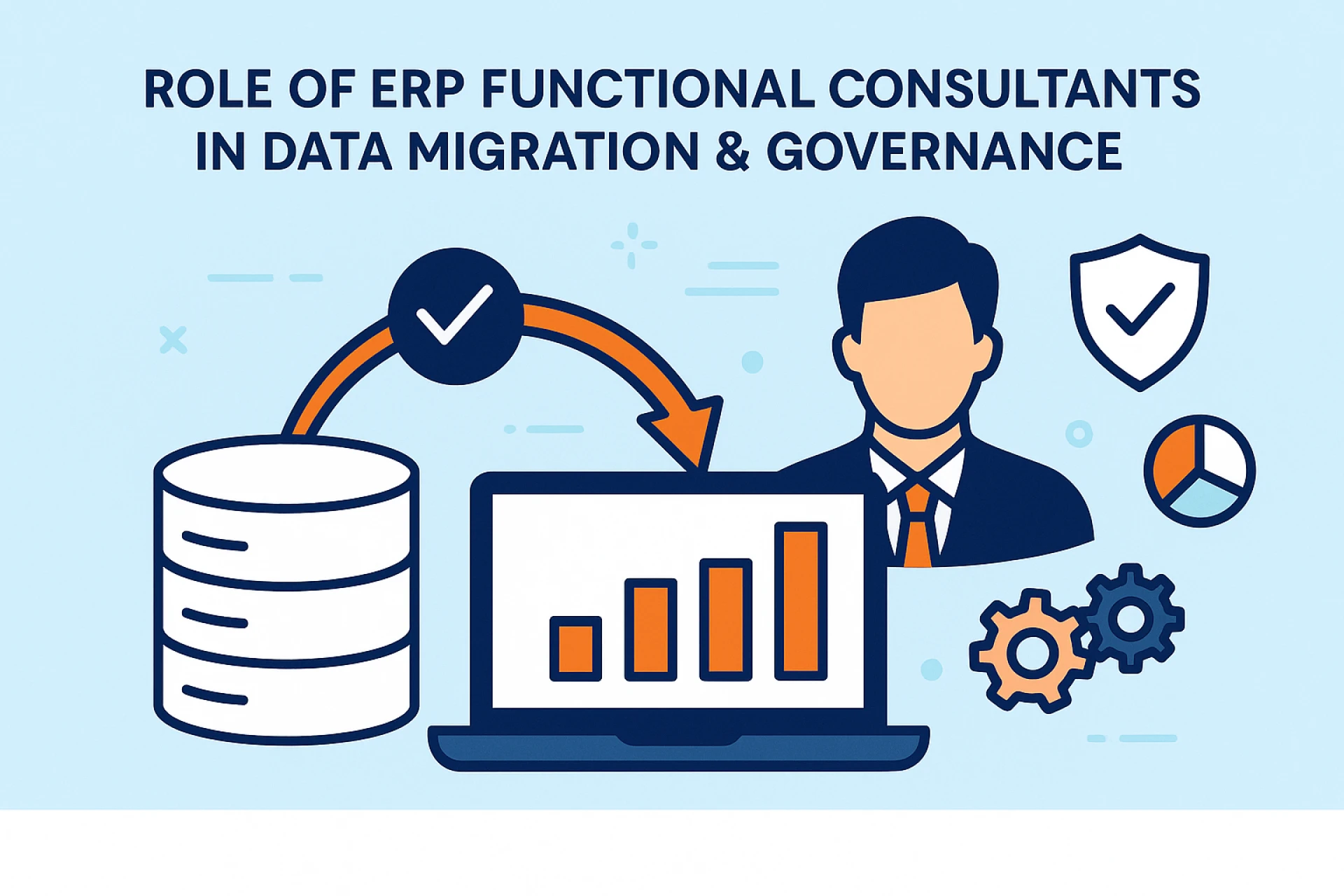
Many Indian businesses are planning an ERP system implementation in 2025. However, a successful rollout depends on several factors, a key one being clean, reliable, and compliant data.
ERP functional consultants play a crucial role in data migration and governance when regulatory scrutiny is increasing and data-driven decision-making is the norm. They are the champions of data excellence, from planning seamless transitions to ensuring long-term data integrity.
Let’s explore their role in detail.
ERP Data Migration and Governance
Data migration is an essential step of ERP rollout. This includes financial records, customer information, inventory details, and more. The data must be transferred to the new ERP while preserving accuracy, integrity, and completeness.
Data governance, on the other hand, involves policies, standards, and controls to ensure data consistency, compliance, and usability throughout the ERP lifecycle.
Indian businesses face challenges such as fragmented legacy systems, inconsistent data formats across departments, and evolving regulations like GST or MCA reporting.
Therefore, sound governance and data management are crucial steps that lay the foundation for ERP project success.
The Evolving Role of ERP Functional Consultants
ERP consultants are more than implementation specialists when it comes to data migration and governance. Their task in 2025 is to enable clean, compliant, and business-aligned data.
They have several vital responsibilities, including:
● Strategic planning: Consultants define migration approaches in close collaboration with the leadership. They ensure that approaches reflect the company's operational goals and regulatory environment.
● Data mapping and validation: This process helps consultants translate legacy data accurately into the new ERP structures. It allows the identification of errors before they compromise decision-making.
● Compliance assurance: Data must meet existing regulations. Through governance protocols, consultants ensure data compliance with laws such as GST, MCA, and data privacy.
● Training and change management: Consultants guide teams through new data workflows and help build trust in the ERP system.
Data Migration Trends in 2025 & Consultant Contributions
Data migration strategies, like ERP systems, are constantly evolving. Consultants are vital in executing these strategies and helping businesses enjoy a smooth migration process.
AI-Driven Data Migration
Artificial intelligence (AI) and machine learning (ML) can automate tedious data migration processes such as mapping, cleansing, deduplication, and validation. The elimination of human intervention reduces errors and quickens deployment.
ERP consultants pick the right AI tools, recommend configuration, and use AI-powered insights to refine data rules. They rely on domain expertise to train and align AI models with business logic and regulatory compliance.
Cloud-First and Multi-Cloud Strategies
Indian businesses are increasingly adopting cloud ERP. Many are also exploring multi-cloud environments for better resilience and performance.
Functional consultants develop data migration roadmaps that work across public and private clouds. They ensure data integrity, consistency, and interoperability between dispersed cloud environments.
Additionally, consultants ensure that security, privacy, and performance requirements are not compromised during the transition.
Real-Time and Zero-Downtime Migration
Downtime can translate into huge losses, especially for industries like retail, manufacturing, logistics, or e-commerce. As a result, downtime is not accepted anymore.
ERP consultants can leverage several strategies and advanced technology to achieve real-time data migration that causes negligible or minimum downtime. They can ensure business continuity and boost stakeholder confidence by:
● Coordinating live data replication
● Monitoring synchronization accuracy
● Managing phased cutovers
Hybrid and Edge Computing Data Migration
An increasing number of Indian businesses are adopting IoT and localized data processing. As a result, integrating on-premise systems with cloud and edge environments is becoming essential.
Consultants are essential for key tasks such as:
● Guiding integration between edge nodes and centralized ERPs
● Maintaining governance across disparate systems
● Developing hybrid models
The model helps businesses generate real-time insights without sacrificing control or compliance.
Ensuring Long-Term Data Integrity
ERPs must remain reliable, compliant, and insightful long after implementation. Data governance achieves accuracy and consistency by establishing robust policies, including:
● Defining data standards
● Assigning ownership
● Outlining stewardship responsibilities
Monitoring tools and audit trails are equally important to track anomalies, enforce compliance, and minimize data risks.
ERP consultants are in charge of developing governance frameworks tailored to the organization’s regulatory and operational needs. They also lead training initiatives, promote accountability across departments, and incorporate best practices in everyday workflows.
In short, consultants are crucial for effective data governance to generate long-term value from ERP investments.
Build a Solid Data Migration Foundation
A successful ERP system implementation starts with efficient data migration. ERP functional consultants are essential to set up sound data migration governance and oversee the entire process. Their responsibilities include developing migration frameworks, planning, data mapping and processing, and choosing the right tools for execution. Additionally, they leverage advanced technologies and trends to help a business generate more returns.
Are you an Indian business rolling out a new ERP? Our expert ERP consultants at Contetra can ensure an efficient data migration process and manage the entire implementation project. Talk to us today and tell us your project requirements to start immediately. Schedule your free consultation as soon as possible.


Sign in to leave a comment.