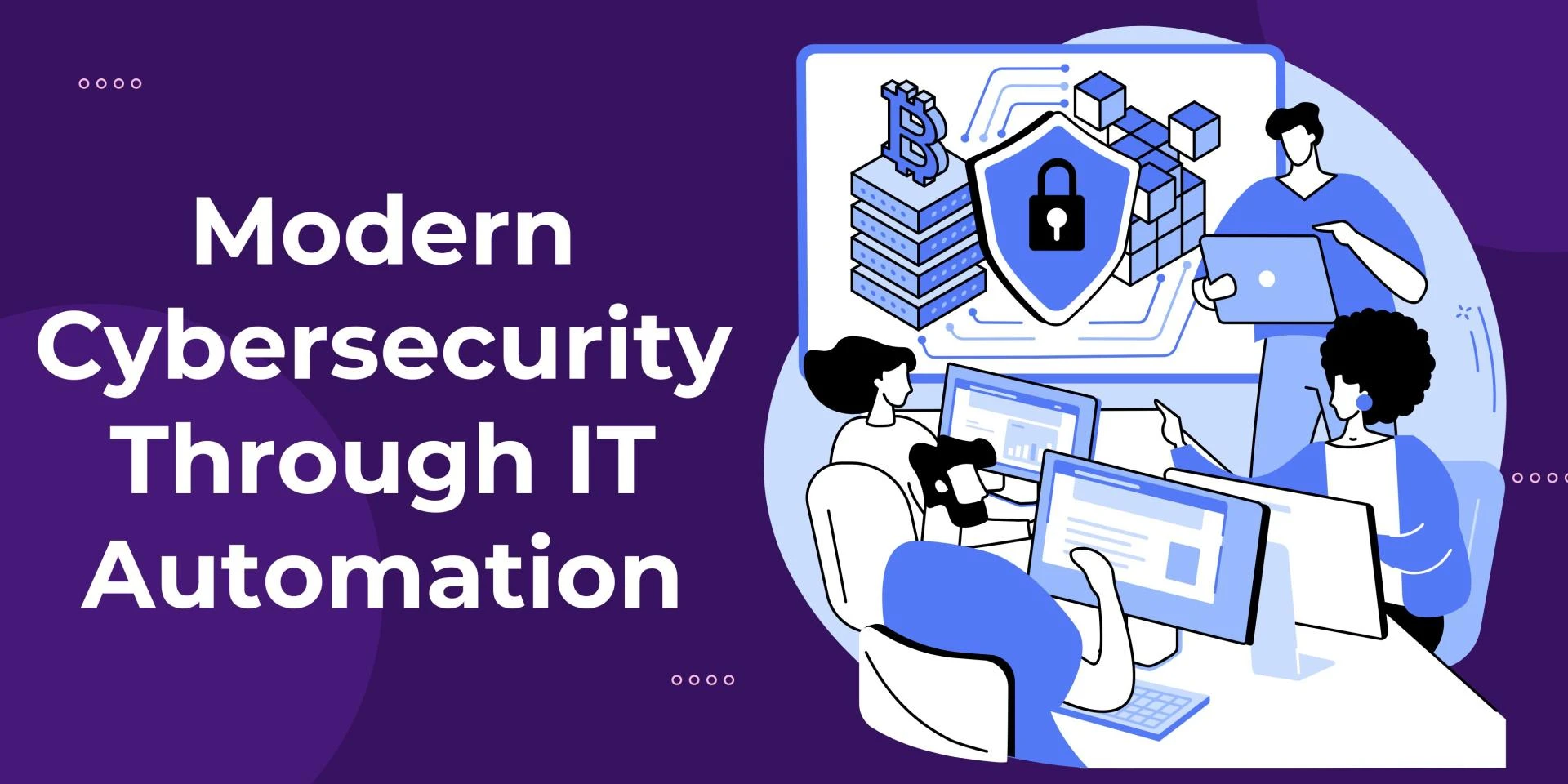

The cyber-field is now by all means an organization's strategic concern because with modern computerization, it has ceased to be solely an IT problem. Cyberattacks were increasing in number and simultaneous in their complexities, thereby making ad hoc solutions redundant. IT automation services, on the other hand, are rewriting the rules on how threats are detected, responded to, and managed within enterprises. By integrating RPA, AI, ML, and more, enterprises can architect adaptive smart security frameworks that put on speed and predict emergencies before they evolve into full-scale crises.
This article further discusses precisely how IT automation offers cybersecurity and end-to-end threat response, with the benefits, technologies, and ways of implementation that spearhead this transformation.
The Need for Automation in Cybersecurity
The modern-day industries generate enormous quantities of data coming from emails, endpoints, cloud infrastructure, IoT devices, etc. This makes it extremely hard for security teams to track possible vulnerabilities and threats. Instances of manual detection of human threats and subsequent responses take a great deal of time and sometimes lead to human errors.
The notion behind IT automation services is that they take a proactive, scalable, and consistent approach toward cybersecurity management, allowing businesses to:
- Detecting suspicious activity across various environments.
- Automate the detection and prioritization of threats.
- Handle initiation workflows for response in real time.
- Comply with standards and reduce operational risks.
Automating Threat Detection and Monitoring
In cybersecurity, one critical job of IT automation is real-time threat detection. Nowadays, traditional SIEM systems can hardly keep up with APTs. IT automation powers these security systems by integrating AI-powered RPA services that work to:
- Continuously scan logs, endpoints, and network traffic for suspicious behaviors.
- Use machine-learning models to detect zero-day attacks and vulnerabilities never seen before.
- Compare suspicious patterns with global threat intelligence databases.
For instance, when the system detects an unusual login attempt from a foreign IP, the automated system can immediately notify concerned officials, correlate suspicious behavior with other IoCs, and uplift for a manual review or perform an autonomous response.
Incident Response Speed-Up with Custom RPA Development
Being fast is necessary in any cybersecurity incident. The longer it delays, the more damage accrues and cost increases. IT automation via RPA custom developer permits speedier incident responses in the following ways:
- Isolating compromised systems automatically.
- Resetting credentials for compromised accounts.
- Generating compliance reports and sending them off.
- Executing custom scripts either to patch the systems or remove the malware.
Such automation playbooks trigger a predefined action straightaway at the time a threat is validated, drastically reducing the average time in which an incident is responded to (MTTR).
Decision-Making-Automated Security Operations
If RPA will carry-out mundane, rule-based, repetitive tasks, then AI-powered RPAs will bring in the chef of decision-making. These can learn from historical attack patterns and modify their detection and mitigation strategy technology accordingly. An example is:
- NLP can be used in analyzing phishing emails.
- Predictive analytics can classify high-risk users or systems on the basis of behavior
- AI algorithms can prioritize incidents based on severity and business impact.
In the end, when these technologies converge, they leverage automation to offer security models that move from reactive to predictive and adaptive against cybercriminals.
Intelligent Automation Services for Compliance and Auditing
The automation capability goes beyond incident response and cybersecurity, including compliance and audit management. Regulatory standards such as GDPR, HIPAA, and ISO 27001 require extensive documentation, monitoring, and reporting.
Automation simplifies the following tasks:
- Continually auditing system logs and access controls.
- Generating reports on policy violations or suspicious access.
- Alerting stakeholders to instances of non-compliance.
This considerably reduces the burden on IT and compliance teams, and it guarantees that security policies are implemented pursuant to the highest standards across all systems.

Key Benefits of IT Automation in Cybersecurity
- Consistency & Accuracy: Automation enforces security protocols consistently, with no chance of human error in the process.
- Faster Speed of Brake Action: Automated detection and response reduces time to respond drastically to neutralize a threat. .
- Scalability: Automation is scalable whether it is monitoring a small enterprise or a global business, without the addition of headcount.
- Cost Effectiveness: Having low amounts of manual intervention directly translates to the ownership cost of any cybersecurity operation being swallowed by almost half.
- 24/7 Security: With automation, there are no sleep breaks, and everything is being monitored against any potential attack day or night.
Implementing IT Automation for Cybersecurity
The following roadmap can guide IT automation implementation to strengthen cybersecurity:
1.Security Assessment: Understand the gaps in security that automation can fill.
2.Define Security Playbooks: Create automated workflows for threats and incidents common in the environment.
3.Deploy Automation Tools: Deploy RPA bots, AI modules, and monitoring systems tailored to your environment.
4.Train and Upskill Security Teams: Prepare human teams to work alongside automated systems.
5.Continuous Optimization: Work with feedback and analytics to further enhance automation workflows.
Conclusion
As cyber threats make a swifter entry into the area than ever before, it is simply unwise to depend solely on an army of manual defense mechanisms. Interweaving sophistication into cybersecurity through RPA custom development, AI-powered RPA, and intelligent automation, allows fortification of a dynamic series of operations for this purpose. Apart from bringing operational efficiency, these technologies equip an organization to work ahead of time, reacting to recently encountered threats and neutralising them with the fastest strike ever.
Having automation be an asset brings enterprises in the fold of stronger digital resilience, superior compliance adherence, and locking down against the next generation of cyberattacks.












Sign in to leave a comment.