
It is like showing computers examples to learn, rather than telling them exactly what to do. Suppose you show a computer a lot of photos of cats and dogs. Once it has seen a sufficient number of examples, the computer can tell the differences by itself. As a result, fitness apps can get smarter as time goes on.
Fitness apps rely on machine learning to study your body and how you use them. They use information from sensors such as your walking speed and heart rate. With more information, the app can offer you better suggestions. In this blog, we will discuss how machine learning helps fitness apps become both more accurate and more efficient.
What Does Machine Learning Mean?
Machine learning helps computers find patterns in the data they receive. Rather than being told what to do by a programmer, a machine learning model examines examples and decides what action to take. If you feed the model information on walking and running, it can identify which activity is being performed.
Most of the time, the process is made up of two main steps. At the beginning, the model is fed with a lot of data to help it learn the patterns. Second, the model is checked to ensure it learned the right thing. If the model makes errors, it is trained again until it improves. Therefore, the model is more dependable when it encounters fresh data.
Why Should Fitness Apps Use Machine Learning?
Fitness apps must handle people who all have different habits and body types. Machine learning allows the app to notice your personal habits such as how fast you run and when your heart rate increases. As a result, the app can suggest advice that matches your needs instead of using the same advice for everyone.
If developers did not use machine learning, they would have to write a lot of if-then statements which can be both slow and inaccurate. Machine learning models remove errors from the data, get better with each new user and continue to improve as more information is added. Because of this, everyone has a better and more intelligent experience.
Also Read: AI in Personalized Nutrition and Diet Plans
How Machine Learning Helps to Increase Accuracy
One way machine learning helps is by accurately counting steps. Some simple step counters can confuse a phone shake with a step. A machine learning model learns to disregard false signals by studying how data moves. So, your step count will probably be closer to the real number of steps you take.
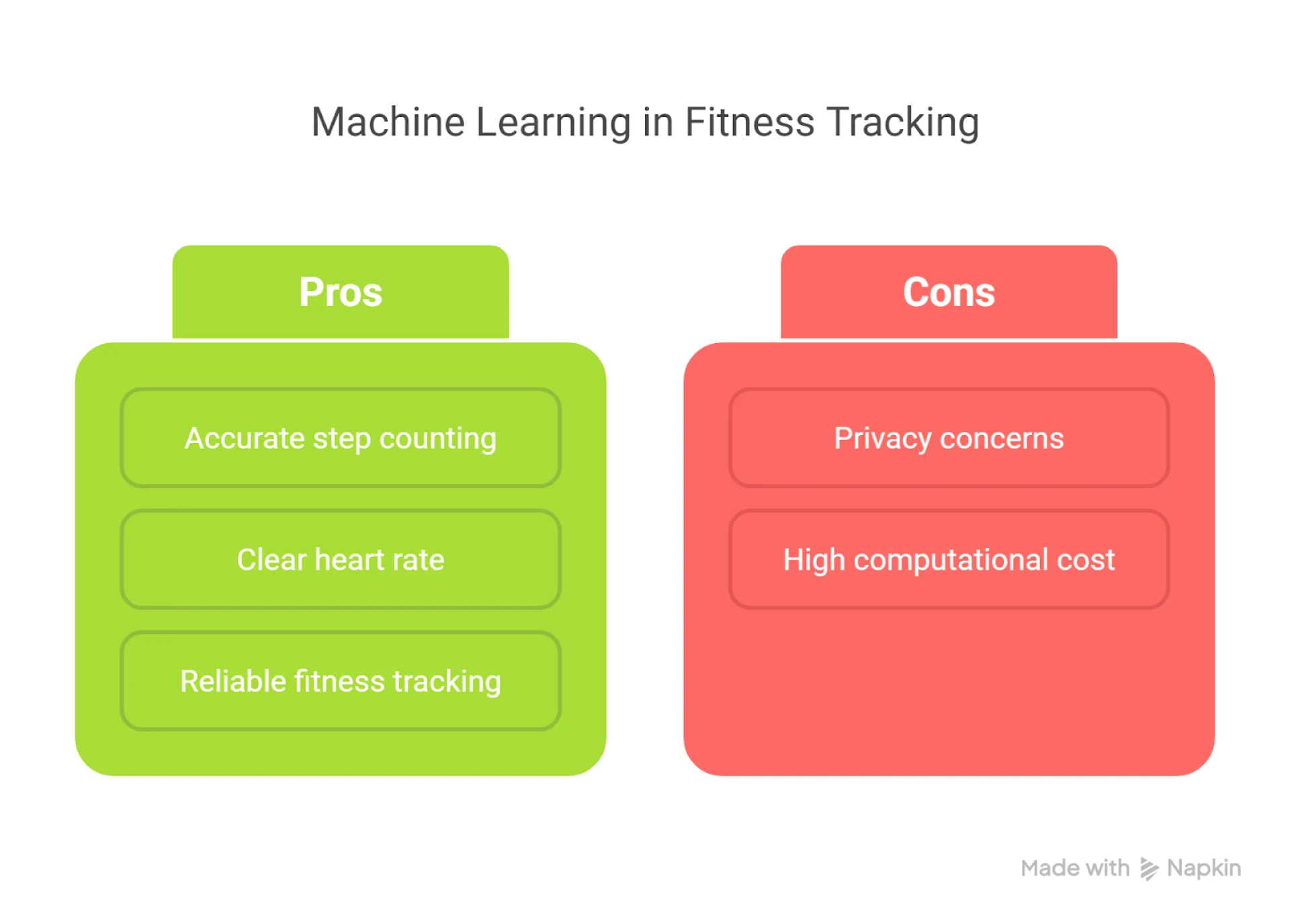
Machine learning is useful for reading heart rate. Noise from movement or sweat is often detected by wrist sensors. The model can remove the noise, so you get a clearer view of your heart rate while exercising. As a result, your fitness tracking becomes more reliable.
How Machine Learning Increases Productivity
Machine learning models can handle processing large amounts of data on your phone. So, you can see your progress right away such as your running speed and the number of calories you’ve burned. You don’t have to wait for a long time for your calculations to complete on the cloud.
Good models are able to be accurate without draining the battery too much. They choose when to enable or disable sensors, so your phone uses less battery. They also decide which jobs will be done on your device and which will be handled by the cloud. This is why the app still runs quickly on older phones.
Challenges and Solutions
There are some difficulties when it comes to machine learning in fitness apps. A major problem is the quality of the data. If the data from the sensors is incorrect or noisy, the model may learn the wrong things. If there is a lot of noise in the heart rate sensor, the app could believe your heart is beating faster than the actual rate. As a result, users may receive incorrect advice or become worried.
Privacy is also a major issue. Users trust the app with their fitness data which is private. As a result, many apps rely on techniques such as federated learning. Federated learning allows the model to be trained locally on your device, not by sending your data to the cloud. As a result, the app can learn from many people while still protecting their privacy.
Future Trends in Machine Learning for Fitness Apps
In the coming years, fitness apps will rely on more advanced machine learning. Predictive analytics will help your apps understand your needs in advance. If the model notices you are close to a training slump, it can advise you to take it easy or have a day off. It keeps you motivated and safe.
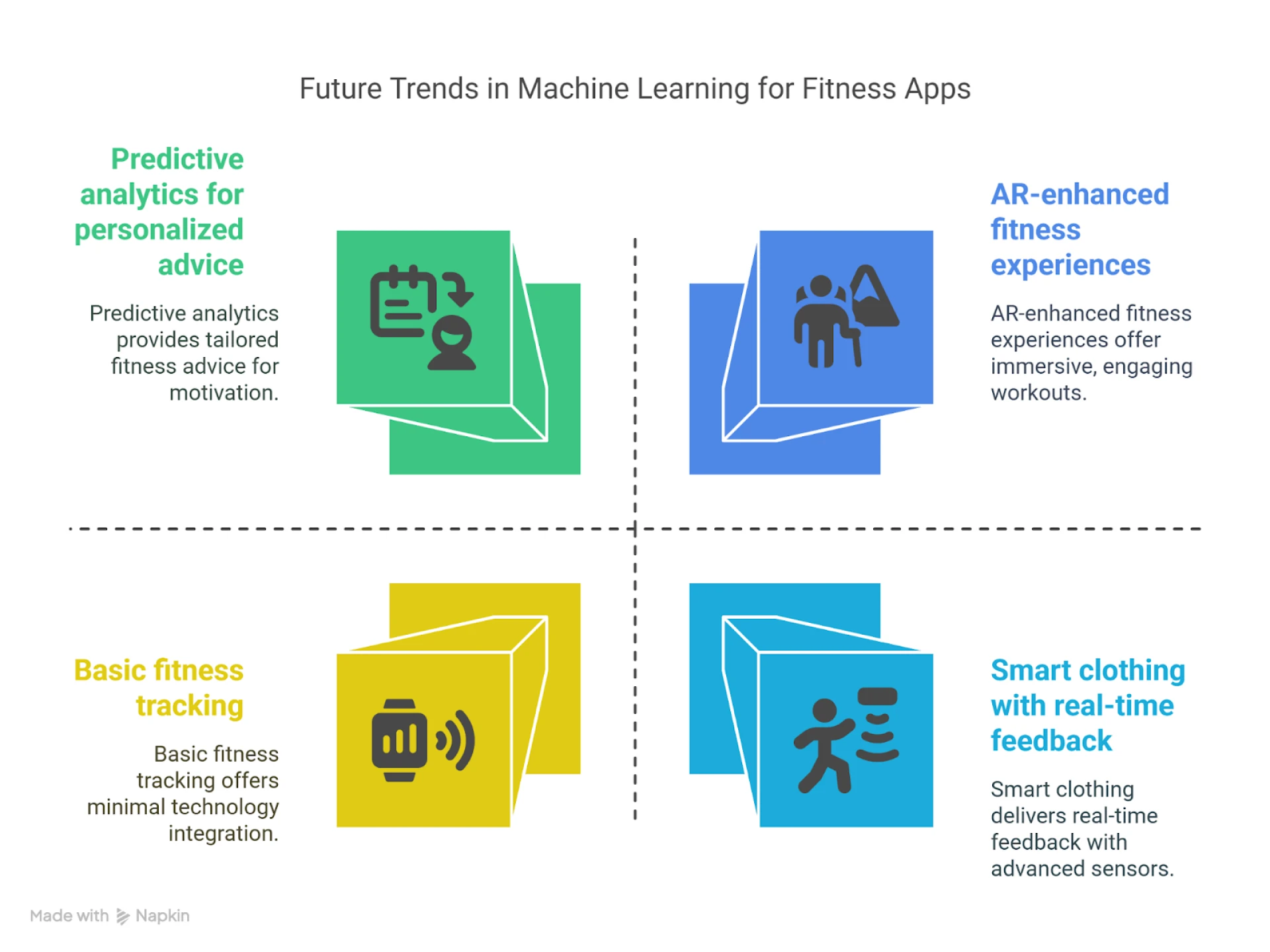
There is also a trend toward combining augmented reality (AR) and new wearable devices. You can use AR glasses or smart clothing with machine learning to receive real-time advice on your movements. Imagine you’re hiking on a trail and getting live advice on your AR screen. When sensors get better, machine learning will make tracking fitness feel more comfortable and useful.
Read More: Top AI Trends in 2025
Real-Life Examples
Some apps in the fitness world use machine learning to design workouts that are tailored to you. The app looks at your previous workouts, your targets and how tough each session was. With time, it will recommend exercises that make you stronger without wearing you out.
Machine learning is able to detect early signs that someone might be injured. If your running style starts to change or your steps become uneven, it will let you know to slow down or take a break. The model can tell when something is unusual by studying data from many people.
How to Find the Right Development Partner
Selecting the right people is essential when you want to make a smart fitness app. Find a company in India that is skilled in fitness and machine learning projects. Look at their portfolio and read what past clients have said about them.
Also, make sure the AI app development company in India has data science experts on its team. Find out what machine learning tools and models are being used. Ensure the company will help you with updates and new features after your app is launched. Your app will always improve as new technologies are introduced.
Conclusion
Machine learning helps fitness apps become more accurate by studying real information. It allows you to accurately count your steps and provides clearer heart rate information. It also makes things more efficient by working fast and saving battery power.
With real examples, we understand how machine learning can advise on workouts that are good for you and help prevent injuries. If you want to create a fitness app, team up with people who understand fitness and AI. As a result, your app will be smart, dependable and prepared for future challenges.













Sign in to leave a comment.