Imagine launching an app with just one core feature—photo filters. No stories, no reels, no marketplace. Just filters. That’s exactly what Instagram did in 2010. Kevin Systrom and Mike Krieger started with a Minimum Viable Product (MVP) called Burbn, a check-in app with photo-sharing capabilities. Realizing users loved only the photo feature, they stripped everything else and relaunched as Instagram. In just two months, they hit 1 million users, and today, Instagram boasts over 2.4 billion monthly active users.
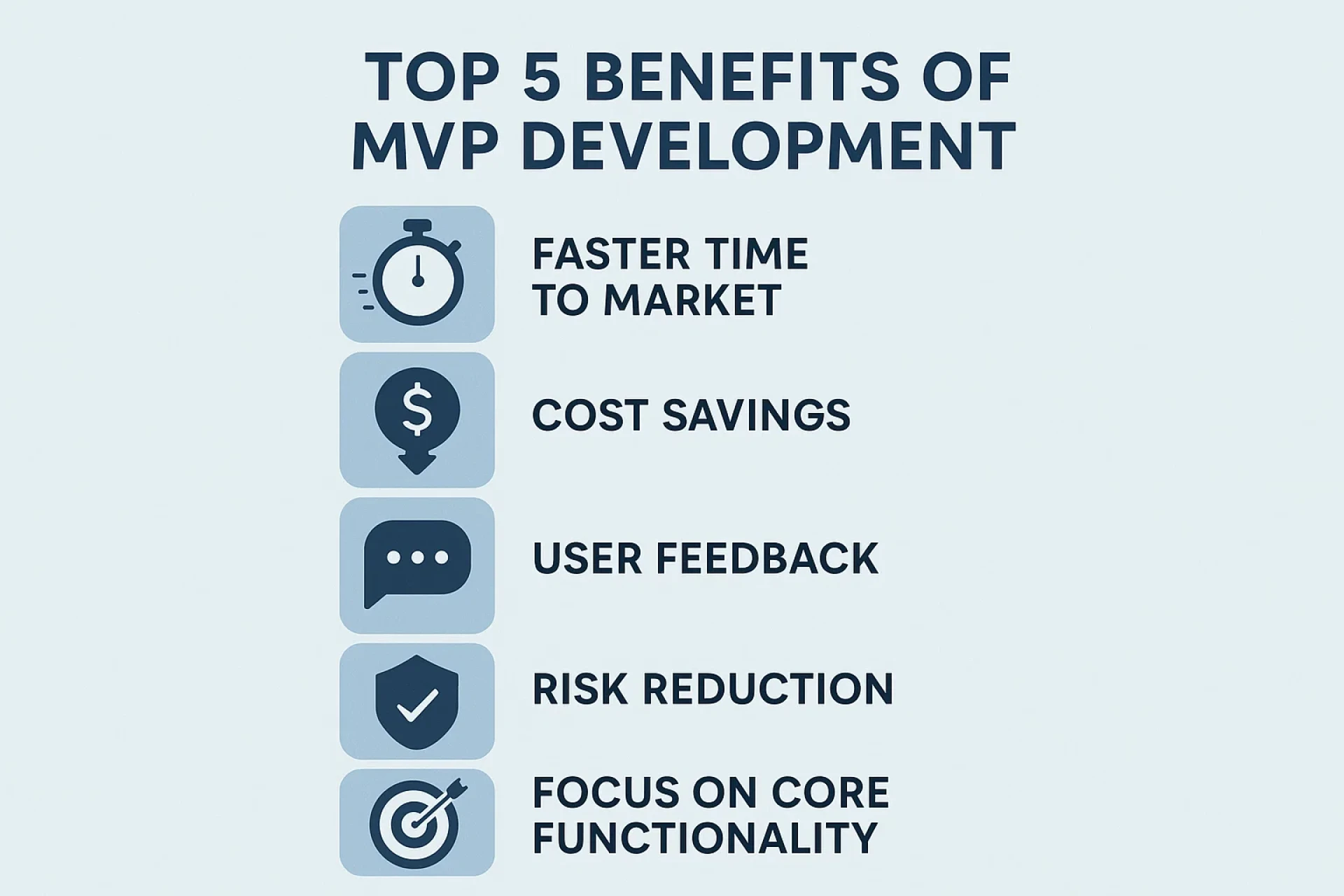
This is the power of MVP development—validating your idea with minimal resources before scaling. Whether you're a startup or an enterprise, an MVP helps you test, iterate, and succeed without burning cash. Let’s explore the top benefits of MVP development, backed by stats and real-world insights.
1. Faster Time-to-Market
In today’s competitive landscape, speed is everything. A full-fledged product can take 12-18 months to develop, but an MVP can be launched in 3-6 months. According to CB Insights, 42% of startups fail because there’s no market need. An MVP helps you launch quickly, gather user feedback, and pivot if needed.
Example: Dropbox started with a simple explainer video (their MVP) to validate demand. The video went viral, and sign-ups jumped from 5,000 to 75,000 overnight—proving demand before writing a single line of code.
2. Cost-Effective Validation
Building a full-scale product without validation is like constructing a house on sand. Startups spend an average of $30,000-$50,000 on an MVP, compared to $500,000+ for a full product.
Why?
- You avoid unnecessary features.
- You invest only in what users truly want.
- Reduces the risk of product-market misfit.
Example: Airbnb’s MVP was a simple website offering air mattresses in a rented apartment. Today, it’s a $75 billion company.
3. Attracts Investors with Proof of Concept
Investors don’t fund ideas—they fund validated concepts. An MVP with real user traction is far more convincing than a pitch deck.
Stats:
- Startups with an MVP are 60% more likely to secure funding.
- 78% of investors prioritize traction over ideas.
Example: Uber’s MVP was a basic app connecting riders with drivers in San Francisco. Once they proved demand, they scaled globally.
4. Reduces Failure Risk Through Real User Feedback
An MVP isn’t just a product—it’s a feedback loop. You launch, learn, and improve.
Key Benefits:
- Identifies flaws before full-scale development.
- Helps prioritize features based on real user behavior.
- Increases chances of long-term success.
Stat: Companies that iterate based on MVP feedback see a 34% higher success rate.
5. Scalability with Confidence
An MVP ensures you scale smartly. Instead of guessing, you have data to guide expansion.
Example: Spotify launched as an invite-only MVP in Sweden. After refining its model, it expanded globally—now with 574 million users.
Conclusion: MVP – The Smart Way to Build & Scale
From Instagram to Airbnb, MVPs have shaped the world’s most successful products. They help you:
Launch faster
Save costs
Secure funding
Reduce risk
Scale confidently
If you’re planning a product, start small, validate, and grow big. As Reid Hoffman (LinkedIn co-founder) says, “If you’re not embarrassed by the first version of your product, you’ve launched too late.”







Sign in to leave a comment.