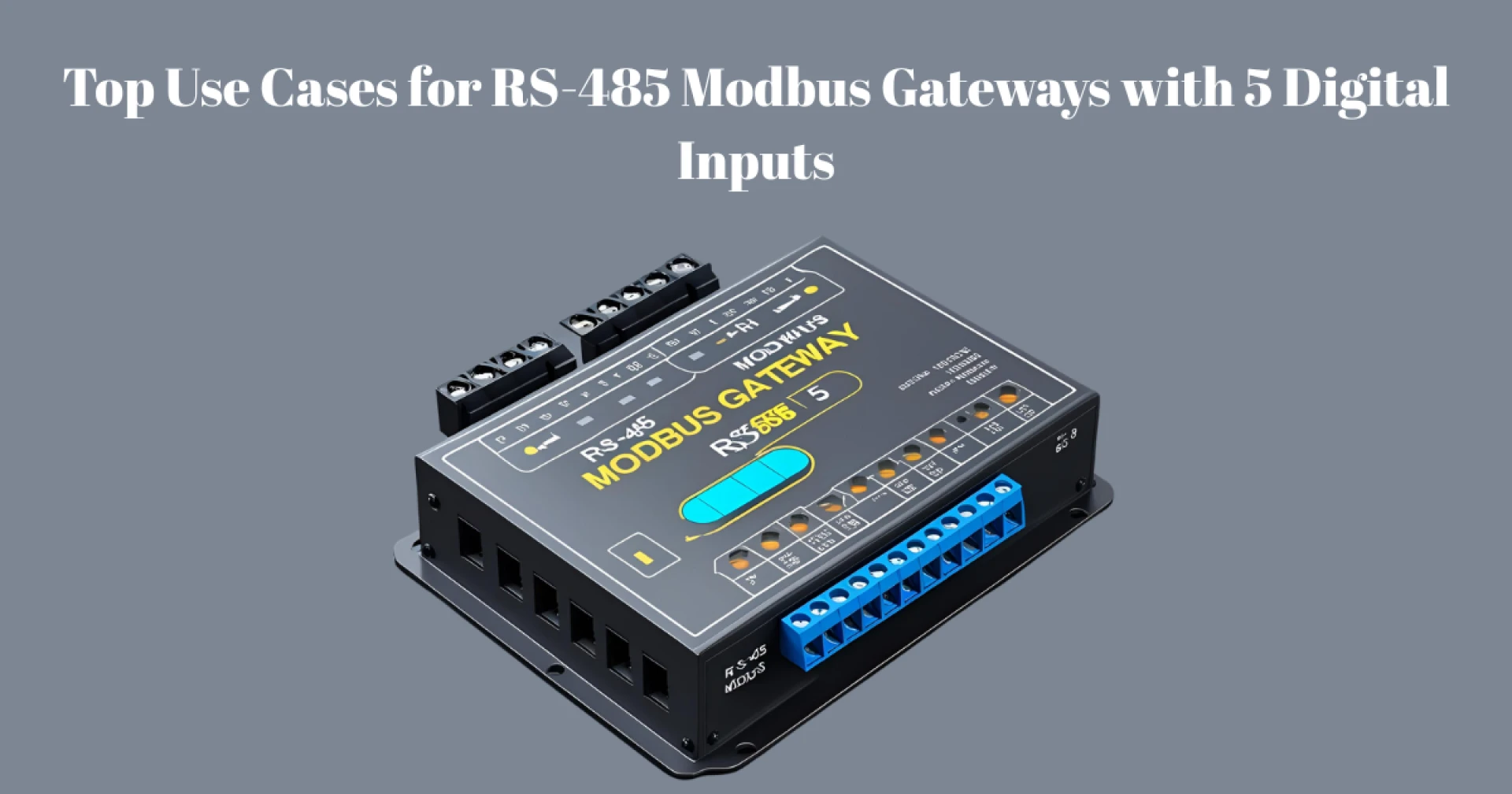

In modern industrial environments where automation, monitoring, and control are key priorities, communication between field-level devices and control systems becomes indispensable. The RS-485 Modbus Gateway with 5 Digital Inputs offers an efficient solution to bridge the gap between binary sensors and higher-level monitoring systems like SCADA, PLCs, or cloud-based dashboards.
Built for rugged and real-time environments, these gateways allow five distinct digital input sources to be monitored, managed, and transmitted over a Modbus RTU protocol using RS-485 serial communication—a widely adopted standard in the automation industry.
This article explores the most common and high-impact use cases for RS-485 Modbus Gateways equipped with 5 digital inputs, helping decision-makers understand their application, advantages, and role in improving operational intelligence.
Understanding the RS-485 Modbus Gateway with 5 Digital Inputs
What It Is
An RS-485 Modbus Gateway is a data communication device that facilitates seamless communication between Modbus slave devices and master systems via RS-485 serial links. When such a gateway includes 5 digital input (DI) channels, it can monitor up to five binary signals from equipment such as sensors, switches, alarms, and other digital status devices.
Core Features
- 5 Independent Digital Input Channels (opto-isolated or non-isolated)
- Support for Modbus RTU over RS-485
- DIN rail mounting compatibility
- LED indicators for each digital input
- Wide temperature range and industrial housing
- Watchdog timers and communication failure protection
Why It Matters
Digital inputs enable real-time detection of events or states—open or closed switches, alarm conditions, movement detection, etc.—that can be instantly communicated to central systems. This is critical for automation, real-time monitoring, and predictive maintenance across industries.
Top Use Cases for RS-485 Modbus Gateways with 5 Digital Inputs
1. Factory Floor Equipment Monitoring
In industrial manufacturing setups, equipment uptime and process integrity are critical. Monitoring the status of essential machinery components via digital inputs helps prevent unplanned downtimes and supports predictive maintenance.
Common Inputs Monitored:
- Motor ON/OFF signal
- Safety door open/closed
- Emergency stop switch
- Conveyor belt sensors
- Overheat/fault indicators
Use Case Example: A production line uses RS-485 Modbus gateways to monitor conveyor belt switches and motor start/stop status. If a belt stops unexpectedly, an alert is instantly sent to the SCADA dashboard for operator intervention.
Benefits:
- Reduced manual inspections
- Centralized visibility into operations
- Early detection of anomalies
2. Remote Pump and Motor Control in Water Utilities
Water pumping stations often operate in geographically dispersed or remote areas. Monitoring essential pump states using RS-485 Modbus Gateways allows operators to track system conditions from a central location without physical access.
Common Inputs Monitored:
- Pump running/stopped
- Float switch (water level)
- Flow switch
- Overload relay
- Manual override switch
Use Case Example: An agricultural irrigation system employs a Modbus gateway to track pump states and water level sensors. When water drops below a set level, the gateway signals a central SCADA system, which then triggers a backup pump.
Benefits:
- Remote visibility
- Automatic control logic integration
- Lower operating costs via reduced field visits
3. Building Management and Automation Systems
In smart buildings, energy efficiency and security are major concerns. RS-485 Modbus Gateways with digital inputs are used to monitor events in HVAC systems, lighting, access control, and fire systems.
Common Inputs Monitored:
- HVAC relay status
- Window/door magnetic contacts
- PIR motion sensors
- Emergency switches
- Fire/smoke alarm triggers
Use Case Example: A commercial building integrates Modbus gateways into its building management system (BMS) to monitor motion detectors. Based on input signals, lighting and HVAC units are automatically turned off in unoccupied areas.
Benefits:
- Enhanced energy savings
- Occupancy-based automation
- Improved response to safety events
4. Renewable Energy and Solar Power Monitoring
Large-scale solar power plants rely on various equipment like inverters, combiner boxes, and weather sensors. Gateways can capture digital signals from these devices and relay critical fault or status information.
Common Inputs Monitored:
- Inverter fault signals
- Panel cleaning system triggers
- Disconnect breaker status
- Overvoltage trip signals
- Lightning protection equipment alerts
Use Case Example: In a solar farm, a Modbus gateway tracks the digital output from surge protectors and circuit breakers. Any trip event gets recorded and forwarded to the monitoring platform for immediate action.
Benefits:
- Faster fault isolation
- Continuous equipment protection
- Reduced losses due to system downtime
5. Elevator and Escalator Monitoring in Smart Buildings
Elevators and escalators require real-time monitoring for safety, maintenance, and operational efficiency. Digital inputs can provide key information about fault conditions, door status, and emergency actions.
Common Inputs Monitored:
- Door open/close sensors
- Overload detection
- Emergency stop buttons
- Fireman service switches
- Intercom activation
Use Case Example: A facility manager installs Modbus gateways with 5 digital inputs to monitor elevator conditions. When an emergency stop is activated or overload occurs, the system logs the event and notifies technical support.
Benefits:
- Real-time alerts for quick response
- Reduced risk for occupants
- Predictive and preventive maintenance
6. Cold Storage & Warehouse Safety Monitoring
Digital inputs play a critical role in monitoring safety and environmental factors in temperature-sensitive environments like food storage or pharmaceuticals.
Common Inputs Monitored:
- Door open/close
- Compressor fault status
- Freezer unit alarms
- Fire alarms
- Emergency lights
Use Case Example: A pharmaceutical cold storage facility uses a Modbus gateway to monitor freezer alarm outputs. If the freezer temperature rises or a door remains open too long, alerts are instantly dispatched.
Benefits:
- Protection of high-value inventory
- Compliance with safety and quality standards
- Reduced loss due to environmental failure
7. Historical Logging and Event Timestamping
Modbus gateways with digital inputs can also support logging or timestamping digital events. These events can be stored locally or pushed to a data historian for compliance and traceability.
Common Logged Events:
- Equipment fault activations
- Manual override triggers
- Access control events
- Emergency drills or tests
- Maintenance schedule initiations
Use Case Example: In an industrial plant, digital inputs from maintenance switches and reset buttons are logged and stored via the gateway. These logs are used for audit trails and process optimization.
Benefits:
- Complete visibility into event timelines
- Historical trend analysis
- Root cause identification
Integration Example: Gateway in a SCADA System
Scenario: A smart manufacturing facility needs to monitor five machine parameters (e.g., motor running status, overload trip, emergency stop, sensor failure, and panel door open).
Integration Steps:
- Connect 5 digital signal wires to the DI terminals.
- Configure Modbus address and baud rate on the gateway.
- Use SCADA software to poll data using Modbus RTU function code 02.
- Set logic alarms and trigger notifications.
- Log data for compliance and maintenance analysis.
Conclusion
The RS-485 Modbus Gateway with 5 Digital Inputs is a compact yet powerful device that can drastically improve visibility, safety, and efficiency across a wide range of industrial and commercial applications. By enabling seamless communication between digital sensors and centralized control systems, these gateways empower automation systems with real-time binary signal intelligence.
From factory floors and building management systems to solar farms and remote pump monitoring, these gateways form a vital part of smart infrastructure, enabling scalable, reliable, and intelligent control systems.
FAQs
Q1. What’s the primary use of digital inputs in RS-485 Modbus Gateways?
Digital inputs allow monitoring of binary states (e.g., ON/OFF, open/closed), which is essential for real-time status updates, alarms, and control signals in automation systems.
Q2. Can the gateway connect to both wet and dry contacts?
Yes, depending on the model. Some gateways support dry contacts (mechanical switches), while others are designed for wet contacts (voltage-based signals).
Q3. Are these gateways suitable for hazardous environments?
Many industrial-grade RS-485 Modbus gateways come with certifications and IP ratings that make them suitable for hazardous or outdoor environments.
Q4. How are digital inputs polled via Modbus?
Using Modbus RTU Function Code 02, a master device can read discrete inputs from the gateway based on its assigned Modbus address.
Q5. Can I expand beyond 5 inputs?
Some manufacturers offer daisy-chaining options or expansion modules to increase the number of digital input channels if required.










Sign in to leave a comment.