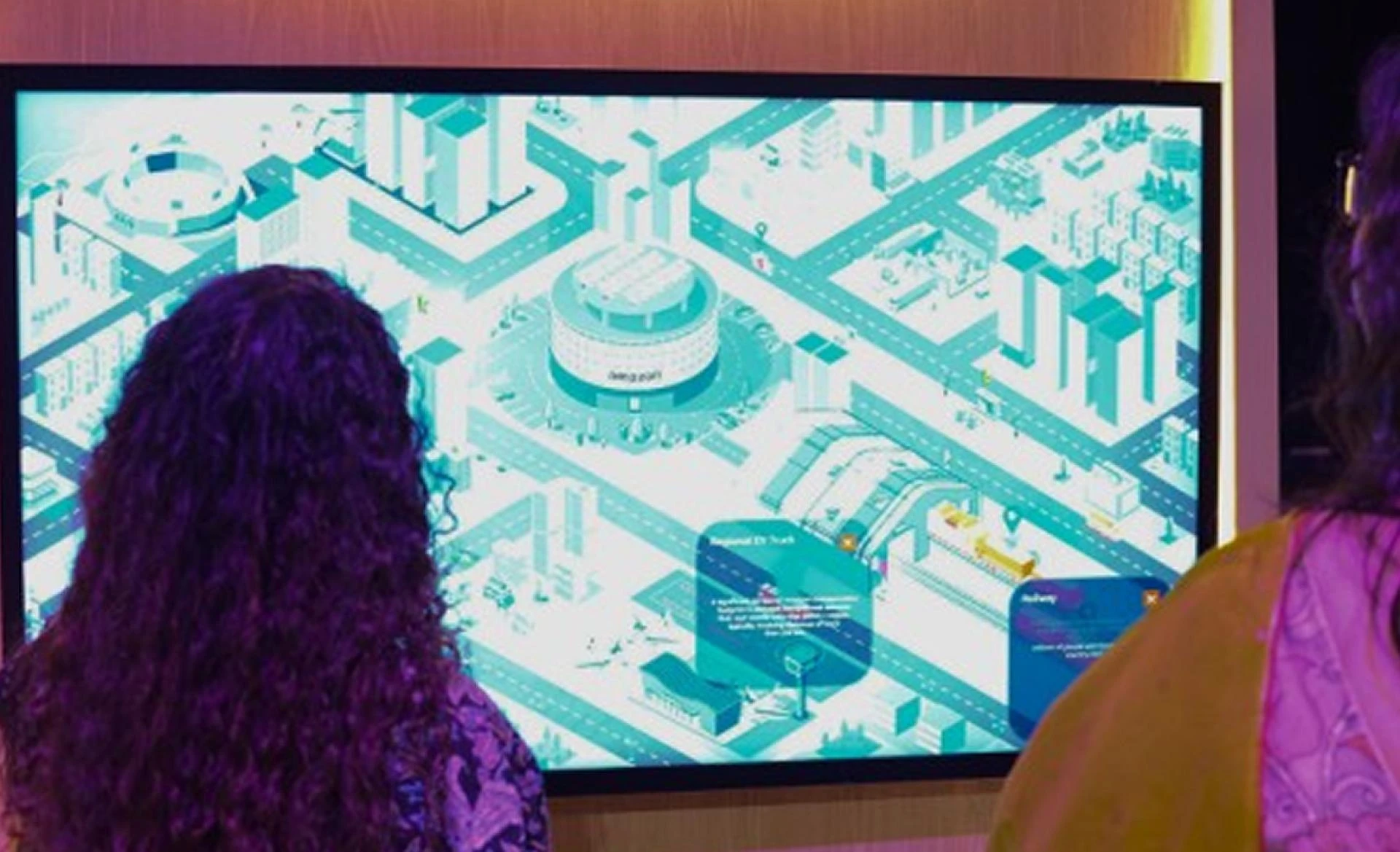

Amazon needed an experience for their Sambhav 2025 event. Something that explained their shipping logistics—freight, cargo, last-mile delivery—without putting people to sleep.
The timeline? Fourteen days from brief to live event.
Most agencies would quote six weeks minimum. IIC Lab said yes.
The Brief That Made Everyone Nervous
Amazon's shipping services operate across three layers: air freight, ground cargo transit, and final delivery. Complex logistics that most people don't think about until a package arrives late.
The challenge: make this supply chain interesting. Not just informative—actually fun. And collect lead information while doing it. Oh, and reward participants with tiered gifts based on performance.
Two weeks. Go.
Why Interactive Gaming Works (When PowerPoints Don't)
Here's a truth about customer experience centers: people will tolerate being sold to, but they'd rather be entertained.
Amazon could have built an explainer booth. Video screens showing warehouse operations, infographics about delivery networks, staff explaining logistics. Informative? Sure. Memorable? Doubtful.
Gaming changes the equation. Suddenly, you're not a passive observer—you're navigating a parcel through the sky, catching cargo in a truck, solving a delivery maze. You're experiencing the system, not just learning about it.
The sticking point: games are notoriously hard to build quickly. Three distinct gameplay mechanics that need to feel cohesive, work reliably with hardware, and complete the entire loop from check-in to prize fulfillment.
IIC Lab built it anyway.
Layer 1: Flight - The Hook That Grabbed Attention
The first level dropped players into a pilot's seat. Your mission: guide a parcel through the air, collecting power-ups, dodging hazards.
Simple concept, but the execution mattered. Controls had to be instantly intuitive. Visual feedback needed to be clear. Difficulty balanced so players felt challenged but not frustrated.
The psychology: Start with fast, accessible action. Get people invested immediately. If Level 1 feels good, they'll stick around for the full experience.
Average play time for Level 1: under a minute. But long enough to pull players into the narrative.
Layer 2: Transit - Where Skill Met Accessibility
Level 2 switched gears. Now you're driving a cargo truck, moving forward automatically. Parcels fall from above. Your job: position the truck to catch them.
Classic arcade logic. Easy to understand, hard to master. Each collected parcel added points. Miss too many, and you'd feel it in your final score.
The balance: Players with zero gaming experience could complete it. Players with quick reflexes could excel. That range mattered for an all-ages event audience.
The truck kept moving, creating natural time pressure without artificial countdowns. Momentum as a mechanic.
Layer 3: Maze - The Finale That Completed the Story
The final level brought it home—literally. Navigate a delivery partner through a neighborhood maze to reach the customer's house.
This level required more strategy than reflexes. Wrong turns added time. Smart planning got you there faster. It felt different from Levels 1 and 2, which was intentional. The full experience needed variety.
Together, the three layers told Amazon's logistics story without words: air freight gets it close, cargo transit moves it regionally, last-mile delivery brings it to your door.
The Hardware Challenge That Almost Derailed Everything
Here's where theory hit reality. The team sourced a joystick controller for physical interaction. Feels great in concept. Becomes a nightmare when calibration goes wrong.
Too sensitive? Players overshoot constantly and get frustrated. Not sensitive enough? Controls feel sluggish and unresponsive.
IIC Lab ran calibration routines across multiple devices, testing with different users. Adjust, test, adjust again. The input mapping had to work consistently whether you'd never held a joystick or grew up on game consoles.
They got it right—but it ate precious development hours.
The Scanning Problem That Emerged On-Site
Check-in worked via QR codes on event ID badges. Scan, start playing. Elegant in theory.
Then venue lighting created a problem. Certain angles made scanning unreliable. Players stood there waving badges while nothing happened. Frustration built fast.
The fix: Redundant scanning angles, on-screen prompts showing correct positioning, and a manual ID entry fallback. Problem solved, but it required real-time adaptation during the event itself.
This is why interactive experience centers need contingency plans. Perfect lab conditions never survive contact with real venues.
Why 200 Players Felt Like a Victory
In two weeks, IIC Lab delivered:
- Three distinct gameplay mechanics unified in one experience
- Hardware integration and calibration
- QR check-in with backend API connection
- Prize fulfillment system tied to performance
- Stable multi-station deployment handling parallel play sessions
The engagement numbers: 200-250 participants completed the full three-layer experience. Drop-off was minimal—only 4-5 people quit mid-game.
More importantly? The qualitative feedback. Older visitors described feeling like kids again. That's not something you get from a PowerPoint presentation.
The Secret Weapon: Modular Design Under Pressure
How did IIC Lab build three games in fourteen days? They didn't build three games. They built one engine with three modular scenes.
Unity handled the heavy lifting. Persistent player session data carried between levels—your score, your ID, your progress—without breaking. State management kept everything connected.
Testing happened in rapid cycles. Build a level, playtest with 3-4 people immediately, tune difficulty based on feedback, iterate. No time for perfectionism—just disciplined execution.
The API integration with Amazon's backend handled the unglamorous but critical parts: address generation, prize queue management, delivery fulfillment. Players never saw this machinery, but it was essential for the complete loop.
What Fast Doesn't Mean (And What It Does)
Let's be clear: fast doesn't mean sloppy.
Fast means ruthless prioritization. Focus on what matters—solid gameplay, reliable hardware, smooth check-in. Skip what doesn't—unnecessary animations, feature bloat, over-engineered solutions.
Fast means parallel execution. Design and development can't wait for each other. Hardware sourcing happens while UI is being finalized. Testing starts before everything's complete.
Fast means trusting your team to solve problems without over-communicating. When you have fourteen days, every hour counts.
Why This Matters for Your Next Event
If you're planning any kind of experiential activation—conference booth, product launch, brand event—the Amazon case demonstrates something crucial:
Tight timelines don't preclude quality. They demand different thinking. Simpler mechanics executed flawlessly beat complex concepts executed poorly.
Hardware interaction creates memory. Touchscreens are fine. But physical controllers—joysticks, buttons, tangible interfaces—create a different kind of engagement. People remember holding something.
Gamification works when it respects your message. Amazon didn't need a racing game. They needed something that mirrored their operations. The gameplay reflected the service.
The Real Measure
Amazon got lead collection. They got brand engagement. They got people sharing the experience with friends (many played multiple times using borrowed QR codes).
But here's what mattered most: they got an activation that people actually wanted to participate in at a crowded event filled with competitors fighting for attention.
That's the bar for interactive experience centers. Not just "Can we build something impressive?" but "Will people choose to engage with this when they have a hundred other options?"
Facing an impossible deadline for an event or experience center? The team at IIC Lab in Mumbai specializes in fast-turn experiential projects that don't sacrifice quality. From concept to on-site deployment, they've proven they can deliver under pressure—and make it look easy.
Talk to the fast-turn experience specialists










Sign in to leave a comment.