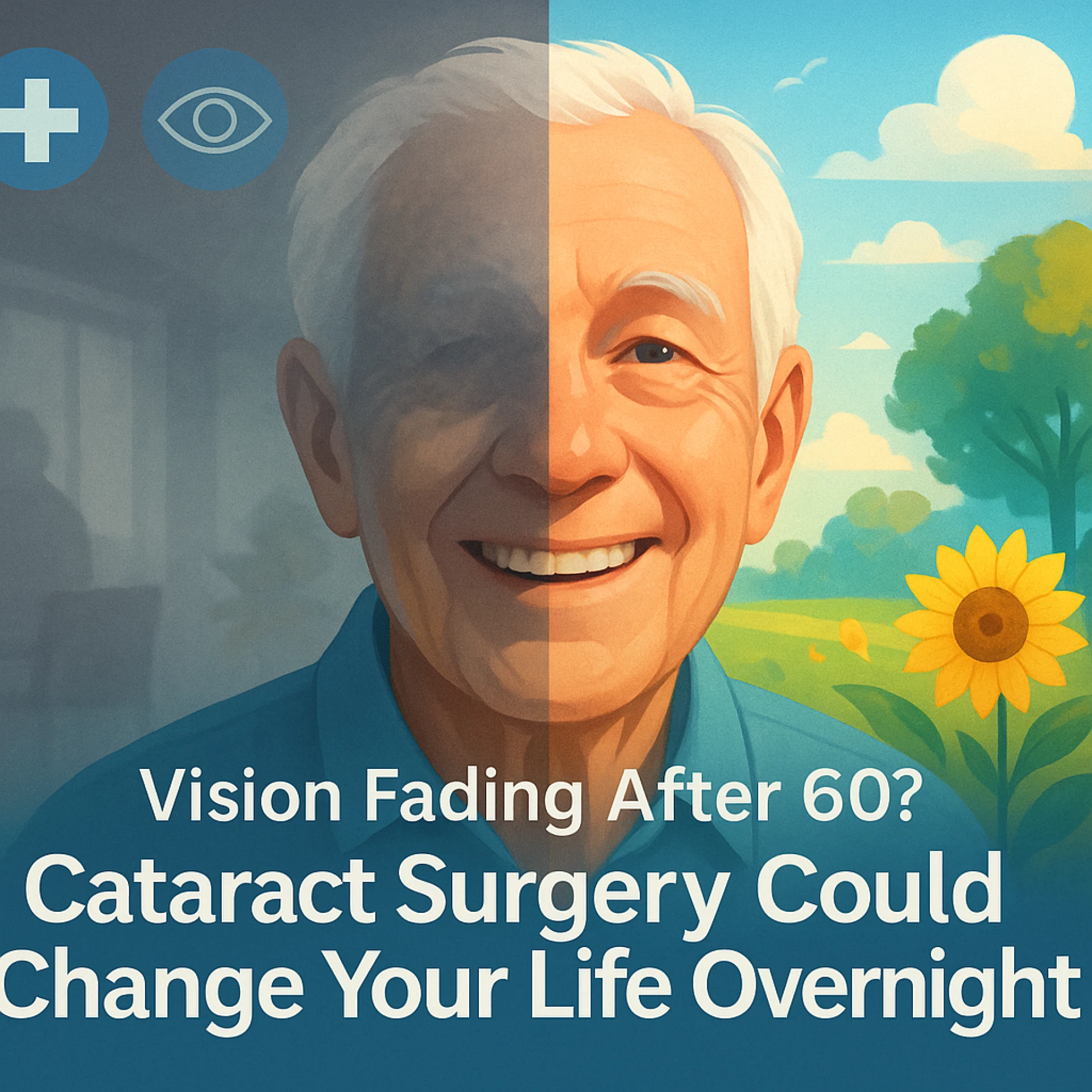

By the time you hit 60, your eyes might not be sending you flowers- but they could be sending you signals. Blurry road signs, halos around headlights, a stubborn haze like someone just dimmed the brightness settings, like the world switched filters. If all of these sound familiar, it sounds like the time for a check-in with your eyes.
You start to squint your eyes, turn up the light, blame the weather, or the specs, or sometimes… your age. But what if we told you that you are not stuck with it?
What you are experiencing might be cataracts, and you can hit the reset button. Cataract eye surgery is safer, quicker and more effective than ever before.
Let’s clear the air (and your vision).
When Life Starts Looking Foggier
A cataract forms due to the clouding of the eye's natural lens. It sits behind the iris and pupil. This clouding blocks or changes the passage of light into the eye, causing blurred vision, glare, and difficulty seeing clearly.
Cataracts never start suddenly. They start slowly and progress. You don’t wake up blind one fine day. You slowly stop noticing things the way you used to, night driving gets tougher, and reading becomes a chore.
The Problem With Waiting
Cataracts won’t go on their own. And here is the problem with waiting. As you wait, they worsen, gradually. And it can even lead to permanent vision loss.
Delaying cataract surgery can result in cataracts that severely impair vision but also increase surgical complexity and the risk of complications to the eye. Additionally, visual impairment in older adults is strongly linked with falls, reduced mobility, and cognitive decline.
Cataract doesn’t affect just your vision. There is more to it. They impact your daily life and, even worse, make it unsafe. Cataracts can turn routine tasks into a challenge. It can also take a toll on your emotions slowly by kicking in frustration, isolation and the quiet erosion of independence.
Here’s What You Need to Know
But what if we told you, you could get your vision back in just 30 minutes?
Sounds unreal? Modern cataract eye surgery is a procedure that requires no hospital stay or massive stitches. You will get your vision back without having a scary story to tell.
The cloudy lens inside your eye is removed, and a clear artificial lens is placed. This lens is called the intraocular lens.
Advances in biometry, optical coherence tomography (OCT), and IOL customisation further allow for holistic, tailored treatment.
What Happens During The Procedure?
Take a deep breath. A cataract eye surgery is not as dramatic as you think it is.
Here is what happens during the surgery.
Modern cataract surgery is typically performed using phacoemulsification, where ultrasonic vibrations emulsify the cloudy lens, which is then replaced with a foldable intraocular lens (IOL). The procedure is conducted under local anaesthesia and requires only a small corneal incision, eliminating the need for stitches and ensuring faster recovery. The cloudy eye lens is removed, and it is replaced with a clear lens. Visual rehabilitation is often rapid, with noticeable improvement within 24–48 hours.
Done under anaesthesia (yes, you will be awake, but you’ll only feel a slight pressure and discomfort), it takes only 15-30 minutes for the entire procedure in each eye.
Am I Eligible For The Surgery?
If you read this far and want to do the surgery, go through the eligibility criteria to see if you check the boxes.
- Over 60 years of age (unless otherwise stated)
- Blurry vision
- Trouble seeing at night
- Sensitivity to light
- Severity of vision impairment
- impact on quality of life
This means that it is time to get your eyes checked. And even if you don’t want the surgery now, you can get a detailed consultation at a trusted eye hospital to give you the clarity to make an informed decision.
The Role of Femtocataract Surgery
For those looking for an even precise cataract eye surgery, here it is: the femtocataract surgery. This is also known as the femtosecond laser-assisted cataract surgery, and this takes the surgery a step ahead. With the assistance of a computer-guided femtosecond laser, this treatment achieves micron-level precision.
This laser can also be used to soften the cloudy lens before removal, speeding up the recovery process. This high precision optimises visual outcomes and is beneficial for those with complex eye conditions.
Takeaway
Cataract surgery remains the most commonly performed and most successful surgical procedure worldwide. Early intervention supported by routine screening significantly enhances the prognosis and minimises vision-related issues.
Growing older should come with more freedom, not dependency. More light, more colour, more brightness, that is more of the future, and not less vision.
It is time to ditch those myths. Squinting your eyes is not okay. It means it is time to get it checked. Step into a world where everything becomes clear and bright.












Sign in to leave a comment.