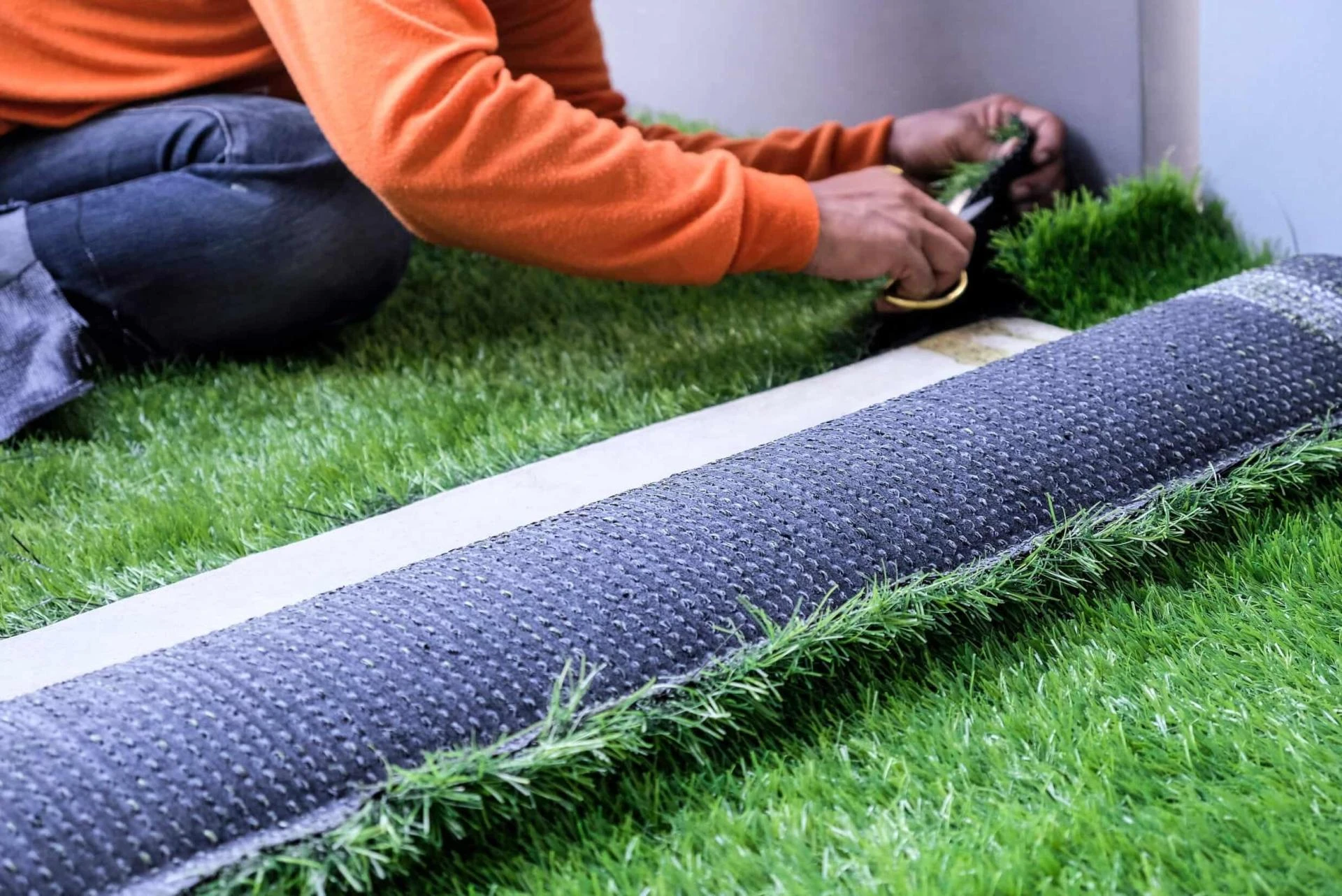

Before hiring a contractor to install artificial turf, it is essential for homeowners to ask a series of specific questions to ensure they are working with a true professional. The longevity and appearance of an artificial turf installation are almost entirely dependent on the quality of the groundwork and the installation technique, so vetting the contractor is critical. The key questions to ask should focus on their experience and credentials, the specifics of the turf products they use, their detailed process for preparing the base, the type of infill they recommend, the warranty they offer, and what is included in their written quote. Asking these questions will help a homeowner identify a skilled, reputable installer and avoid the common pitfalls of a poorly executed project.
This guide will break down each of these six questions, explaining what to listen for in a contractor's response. To ensure the information is practical and current, it has been reviewed by Sophie Williams, a professional with 7 years of field experience in landscape contracting.
1. What Are Your Credentials and How Much Experience Do You Have with Turf?
This is the foundational question. You need to know that you are working with a legitimate and experienced business. A good response will include:
- Licensing and Insurance: They should be able to readily provide proof of a valid business license and, more importantly, both general liability and workers' compensation insurance.
- Specific Experience: Ask them how many turf installations they have completed. Artificial turf is a specialized field, and you want a contractor who has a deep and proven track record with this specific type of work, not just a general landscaper who is trying it out.
- A Portfolio of Past Work: A confident contractor will be proud to show you photos of their completed projects and may even be able to provide you with the addresses of local installations you can drive by to see their work in person.
2. Can You Tell Me About the Specific Turf Product You Recommend?
Not all artificial turf is created equal. The quality of the product itself is a major factor in its appearance, feel, and lifespan. A knowledgeable contractor should be able to provide modern artificial turf technologies and act as a consultant, explaining the differences between various products. They should be able to discuss:
- The Manufacturer: Where is the turf made? High-quality turf is often made in the USA and comes from established manufacturers.
- The Materials: Is it made from polyethylene, polypropylene, or nylon? Polyethylene is the most common and is known for its soft feel, while nylon is extremely durable.
- The Specifications: They should be able to explain the "face weight" (how dense the fibers are), the "pile height" (how long the blades are), and the type of backing the turf has.
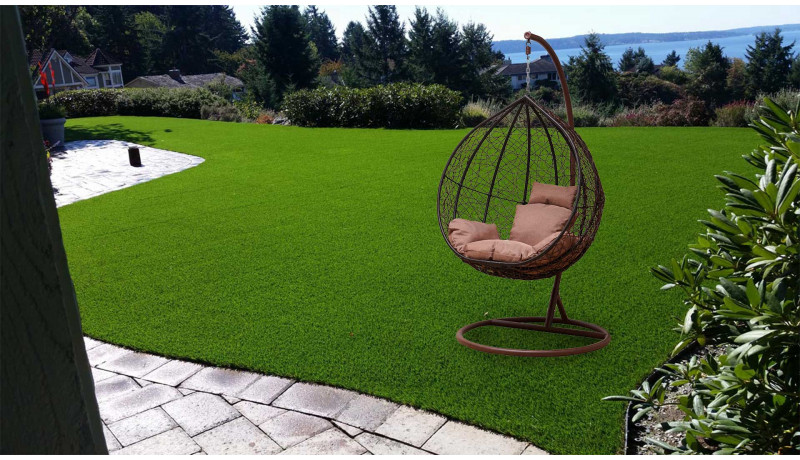
3. What is Your Detailed Process for Preparing the Base?
This is arguably the most important question you can ask. The preparation of the aggregate base underneath the turf is the single most critical factor in a successful, long-lasting installation. A poor base will lead to sinking, lumps, and drainage problems.
An expert artificial turf contractor will describe a detailed, multi-step process that includes:
- Excavation: Removing the existing sod and soil to a depth of 3 to 4 inches.
- Sub-Base Installation: Putting down a thick layer of crushed rock or a similar aggregate.
- Compaction: Using a heavy plate compactor to thoroughly compact the aggregate base until it is solid and stable.
- Grading: Carefully grading the base so that it is smooth and has the proper slope for drainage.
4. What Type of Infill Do You Use and Why?
The infill is the granular material that is spread over the top of the turf and brushed down in between the blades. It serves several critical functions: it helps the blades stand up, it weighs the turf down, it protects the backing from UV rays, and it provides a soft, cushioned feel underfoot.
There are several types of infill, and a professional should be able to explain why they recommend a certain type for your specific needs. The most common options include:
- Silica Sand: The most basic and affordable option.
- Zeolite or other Pet-Friendly Infill: These are highly recommended for homeowners with dogs, as they are designed to trap and neutralize the ammonia in pet urine, which is the primary cause of odor.
- Cooling Infill: In a hot climate, a special cooling infill can be used that is designed to trap moisture and release it slowly through evaporation, which can help to keep the turf's surface temperature lower.
5. What Kind of Warranty Do You Offer on the Product and the Installation?
A professional installation should be backed by a solid warranty from both the turf manufacturer and the installer.
- The Product Warranty: The artificial turf itself should come with a manufacturer's warranty, typically for 10 to 15 years. This warranty covers defects in the product, such as fading or fiber degradation.
- The Installation Warranty: The contractor should also provide their own warranty on the installation workmanship, typically for 1 to 2 years. This covers any issues that might arise from the installation process itself, such as a seam coming apart or a low spot developing in the base.
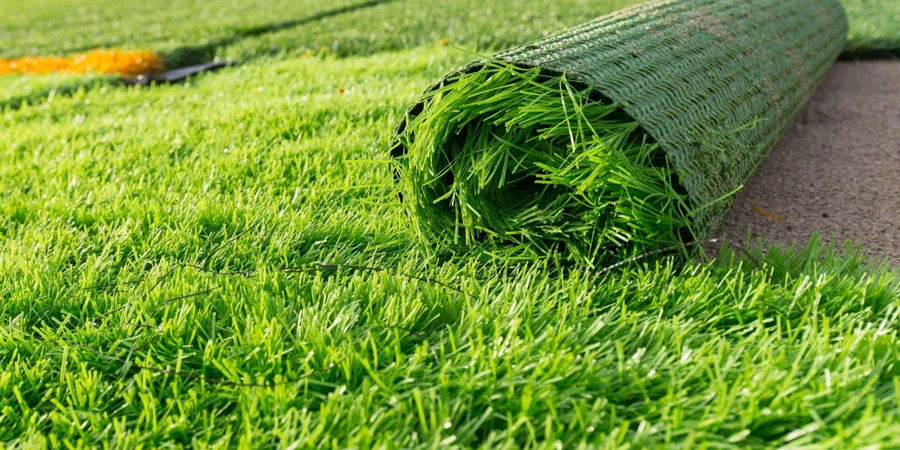
6. What Is Included in Your Written Quote?
The final quote should be clear, detailed, and transparent. A professional contractor will always perform an on-site inspection and measurement before providing a written proposal. The quote itself should include:
- The exact square footage of the area to be installed.
- The specific name and manufacturer of the turf product.
- A clear description of the base preparation process.
- The type and amount of infill to be used.
- A clear breakdown of all costs, including materials, labor, and any necessary site work like sprinkler capping.
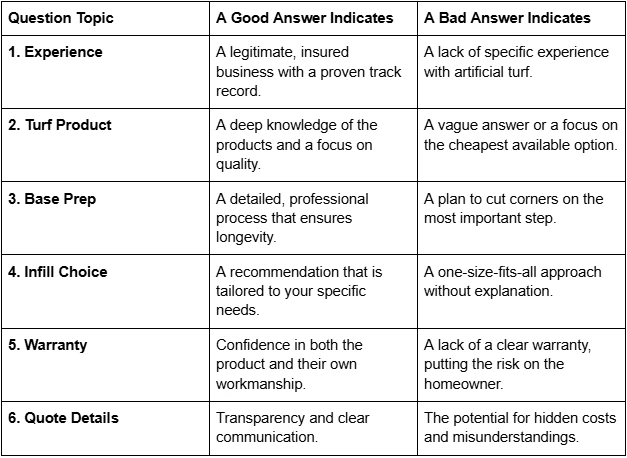
Here is a quick summary of what to look for in a contractor:
Final Thoughts on Choosing the Right Partner
Beyond these individual points, an investment in a high-quality artificial turf system is an investment in a beautiful, low-maintenance, and water-wise landscape for years to come. The long-term success of that investment is in the hands of the contractor you choose. By taking the time to ask these six key questions, you can move beyond the price and truly vet a contractor's expertise, professionalism, and commitment to quality. This due diligence is the best way to ensure that you are hiring a true partner who will deliver a beautiful and long-lasting result.
Get a Professional Artificial Turf Consultation
For homeowners ready to find a contractor who can confidently answer all of these questions, the best first step is a professional evaluation. An experienced team can provide a thorough assessment of your property and a clear, science-based recommendation. For homeowners seeking an expert opinion, the team at All Seasons Lawn Care & Landscaping has deep expertise in all aspects of landscape and artificial turf installation. They can be reached for a consultation by email at [email protected] or by phone at (225) 276-8658.
Reviewer: Sophie Williams looked over this post and brought 7 years of field experience to her suggestions, helping ensure the content stays relevant to business owners and practical for everyday use.










Sign in to leave a comment.