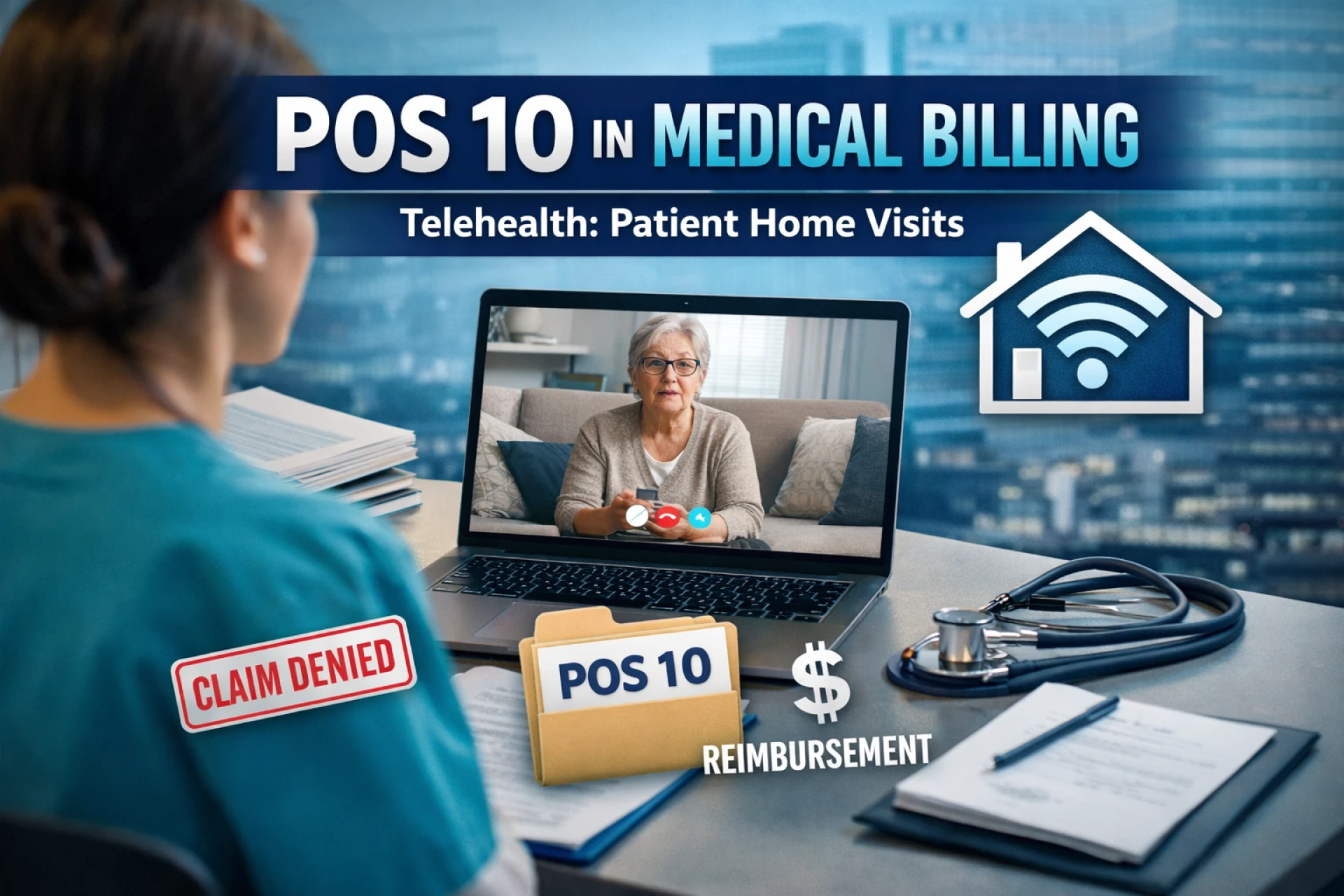

Telehealth is no longer an exception in healthcare delivery. It is a standard access point for patient care. With that shift, accurate place of service reporting has become critical. One code in particular continues to create confusion and revenue loss when misused. Understanding pos 10 in medical billing is no longer optional for practices billing virtual services in 2026.
As a healthcare revenue cycle management professional with more than five years of experience improving reimbursements and reducing denials, I have seen repeated claim rejections tied directly to incorrect place of service selection. POS accuracy directly affects payment rates, compliance risk, and audit exposure. Precision matters.
Definition of POS 10 in Medical Billing
POS 10 in medical billing refers to telehealth services provided in the patient home. It was created to distinguish between telehealth delivered to a patient at home and telehealth delivered to a patient located in another facility.
The official definition is telehealth provided in the patient home. This means the patient is physically located in their private residence when receiving services through interactive audio and video communication technology.
This code is different from POS 02, which represents telehealth provided outside of the patient home. Confusing these two codes is a common billing error.
Why POS 10 Was Introduced
Before POS 10 existed, most telehealth services were reported under POS 02. During the public health emergency, telehealth usage expanded rapidly. Regulators recognized the need to distinguish between patient home based services and services provided in other originating sites.
The introduction of pos 10 in medical billing allowed payers to track utilization more accurately and apply correct reimbursement policies. In many cases, services provided in the patient home are reimbursed at rates comparable to in person visits, depending on payer policy.
Accurate reporting now influences payment parity decisions and long term telehealth policy development.
POS 10 Versus POS 02
Understanding the operational difference is essential.
POS 10
Used when telehealth services are provided and the patient is located in their home.
POS 02
Used when telehealth services are provided and the patient is located somewhere other than their home. This could include a hospital, skilled nursing facility, or other healthcare site.
Incorrect selection leads to claim denials or reduced reimbursement. Some payers reimburse differently based on location. Others flag mismatches between documentation and place of service codes.
Documentation must clearly support the patient location at the time of service.
When to Use POS 10 in Medical Billing
Use POS 10 when the following criteria are met
- The service is delivered via real time interactive audio and video communication
- The patient is physically located in their home
- The provider is licensed to provide services to the patient in that location
- The service is eligible for telehealth reimbursement under payer guidelines
Do not use POS 10 for audio only services unless payer policy explicitly allows telehealth billing under those circumstances. Policies vary by payer and state.
Failure to confirm eligibility before claim submission increases denial risk.
Documentation Requirements for POS 10
Accurate documentation is non negotiable. Claims using pos 10 in medical billing must reflect
Confirmation that the visit occurred through interactive audio and video technology
Statement that the patient was located in their home
Patient consent for telehealth services
Clinical documentation meeting standard evaluation and management guidelines
Incomplete notes create audit vulnerability. If the chart does not clearly state the patient location, payers may reprocess or recoup payment.
Internal compliance audits should routinely verify alignment between documentation and place of service coding.
Reimbursement Impact in 2026
Telehealth reimbursement policies continue to evolve. Some commercial payers reimburse telehealth services at parity with in person visits when POS 10 is reported. Others apply reduced rates.
Medicare policies also distinguish between patient home and other originating sites for certain services. Practices must monitor payer bulletins and contract language carefully.
From a revenue cycle perspective, incorrect use of pos 10 in medical billing affects
- Allowed amounts
- Modifier requirements
- Claim adjudication timelines
- Post payment audit exposure
Denial trends frequently show patterns tied to incorrect place of service selection. Clean claims begin with accurate coding.
Common Billing Errors With POS 10
Several recurring errors impact revenue performance
Using POS 02 when the patient is at home
Failing to include required telehealth modifiers
Not documenting patient location
Billing telehealth services that are not eligible under payer policy
Using POS 10 for services performed in facility settings
Each of these errors increases rework, accounts receivable days, and compliance risk.
Front end intake workflows must capture patient location at time of service. Billing teams must validate coding before submission. Reactive correction is inefficient and expensive.
Compliance and Audit Considerations
Telehealth utilization remains under scrutiny. Payers analyze billing patterns and utilization data. Incorrect use of pos 10 in medical billing can trigger focused audits.
High frequency telehealth billing without proper documentation creates risk. Practices must maintain
- Clear telehealth consent documentation
- Accurate provider licensure validation
- Evidence of interactive technology usage
- Consistent internal coding education
Compliance is operational discipline. It is not optional.
Operational Best Practices for Accurate POS 10 Reporting
Strong revenue cycle performance requires structured processes
Train providers and staff on telehealth documentation standards
Update electronic health record templates to capture patient location
Implement claim scrubbing rules specific to telehealth codes
Conduct periodic internal audits of telehealth claims
Monitor payer specific guidance quarterly
Telehealth coding cannot rely on assumptions. Systems must enforce accuracy at the point of documentation and claim creation.
Strategic Importance of POS 10 in Medical Billing
Telehealth is embedded in modern healthcare delivery. Place of service coding influences reimbursement stability and regulatory positioning. Practices that treat telehealth coding casually will experience higher denial rates and compliance exposure.
Accurate use of pos 10 in medical billing supports predictable revenue, defensible documentation, and payer alignment. Operational control over coding details determines financial performance.
Precision in place of service coding is a revenue strategy, not an administrative formality.











Sign in to leave a comment.