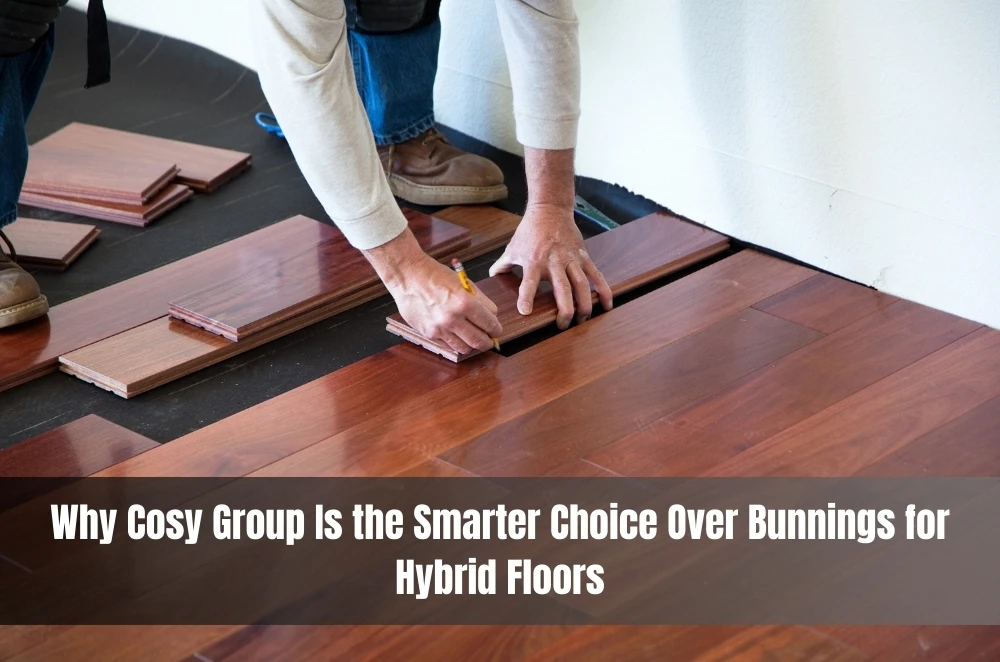

Tossing up where to buy and install hybrid flooring in Sydney? Here’s the short version: big-box retail is great for cheap boxes and quick pickup; whole-home flooring lives or dies on subfloor prep, acoustics, and installation quality control. To compare apples with apples, start by scoping a trusted hybrid floor supplier so you can benchmark supply, labour, warranties and compliance—before a low per-box sticker sways you.
Hybrid basics (and why installation makes or breaks it)
Hybrid boards are rigid-core planks (SPC/WPC) with a click system, wear layer, and often an integrated underlay. They’re tougher than many laminates, more water-tolerant than most engineered timbers, and kinder underfoot than ceramic. But even the best board will creak, cup or gap if the subfloor isn’t flat, dry and acoustically isolated.
Real-world moment: Two neighbours chose the same brand. One used specialist installers who laser-levelled, skimmed dips, and left proper expansion at perimeters. The other DIY’d a weekend sprint and jammed boards tight to skirtings. Three weeks later—edge peaking. Same product; different process.
The model gap: Warehouse vs specialist
Warehouse (e.g., big-box):
- Prioritises low price and broad range; installs are often outsourced to mixed-standard contractors.
- Subfloor rectification is “additional”; quotes may assume a perfect base.
- Advice is generalist—fine for colour choice, weak on stairs, laundries and strata acoustics.
Specialist installer-retailer (Cosy Group model):
- One accountable chain: measure, prep, supply, install, aftercare.
- Site-specific quoting (levelling, moisture mitigation, trims) upfront—fewer “surprise” line items.
- Tighter QC on crews, with callbacks handled by the same business that sold the boards.
Compliance, you actually need to care about
Flooring intersects with the National Construction Code (NCC) more than most people realise. Wet entries, stairs, ramps, and landings have slip expectations and detailing requirements. When a partner references slip resistance ratings as 4586, they’re talking about testing and classifications that help avoid slick surfaces and non-compliant stair nosings. That’s not bureaucracy—that’s safety and liability.
Translate that at home:
- Kitchens/laundries: choose realistic slip characteristics and cleanability, not just the “waterproof” label.
- Stairs/landings: nosing profiles, trim grip and finish matter.
- Apartments/townhouses: underlay density and perimeter isolation affect neighbour noise; check strata targets early.
Total cost of ownership (not just $/m²)
The price on the box isn’t the bill you pay. The number that matters is delivered, compliant, and under warranty.
Line items to compare fairly
- Levelling: grinding, self-leveller, patching dips—where budgets usually blow out.
- Moisture mitigation: essential over on-grade slabs or suspect particleboard.
- Underlay choice: acoustic rating, compression set, thermal transfer; not all foams are equal.
- Profiles & trims: stair nosings, reducers, thresholds—cheap looks cheap and can be unsafe.
- Waste factor: 5–10% for cuts; more for small rooms and many doorways.
A specialist will price these upfront. With a warehouse route, you often discover them when the installer arrives and the slab waves hello.
Product curation vs wall-of-boxes
Big-box stores excel at variety; specialists excel at curation. The latter typically stocks fewer SKUs they’ve stress-tested—checking click strength, edge durability, telegraphing over minor defects, and dent resistance under chairs.
Questions worth asking anywhere
- How strong is the click under racking force?
- What’s the real wear layer thickness and scratch profile (beyond lab numbers)?
- How do edges cope with steam-mop users and rolling appliances?
Apartments, acoustics and the underlay problem
Hybrid’s integrated pads are convenient, but they rarely provide enough coverage for tighter strata targets. If your building mandates higher ratings, you’ll need an additional acoustic layer and perimeter isolation. Park a deeper dive for readers with the best underlay for hybrid flooring —covering IIC/Ln, with numbers, flanking paths, door undercuts, and why foam strips around perimeters matter.
Small story, big lesson: In a Newtown unit, we swapped the default 1 mm pad for a denser acoustic underlay and added isolation foam. Same boards; the neighbour below stopped hearing “marble runs” at night. The installer’s site notes made the difference.

Kitchens and laundries: It’s about edges, not hype
Hybrid tolerates splashes, but failures tend to start at the edges—such as dishwashers, fridges, and laundry pans. Look for sealed perimeters, silicone at penetrations, and a click profile that doesn’t pop under appliance moves. For neutral reading, earmark hybrid flooring for kitchens and laundries so readers can sanity-check water and cleaning guidance.
Installation quality control (QC): Who actually owns it?
- Warehouse route: store sells; third-party installs; warranty queries can ping-pong between vendor, installer and manufacturer.
- Specialist route: one accountable chain. If a plank telegraphs a subfloor ridge, the same business that measured the room fixes it—no finger-pointing.
QC habits to request
- Laser-level report and photos of levelling/patching
- Moisture readings logged against thresholds.
- Documented expansion gaps at perimeters and fixed points
- Stair/nosing profiles verified against NCC slip guidance
Aftercare that prevents warranty wrangles
Most hybrid warranties hinge on use and care: mats at entries, felt pads on furniture, no soaking mops, manage indoor humidity, and lift—not drag—heavy appliances. A specialist typically leaves a clear care sheet and the right cleaning kit so you don’t nuke the finish with harsh chemicals.
Maintenance rhythms
- Dry-mop weekly; spot-clean spills quickly
- Refresh chair-leg pads seasonally
- Check the silicone and trims annually near wet areas
- Disengage boards with the correct method (don’t pry the click the wrong way)
When a warehouse route does make sense
To be fair, big-box shines when:
- You’re doing a single, regular room over a flat timber subfloor
- You’re confident with levelling and door/trim carpentry.
- Timing is tight, and you need same-day stock.
If that’s you, buy extra for waste, rent a laser level, and spend a weekend just on prep. In the future, you will be glad you did.
When a specialist route is the smarter play
Choose an end-to-end specialist when:
- You’ve got stairs, laundries, or long sun-struck hallways
- The slab is wavy, patched, or moisture-suspect
- It’s an apartment/duplex with acoustic rules and close neighbours
- You want one party answerable for the finish and compliance.
From the site diary: On a heritage semi, the crew found a 10 mm hump across a 4 m span. They ground the ridge, feather-finished a skim, and staged the lay so doors still cleared. You can’t fix that with an extra box of boards; you fix it with experience and the right gear.
How to compare quotes fairly (and quickly)
- Pilot one room with levelling assumptions stated in millimetres.
- List trims (stair nosings, reducers, thresholds) by type/location.
- Nominate underlay spec (density, thickness, acoustic rating).
- Confirm compliance on wet-area details and AS 4586-related slip expectations.
- Ask for a QC pack: moisture readings, levelling photos, and a care sheet.
Do those five and you’ll see the real gap between “cheap” and “good value”.
Bottom line
You don’t buy hybrid floors; you buy a finished surface that must look great, feel quiet and safe, and stay that way for years. Warehouses are brilliant for choice and price on simple jobs, but when subfloors, acoustics, stairs and compliance enter the chat, a specialist like Cosy Group has the edge: tighter QC, realistic prep, and one accountable chain from quote to warranty. Start by benchmarking hybrid flooring installation in Sydney, sanity-check compliance with slip resistance ratings as 4586, and decide your underlay and wet-area details before you fall for a colour board. That’s the smarter choice—whoever you buy from.











Sign in to leave a comment.