

I still remember the first time we realized our booking problem wasn’t about marketing.
We were getting traffic. Decent traffic, actually. People were landing on our hotel pages, browsing rooms, even clicking “Book now.” But somewhere between choosing dates and completing payment, they disappeared. At first, we blamed pricing. Then we blamed demand. Eventually, after watching enough session recordings and reading enough support tickets, the truth became uncomfortable: the booking experience itself was broken.
Not visibly broken. Functionally broken.
That was my first real lesson in why hotel booking engines matter far more than most early-stage travel teams think.
The Digital-First Traveller Has Changed the Rules
Today’s traveller doesn’t “browse” the way people did even five years ago. They move fast. They compare instantly. They expect answers without friction.
If availability isn’t clear, they leave.
If prices change at the last step, they lose trust.
If the booking flow feels slow or confusing on mobile, they don’t try again later.
This isn’t impatience. It’s conditioning.
Every experience people have with flights, rides, food delivery, or shopping shapes what they expect from travel platforms. A hotel booking engine is no longer just a system that processes reservations. It’s the moment where trust is either built or lost.
And once lost, it’s very hard to earn back.
Booking Engines Are Not a Backend Detail
One of the biggest mindset shifts we had to make was stopping the idea that “the booking engine is just infrastructure.”
In reality, it’s one of your most visible product layers.
It decides:
- How quickly users get answers
- How confident they feel before paying
- Whether they believe your prices
- Whether they come back next time
From the user’s perspective, the booking engine is your product. They don’t separate your UI from your availability logic or your pricing sync. They experience it as one continuous flow. Any weakness shows up immediately as hesitation or drop-off.
User Experience Is Conversion, Not Design
Early on, we spent a lot of time improving layouts, images, and copy. Those things matter, but they don’t compensate for poor booking logic.
What actually moved conversion was:
- Accurate availability without refresh loops
- Clear room options with consistent pricing
- Fewer steps between search and confirmation
- Predictable behaviour when dates or guests changed
When the engine responds instantly and behaves consistently, users relax. When it doesn’t, they start second-guessing everything.
A smooth booking engine removes mental load. That’s the real conversion boost.
Inventory Accuracy Builds or Destroys Trust
Nothing damages credibility faster than showing a room that isn’t actually available.
It sounds obvious, but many startups underestimate how hard real-time inventory sync really is, especially when dealing with multiple suppliers, rate plans, or properties.
We learned this the hard way when customer support tickets started piling up around “booked but not confirmed” scenarios. Even if refunds are issued quickly, the damage is already done. Users don’t remember the resolution. They remember the stress.
Accurate inventory isn’t a nice-to-have. It’s foundational to trust. And trust is what makes users comfortable booking directly instead of switching to a larger platform.
Pricing Consistency Is a Product Decision
Another painful lesson: pricing mismatches rarely feel like “technical errors” to customers. They feel like dishonesty.
If the price changes between search and checkout, users assume the worst. Even small differences trigger doubt.
A good booking engine handles pricing updates clearly and predictably. It explains changes when they happen and avoids surprises whenever possible. That clarity is what keeps users from opening a new tab to “double-check.”
And once they open that tab, you’ve probably lost them.
Mobile Is Not a Smaller Desktop
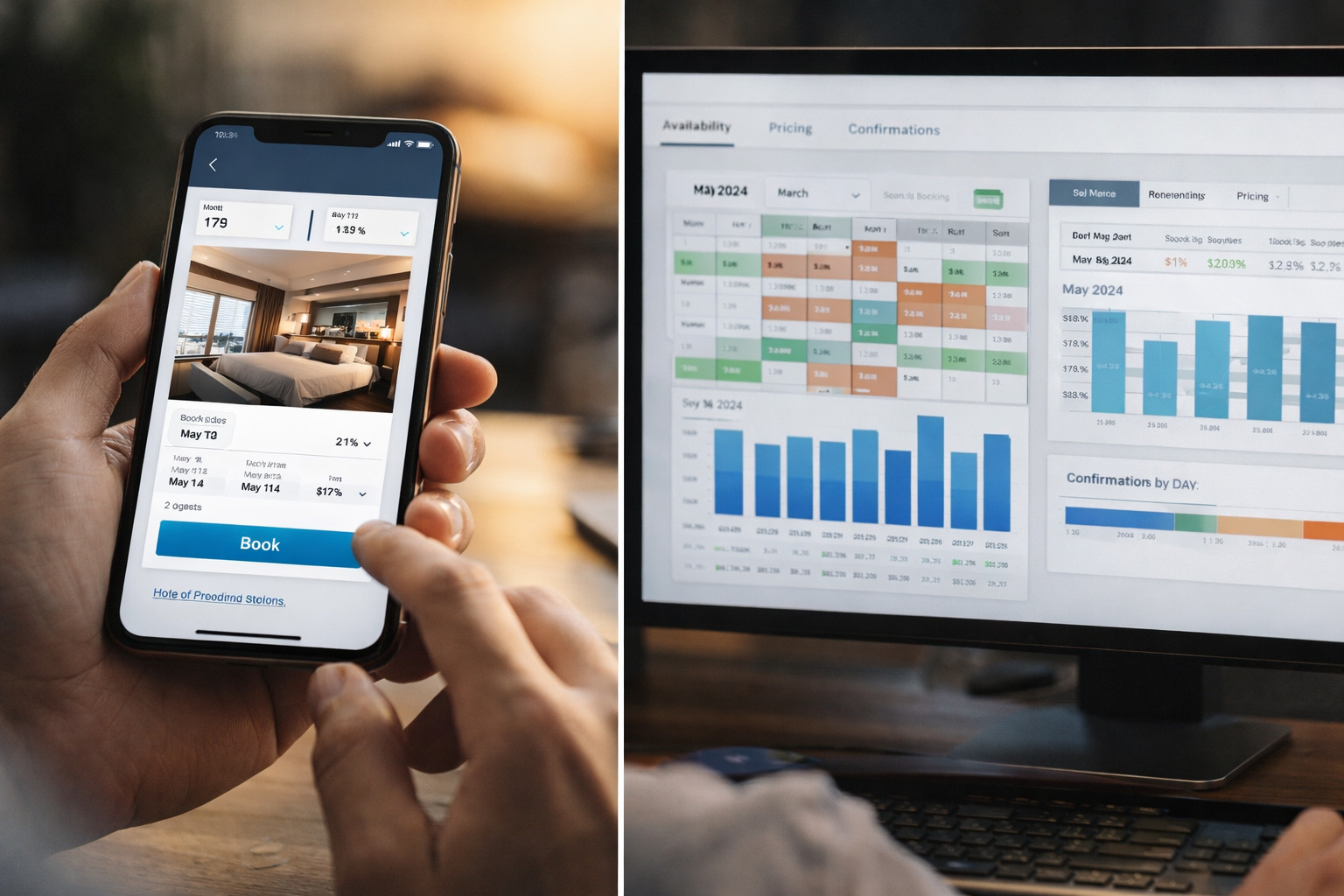
Most of our bookings now come from mobile. That wasn’t always the case, but it became true faster than we expected.
Mobile users don’t tolerate slow loading, repeated fields, or unclear error messages. A booking engine that works fine on desktop can quietly fail on mobile without anyone noticing until numbers start slipping.
Designing the booking flow with mobile-first logic forced us to simplify decisions, reduce friction, and prioritize speed over complexity. In hindsight, that discipline improved the experience on all devices.
International Reach Depends on Engine Stability
As soon as we expanded beyond one market, the booking engine became even more critical.
Different currencies, time zones, payment behaviours, and booking windows exposed weaknesses we hadn’t seen before. A system that barely held together in one region quickly showed cracks when scaled globally.
International users are less forgiving. They don’t have brand familiarity or local context to fall back on. If something feels off, they leave without complaint.
A stable, predictable booking engine is often the difference between successful expansion and silent failure.
Repeat Bookings Start at the First One
Retention in travel is tricky. People don’t book hotels every week. That means the first experience has to be strong enough to be remembered months later.
When users complete a booking smoothly, receive clear confirmations, and feel confident throughout the process, they’re far more likely to return directly next time. Not because of loyalty programs or emails, but because of memory.
The booking engine is where that memory is formed.
Common Mistakes We See (and Made)
Many startups treat booking engines as something to “improve later.” That usually leads to:
- Patching issues instead of fixing root problems
- Accumulating technical debt in the most sensitive part of the product
- Designing features around limitations instead of user needs
Another mistake is over-optimizing for speed to market without thinking about scale. Shipping fast matters, but not if it locks you into a fragile system that becomes impossible to evolve.
Every shortcut taken in the booking layer eventually shows up as friction, support cost, or lost trust.
The Real Trade-Off: Short-Term Speed vs Long-Term Control
There’s no perfect answer here. Early-stage teams have limited resources and real pressure to launch.
But one thing I’ve learned is this: decisions around booking engines compound faster than almost any other product choice in travel.
A flexible, reliable booking foundation gives you room to experiment, expand, and improve. A brittle one slows everything down, even growth initiatives that seem unrelated.
The goal isn’t perfection. It’s intentionality.
Final Thought
In a digital-first travel world, hotel booking engines are no longer background systems. They are trust engines. Growth engines. Retention engines.
If you’re building or scaling a travel platform, don’t treat your booking engine as a checkbox feature. Treat it as a core product decision that deserves the same attention as your brand, your marketing, and your growth strategy.
Because in the end, all roads lead to the moment a traveller clicks “Confirm booking.” And that moment matters more than ever.


Sign in to leave a comment.