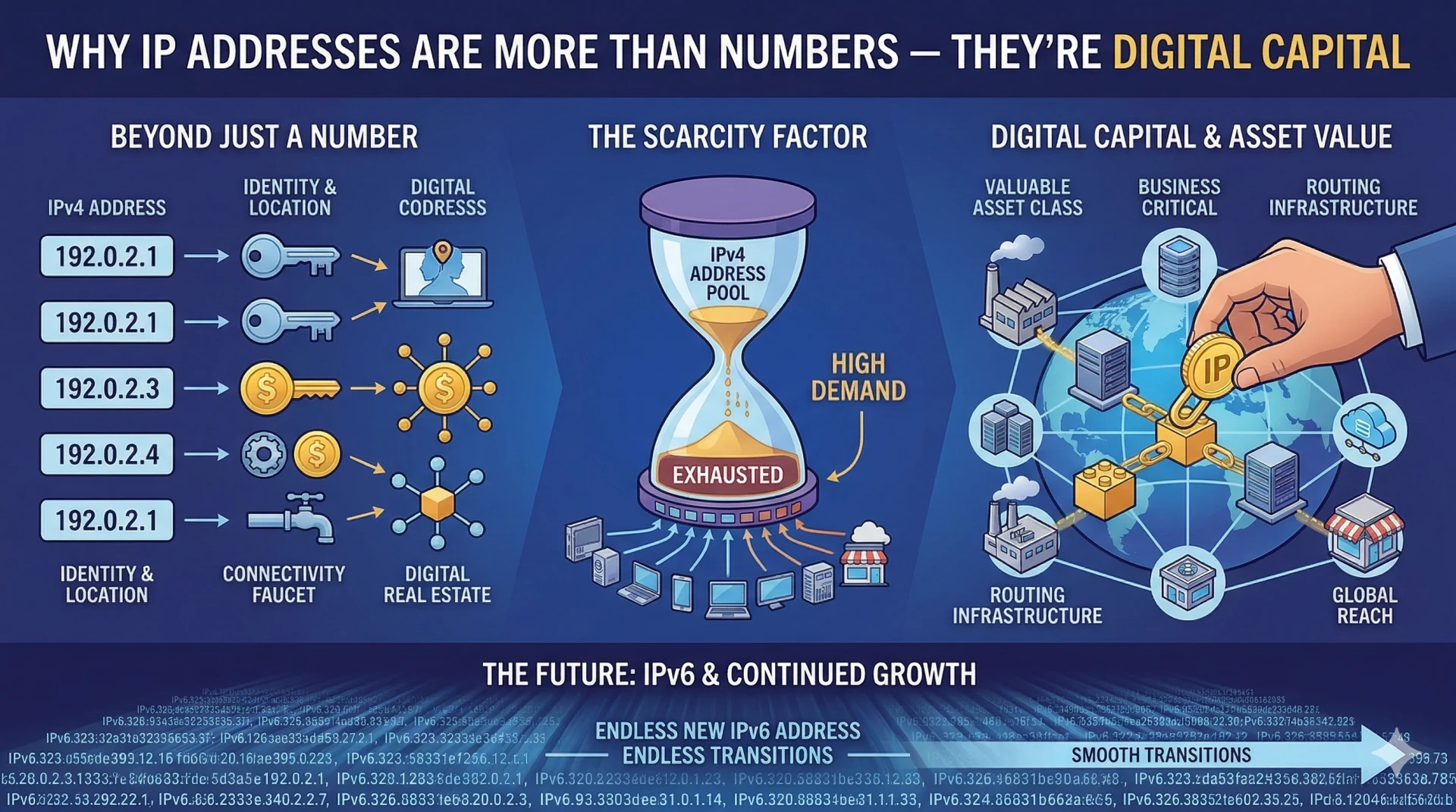

Why IP Addresses Are More Than Numbers — They’re Digital Capital
For decades, an IP address was merely a technical label — a string of digits used by networks to identify and route traffic across the internet. Today, however, its role has quietly but profoundly transformed. No longer just foundational plumbing for connectivity, IP addresses — especially IPv4 addresses — have evolved into a scarce, tradable and strategically important form of digital capital.
From Technical Necessity to Economic Asset
At its core, an IP address is a numerical identifier assigned to every device connected to a network that uses the Internet Protocol. It enables computers, servers, phones and IoT devices to find each other and exchange data. In the early years of the internet, addresses were abundant and largely allocated without much economic thought — simply enough to make networks function.
But that abundance didn’t last. The original IPv4 system supports roughly 4.3 billion unique addresses, of which only about 3 billion are usable. As the internet exploded — driven by cloud growth, mobile connectivity and billions of networked devices — that address space was exhausted. Even as newer IPv6 space exists in vast quantities, its slow adoption has kept demand for IPv4 high.
This finite supply, combined with persistent demand, has given rise to scarcity economics — a textbook condition where limited availability and rising need create value. And that’s where IP addresses start to look a lot like capital.
What Makes an IP Address Digital Capital?
Economists typically define capital as assets that possess four key characteristics: scarcity, utility, ownership rights and economic value. IP addresses increasingly meet all of these.
- Scarcity: IPv4 address blocks are finite. With free allocations long exhausted, organisations must acquire space through transfers, leases or secondary markets — and this scarcity creates intrinsic value.
- Utility: Every external digital service — from websites to cloud APIs to IoT sensors — requires an IP address to operate. This universal utility makes IP space essential for business operations and digital services.
- Economic Value: Secondary markets have emerged where address blocks are bought, sold and leased. Some enterprises track these holdings alongside physical or financial assets, recognising that they can directly influence growth, scalability and valuation.
- Ownership Dynamics: While Traditional internet governance bodies — Regional Internet Registries (RIRs) — allocate addresses without recognising full proprietary ownership, market practice has created de facto ownership via transfer and leasing arrangements. This blurs the line between administrative resources and tradable assets.
How Organisations Treat IP as Capital
For modern businesses, IP addresses are no longer a back‑office afterthought:
- Strategic Holdings: Large cloud providers and telecommunications firms carefully manage and optimise their IP portfolios to support growth, ensure connectivity continuity, and reduce dependency on costly external leases.
- Asset Value in M&A: Scarce IP holdings can influence corporate valuations during mergers, acquisitions or investment discussions, especially in infrastructure‑heavy sectors.
- Operational Advantage: Companies with robust address inventories can scale services faster, expand into new markets with fewer friction points and negotiate better deals on cloud deployments or network expansion.
- Security and Reputation: Address blocks carry reputational weight. Those with histories of spam or abuse can degrade email deliverability, harm cybersecurity postures, and lower perceived value — further reinforcing the idea that IP addresses behave like real capital with value that can appreciate or deteriorate.
Governance, Equity and Future Challenges
Treating IP addresses as capital raises deeper governance questions. RIR policies historically emphasised fair distribution and stewardship, not market efficiency or financial ownership. This mismatch creates structural barriers — such as limited liquidity, opaque transfer rules and ambiguous ownership rights — that suppress mature capital market behaviour around IP resources.
Critics argue that without clearer frameworks and reforms, scarcity could deepen digital inequality. Smaller networks, start‑ups and emerging‑market operators might face higher costs or barriers to participation simply because they cannot afford or access sufficient address space.
Conclusion: Recognising a New Form of Capital
Once seen purely as a technical utility, IP addresses — particularly IPv4 blocks — have crossed a threshold into strategic digital capital. They combine scarcity with essential utility, tradability and economic value, making them critical to modern digital business strategy. As internet governance evolves and markets for IP space mature, organisations that understand and manage this form of capital will be better positioned in an increasingly connected and competitive world.










Sign in to leave a comment.