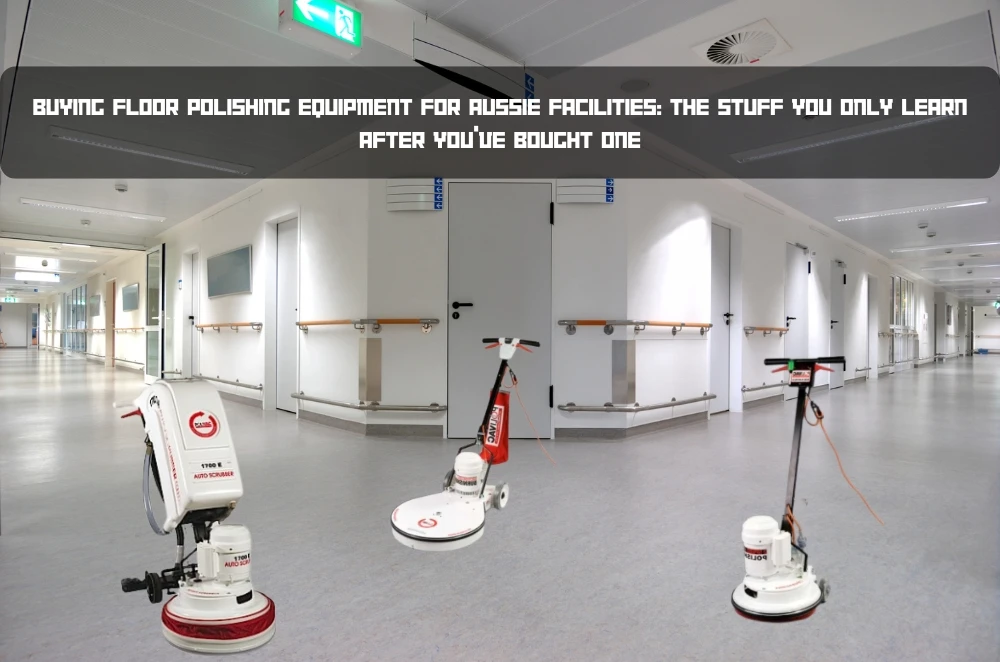

There’s a moment every facilities person knows.
You’ve just signed off on a “great” machine. The rep demo was smooth. The specs looked solid. Everyone nodded like it was a sensible purchase.
Then it’s 6:40 pm on a Thursday, you’ve got an hour before the place needs to look respectable again, and the machine is wedged in a corridor because it can’t quite swing around the corner without bumping skirting boards. Someone’s asking where the right pad is. Someone else filled the solution tank with the wrong mix. And the floor looks… kind of worse, somehow.
That’s the real test. Not the brochure.
So if the goal is to choose commercial floor polishing equipment for Australian facilities without buying something you’ll quietly resent, here’s the human version of how to do it.
The first truth: “Shiny” isn’t the job
Most buildings don’t need shiny floors. They need floors that look looked after.
That usually means:
- Scuffs aren’t screaming at you from ten metres away
- The floor isn’t slippery or greasy in the wrong places
- The finish is consistent (no patchy “clean here, dirty there” look)
- The routine can actually be repeated by whoever is on shift next week
If you buy a machine chasing a glossy “before and after” moment, you’ll almost always overbuy. The right purchase is the one that fits the routine you can keep doing, week after week, without heroics.
“Polishing” is a messy word (and that causes bad buys)
When people say “we need a polisher,” they can mean three different things:
Scrubbing: The honest work. Lifting soil and residues properly so you’re not just spreading grime with a fancy pad.
Polishing: Refining the look and reducing visible marks after the floor is actually clean.
Burnishing: Boosting appearance on the right finish system, usually at a higher speed, usually with less tolerance for “close enough” technique.
The mistake is treating all three like the same job. That’s how you end up with a machine that does one thing brilliantly… and is awkward for what you actually need most days.
The decisions that matter in real buildings
1) What are the floors, really?
Not “hard floors.” Actual floors.
Vinyl behaves differently from sealed concrete. Stone-look tiles behave differently to terrazzo. Even within one site, the finish systems can vary because one area was refurbished three years after another.
If you’ve got mixed surfaces, the smartest move is usually to plan by zones, not by “the building”. Staff can follow zones. Buildings are too messy.
2) When can the work actually happen?
This is where Australian facilities get caught out, because many sites don’t have the luxury of long closures.
Hotels, restaurants, medical centres, hospitals, and office buildings often need work done:
- After hours but not too late
- Quietly, because people are still around
- Quickly, because access windows are short
- With predictable drying, because nobody wants a surprise slip risk
A machine that’s powerful but slow to set up, loud, or fussy about technique can be a nightmare in a tight operating window.
3) Can you move it through the building without swearing?
This is the unglamorous part nobody wants to talk about, but it decides everything.
- Does it fit in the lift?
- Can it turn in corridors?
- Can it handle thresholds without feeling like a wrestling match?
- Does storage make sense, or will pads and parts end up in random cupboards?
A machine that’s slightly less “impressive” but easy to move and easy to deploy will get used more. And the machine that gets used more is the one that actually improves the floors.
4) Pads and consumables aren’t accessories. They’re the system.
Facilities teams often buy the machine and treat pads like an afterthought.
Then they wonder why outcomes vary.
Pads are the difference between:
- “This looks great”
- “Why is it streaky?”
- “Why did it dull the finish?”
- “Why does it look amazing in one area and average in the next?”
If you want consistent results, you need a simple pad plan that staff can follow without guessing.
5) Can you keep it running without drama?
Commercial equipment lives or dies on supportability.
Not in a theoretical way. In a “what happens when a part wears out right before a big inspection” way.
If the building relies on routine floor presentation, parts availability and a straightforward path for repairs, it matters as much as the machine itself. If you’re comparing scrub-and-polish options and trying to sanity-check what’s practical, the AC Cleaning Supplies machine selection guide is a handy mid-stream reference for seeing machines and parts in the same place, rather than treating them like separate decisions.
6) Who’s actually using it?
This is the question most buyers avoid because it’s awkward.
If a machine requires a “special operator” to get good results, you don’t have a machine—you have a dependency.
The best commercial setups are:
- Easy to teach
- Forgiving when someone is learning
- Consistent across shifts
- Simple to check (so the method doesn’t drift)
Because the reality is: it will be used by different people, on different nights, under different levels of pressure.
Common mistakes (the ones you see again and again)
Buying for the foyer and forgetting the rest of the building.
The lobby looks great, but the machine is useless in corridors and awkward zones, so staff stop using it.
Trying to “polish over” poor cleaning.
If the floor is still dirty, polishing just turns dirt into a smoother-looking problem.
No plan for edges and corners.
Centres look better, edges look worse, and the contrast makes the floor feel unfinished.
Ignoring the post-job reality.
If cleaning the machine is annoying, it won’t be done properly. If storage is chaotic, pads go missing. If maintenance isn’t planned, performance drops quietly until someone complains.
No agreed definition of “done.”
One person aims for high gloss, another aims for “good enough,” and the building ends up inconsistent.
Operator Experience Moment
In facilities work, the biggest step up usually isn’t a new machine—it’s removing decision fatigue. When operators know “this pad for this zone, this routine, this finish standard,” results stop swinging wildly from shift to shift. The floors don’t just look better; the team feels less stressed because the work becomes predictable.
A simple 7–14 day plan that saves you from buyer’s remorse
Days 1–2: Walk the site and split it into zones by surface type, traffic, and operating hours. Write it down. Don’t rely on memory.
Days 3–4: Define the target outcome per zone in plain language. Not “polished.” More like: “scuffs controlled, consistent finish, safe to reopen in X minutes.”
Days 5–7: Trial in small, representative sections. Test the least aggressive method that could work. Note drying times and noise issues in real conditions.
Days 8–10: Turn trial results into requirements: manoeuvrability, operator ease, pad system, maintenance needs, and parts support.
Days 11–14: Lock in a basic SOP and train it. Include pad selection, overlap technique, edge approach, dilution basics, and daily/weekly checks.
That’s it. Not fancy. Just practical.
Local SMB mini-walkthrough (Australia)
A suburban medical centre often needs low-noise work with predictable drying so patient movement isn’t disrupted.
Restaurants usually need fast recovery at entrances where traffic and spillover hit hardest, without long closures.
Hotels tend to run two standards: presentation-heavy in lobby areas, efficiency-heavy in back-of-house routes.
Office buildings are ruled by access windows and tenant expectations, so manoeuvrability and drying are huge.
A cleaning contractor juggling multiple sites benefits most from standardised pads, training, and parts routines.
Aged-care and community facilities commonly prioritise consistency and safe walkability over high-gloss finishes.
Practical Opinions
Buy the machine you’ll happily use on a busy week, not the one you’d use on a perfect week.
If it’s awkward to move or set up, it will quietly fall out of the routine.
Pads + process will fix more problems than chasing “more power.”
Key Takeaways
- The “right” machine is the one that fits the building’s constraints and the team’s routine.
- Polishing only works well when the floor is genuinely clean and the system is matched.
- Access, storage, noise, and drying time are often bigger deal-breakers than specs.
- Standardising pads and methods by zone is where consistency usually comes from.
Common questions we hear from Australian businesses
How do we know whether we need scrubbing, polishing, or burnishing?
Usually, the quickest way is to trial the least aggressive approach that could meet the zone’s finish target. The next step is to test one small area and document the pad, solution, and method that worked. In many Australian sites with tight access windows, the best choice is the one that fits the time you actually have, not the one that looks best in a demo.
Can one machine cover multiple floor types in the same facility?
It depends on how different the surfaces are and whether the team can follow a clear zone-based pad plan. The next step is to map surfaces and run short trials in representative areas before assuming one setup will do everything. In most cases across Australian commercial buildings, versatility works best when pads and procedures are simplified, not when staff are expected to guess.
What’s a clear sign we’re overbuying?
In most cases, overbuying shows up when the machine is too big for access, too complex for staff, or aimed at a finish level the routine doesn’t actually require. The next step is to list your real constraints—lifts, storage, noise limits, and operating windows—before comparing models. In Australian venues with tight after-hours work, building logistics rule out more options than performance specs ever will.
How do we keep downtime from turning into a constant headache?
Usually, a simple maintenance rhythm beats a complicated program nobody follows. The next step is to create a short checklist for daily checks, weekly cleaning, and a small on-hand list of wear items. In most Australian contract environments where service windows are tight, predictable parts access and routine upkeep are what keep machines reliable.











Sign in to leave a comment.