
Paying Twice for the Same Service: Inside Pettable.com's Controversial Verification Fee
An investigative analysis of why customers must pay an extra $50 to prove their $190 ESA letter is real
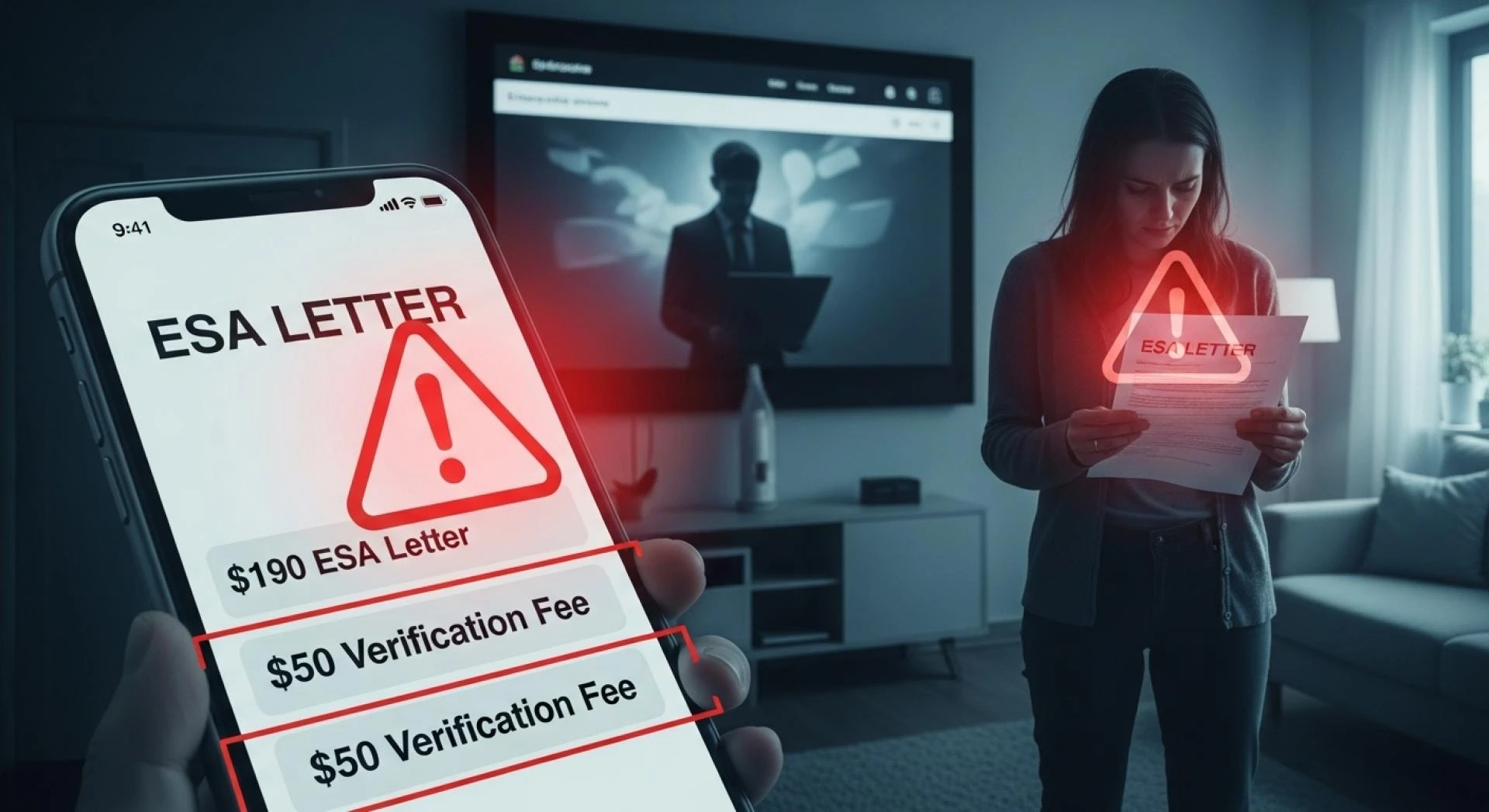
When Rachel Kim paid $190 to Pettable.com for an ESA letter, she thought she was buying complete documentation for her emotional support animal. The website promised "everything you need" for housing accommodations. The confirmation email said her letter was "ready to use."
Two weeks later, her property manager requested verification through PetScreening.com, a standard procedure for confirming ESA letters are legitimate. That's when Pettable.com demanded another $50 before they would verify the letter Rachel had already purchased.
"I was furious," Rachel told us. "I already paid them $190. Now they want $50 more to confirm they actually wrote the letter? That's like a mechanic charging you to tell your insurance company they actually fixed your car. You already paid for the service. Why should verification cost extra?"
According to complaints filed with the Better Business Bureau, Rachel's experience represents a disturbing pattern. Dozens of Pettable.com customers report being charged twice for essentially the same service: once to create the letter, and again to verify it's real.
This investigation examines why Pettable.com charges customers to verify their own work, whether this practice constitutes unfair business dealings, and what it reveals about their priorities.
The Double Payment Problem: Breaking Down the Charges
To understand why customers find this practice so problematic, let's examine what they're actually paying for at each stage.
First Payment: $190 for the ESA Letter
Customers pay $190 (or $149 if they accept hidden subscription charges) for what Pettable.com describes as a complete ESA letter service. This payment allegedly covers:
- Initial consultation with a licensed mental health professional
- Clinical evaluation for ESA need
- Writing and issuing the ESA letter
- Professional documentation meeting Fair Housing Act requirements
- A letter that landlords will accept
The website promises this service is "complete" and provides "everything you need" for housing accommodations.
Second Payment: $50 for Verification
When property managers or landlords request verification (an increasingly common practice), Pettable.com charges an additional $50. This payment covers:
- Confirming the therapist actually wrote the letter
- Verifying the customer was actually evaluated
- Answering basic questions about the letter's authenticity
- Providing contact information for the issuing provider
In essence, customers pay $50 for Pettable.com to confirm they did the work customers already paid $190 for.
The Core Problem: Paying Twice for One Service
"It's fundamentally dishonest," consumer protection attorney Jennifer Walsh explains. "When you pay a professional to provide a service, confirming you actually provided that service shouldn't be a separate charge. That's part of professional accountability."
Think of it this way: When a doctor treats you, they don't charge extra to confirm to your insurance company that treatment occurred. When a contractor repairs your home, they don't charge extra to verify to your mortgage company that repairs were completed. The verification is part of the service.
"What Pettable.com is doing is called double dipping," Walsh continues. "They're charging once for the service, then charging again for basic accountability around that service. It's ethically questionable and potentially legally problematic."
When the Double Charge Hits: Customer Stories from Crisis Moments
The most troubling aspect of Pettable.com's verification fee isn't just that it exists, but when it's revealed. Customers discover this charge at the worst possible moment: right when they need housing.
David's $240 Reality: Trapped During Application
David Rodriguez's story, detailed in his BBB complaint, shows the timing trap in action.
David's Timeline:
- Week 1: Pays $190 for Pettable.com ESA letter
- Week 3: Finds apartment, submits application with ESA letter
- Week 4: Property management sends verification request to Pettable.com
- Week 5: No response from Pettable.com to verification request
- Week 5, Day 4: Property manager warns application may be denied without verification
- Week 5, Day 5: David contacts Pettable.com, discovers $50 verification fee
- Week 5, Day 5: David pays $50 because he's already invested in application and holding deposit
"They refused to verify the letter I already paid $190 for unless I paid an additional $50," David wrote in his complaint. "I had no choice. My application was pending. I'd already paid fees. I either paid the extra $50 or lost the apartment."
David's total investment by the verification crisis:
- Pettable.com ESA letter: $190
- Application fee: $75
- Holding deposit: $500
- Total: $765
Walking away would have meant losing $765. The $50 verification fee had maximum leverage precisely because of timing.
Sarah's Three Day Countdown
Sarah Mitchell discovered the verification fee exactly three days before her scheduled lease signing.
"My property manager said the verification was pending," Sarah recalled. "I assumed that meant Pettable.com was processing it. Three days before signing, she told me they still hadn't heard back. That's when I learned I needed to pay $50 first."
Sarah had already:
- Given notice at her current apartment
- Paid first month's rent and security deposit ($2,800)
- Scheduled movers
- Arranged utilities
- Taken time off work for the move
"I was three days from homelessness if the lease didn't go through," Sarah said. "Pettable.com had me completely trapped. They knew I'd pay anything at that point."
Sarah paid the $50 immediately. Her total Pettable.com costs reached $240, plus countless hours of stress wondering if her housing would fall through over a verification fee.
Jennifer's Impossible Choice
Jennifer Lopez, a single mother, faced the verification fee when she literally couldn't afford it.
"I had $60 in my checking account," Jennifer told us, her voice breaking. "I'd already maxed out my budget paying first month rent, deposit, and moving costs. I didn't have another $50. But without verification, I'd lose the apartment."
Jennifer called Pettable.com crying, explaining she was facing homelessness with her daughter. The response: "I understand, but verification requires a $50 payment. There's nothing I can do."
Jennifer borrowed $50 from her mother, money that was supposed to buy groceries. "That $50 wasn't just money. It was food for my child. And I had to pay it to verify a letter I'd already paid $190 for. It felt like robbery."
The Pattern: Maximum Leverage at Minimum Choice
These stories share critical commonalities:
- Customers discover the fee after significant investment
- Timing creates maximum financial pressure
- Walking away means losing hundreds or thousands
- Customers have no meaningful alternative
- Pettable.com leverages desperation to extract payment
"The timing isn't accidental," notes consumer advocate Patricia Williams. "If customers knew about the verification fee upfront, they might choose differently. But revealing it when they're committed to housing applications? That's when they have the least power to refuse."
The Cost Analysis: What Customers Actually Pay
Let's break down the true total cost of Pettable.com's double dipping approach:
Scenario 1: Base Case Plus Verification
- Advertised price: $150
- Actual base price (declined subscription): $190
- Verification fee: $50
- Total: $240
- Increase from advertised: 60%
Scenario 2: Standard Experience (With Subscription Issues)
- Advertised price: $150
- Checkout price: $149 (accepted subscription)
- Three months subscription before successful cancellation: $44.97
- Verification fee: $50
- Total: $243.97
- Increase from advertised: 63%
Scenario 3: The David Rodriguez Experience
- Advertised price: $150
- Actual checkout: $190
- Verification fee: $50
- Three months subscription charges: $44.97
- Total: $284.97
- Increase from advertised: 90%
What the Verification Fee Represents
In every scenario, the $50 verification fee represents 20 to 26 percent of the total cost. But more importantly, it represents paying for something that should have been included.
"You're not paying for a new service," attorney Walsh emphasizes. "You're paying for Pettable.com to acknowledge they provided the service you already paid for. That's the definition of double dipping."
The Legal Analysis: Unfair Business Practices?
Is charging customers to verify work you already did legally problematic? Legal experts suggest it may be.
Potential Consumer Protection Violations
False Advertising Claims: When Pettable.com advertises "everything you need" for housing accommodations, but verification is needed for housing and costs extra, that could constitute false advertising.
"If verification is necessary for most customers to actually use the letter, then it's not 'everything you need,'" Walsh explains. "It's part of what you need, sold separately at extra cost."
Unfair Trade Practices: Many states prohibit business practices that are unconscionable, oppressive, or unethical. Charging customers to verify work they've already paid for, revealed only when they're trapped in housing applications, could qualify.
"California's Unfair Competition Law prohibits practices that are unfair even if they're not illegal," Walsh notes. "Charging to verify your own work, disclosed only at points of maximum customer vulnerability, is arguably unfair."
Breach of Implied Contract: When customers pay for a professional service, there's an implied understanding that the provider will stand behind their work. Refusing to verify unless customers pay again could breach that implied contract.
"Professional accountability is inherent in service provision," Walsh argues. "Doctors don't charge extra to confirm they treated you. Lawyers don't charge extra to verify they represented you. Making verification a separate paid service may violate the implied terms of the original service contract."
The Timing Element: Coercion Concerns
The moment when verification fees are revealed adds another legal dimension.
"Customers discover this fee when they've already invested hundreds or thousands in housing applications," Walsh explains. "At that point, refusing to pay means losing their investment. That creates economic duress, which can invalidate consent."
In contract law, agreements made under duress may be voidable. When customers pay verification fees because the alternative is losing housing and all related investments, that payment isn't freely given.
"If Pettable.com disclosed verification fees prominently before purchase, customers could make informed choices," Walsh notes. "But revealing them only after customers are committed? That approaches coercion."
Industry Standards: What's Normal?
To determine if Pettable.com's practice is standard or anomalous, we examined industry norms.
Medical Professional Standards: Healthcare providers routinely verify their work to insurance companies, other providers, and patients at no additional charge. It's considered part of professional obligation.
Legal Professional Standards: Attorneys verify their representation of clients to courts, opposing counsel, and third parties as a professional duty, not a billable service.
Mental Health Professional Standards: Licensed therapists and psychologists responding to verification requests typically do so at no charge as part of their ethical obligations.
"In every professional field I can think of, verifying your own work is an inherent part of providing the service," Walsh observes. "Pettable.com's approach is an outlier, not industry standard."
What Verification Actually Involves: Why It Shouldn't Cost $50
To understand why the $50 verification fee is so problematic, let's examine what verification actually requires.
The Verification Process
When property managers send verification requests to ESA letter providers, they typically ask:
- Did you write this letter?
- Did you evaluate this patient?
- Is the letter genuine?
- Are you licensed in the patient's state?
These questions take minutes to answer. Most verification requests are completed via email or a brief phone call.
Time Investment Analysis
Professional time required for verification:
- Reading verification request: 2 minutes
- Reviewing patient file: 3 minutes
- Responding with confirmation: 2 minutes
- Total: 7 minutes
$50 for 7 minutes of work equals:
- $428 per hour
- Over $890,000 per year if working full time at this rate
"The verification fee has no relationship to the actual work involved," notes Dr. Amanda Rodriguez, a licensed clinical psychologist. "Seven minutes of file review doesn't justify $50. This is pure profit extraction."
What Should Be Included
Professional standards suggest verification should be included in the original service fee because:
- It's minimal work (under 10 minutes)
- It's professional obligation (confirming your own work)
- It's necessary for service utility (customers need verifiable letters)
- It's industry standard (other providers include it)
- It's already paid for (covered by the original $190)
"When I write an ESA letter for $200, that fee covers everything," Dr. Rodriguez explains. "Initial evaluation, letter writing, AND verification if needed. I don't charge separately for each component. That would be unethical."
The Broader Context: A Pattern of Extra Charges
The verification fee doesn't exist in isolation. It's part of a broader pattern of charges that customers discover after initial purchase.
The Subscription Trap
At checkout, pre checked boxes enroll customers in $14.99 monthly subscriptions. Declining these subscriptions increases the base price by $40. Canceling requires multiple attempts over months.
The Price Manipulation
Advertised prices of $150 become $190 when customers try to avoid subscriptions. The pricing structure pressures acceptance of recurring charges through punitive increases for declining them.
The Customer Service Barrier
When customers try to address these issues, they encounter unresponsive support, conflicting information, and representatives who claim to have no record of previous interactions.
The Letter Quality Issues
Customers frequently report letters that appear generic, template based, and lacking professional clinical detail. Landlords sometimes reject them as unprofessional or suspicious.
"Every interaction costs more than expected," observes Marcus Chen, who paid $270 total to Pettable.com. "The subscription I couldn't cancel. The price increase for declining it. The verification fee. The time dealing with customer service. Nothing was as advertised."
What Should Change: Reform Recommendations
The verification fee should be eliminated immediately. Mental health professionals verifying their own work is a professional obligation, not a premium service.
Immediate Actions Pettable.com Should Take
Include verification in base price: Respond to verification requests within 24 to 48 hours at no additional charge.
Disclose all costs upfront: If verification will ever cost extra, say so before purchase, not when customers are trapped in housing applications.
Honor professional obligations: Train providers that verification is part of service delivery, not a separate revenue opportunity.
Stop exploiting timing: Don't leverage housing crises to extract payments for services that should be included.
Broader Reforms Needed
Transparent pricing: Advertised prices should reflect actual all in costs including typical necessary services like verification.
Subscription clarity: Make subscriptions genuinely optional without penalty pricing for declining them.
Service quality: Ensure letters meet professional standards that landlords will accept.
Customer support: Provide responsive, helpful service instead of barriers and excuses.
How Customers Can Protect Themselves
Until Pettable.com reforms or regulators intervene, customers must protect themselves.
Before Purchase
Ask specific verification questions:
- Is verification included in this price?
- Will you verify at no charge if my landlord requests it?
- What is your typical verification response time?
- Are there any circumstances where verification costs extra?
Get answers in writing: Don't rely on verbal assurances. Request email confirmation that verification is included.
Research complaint patterns: Check BBB complaints, review sites, and consumer forums for verification fee reports.
If Charged Verification Fees
Refuse initial payment: State clearly: "I already paid $190 for a complete ESA letter service. Verification of your own work should be included in that price."
Escalate immediately: Request supervisors. Reference professional standards. Cite consumer protection concerns.
Set firm deadlines: "I need written confirmation within 24 hours that you will verify at no charge, or I will file complaints with FTC, BBB, and state attorney general."
File complaints regardless: Even if you ultimately pay, file complaints to document the pattern.
Where to Complain
Federal Trade Commission:ReportFraud.ftc.gov for deceptive pricing and unfair practices
Better Business Bureau:File complaint against Pettable, Inc. to document pattern
State Attorney General:naag.org/find-my-ag for consumer protection violations
Credit Card Dispute: Dispute verification fees as unauthorized additional charges for services already purchased
Conclusion: Paying Twice for One Service
The $50 verification fee crystallizes everything problematic about Pettable.com's approach. It charges customers twice for the same service. It reveals fees at moments of maximum vulnerability. It prioritizes revenue extraction over professional ethics.
Rachel Kim, who started this investigation, summarizes: "I paid $190 for an ESA letter. They won't verify their own work without charging me again. That's not a business model. That's a scam."
David Rodriguez, who paid $285 total, adds: "They trapped me with subscriptions, manipulated prices, and then charged extra to confirm they did the work I'd already paid for. Every step extracted more money."
Jennifer Lopez, who borrowed money to pay the verification fee, offers perhaps the most damning assessment: "They knew I was desperate. They knew I had no choice. They charged me anyway to verify a letter I'd already paid for. That's not providing mental health services. That's exploitation."
The practice of charging verification fees for work already performed and paid for represents either stunning ethical blindness or calculated exploitation. Either way, customers deserve better. Mental health services should support vulnerable populations, not extract additional payments at moments of crisis.
Until Pettable.com eliminates verification fees and reforms its broader practices, customers should document everything, file complaints aggressively, and consider whether a company that charges twice for the same service deserves their business at all.
Because when you pay $190 for a service, you shouldn't have to pay $50 more to prove you got what you paid for.
Were you charged Pettable.com's $50 verification fee? Share your story to help document this practice and protect other consumers.
Take Action Now:
Disclaimer: This article is based on BBB complaints, customer testimonials, and legal analysis. Pettable.com may dispute these characterizations. Consumers should conduct independent research and consult appropriate legal resources.

Sign in to leave a comment.