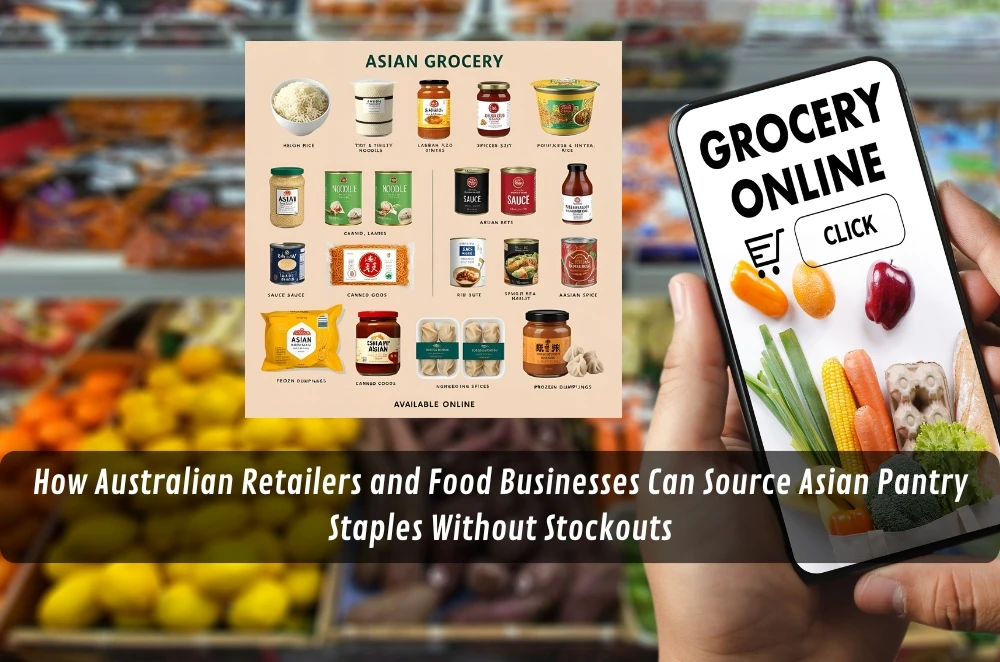

If you’ve ever had someone ask for “that exact noodle” or “the right chilli paste” and felt your stomach drop because you know it’s not on the shelf, you’re not alone.
In Australia, demand for Asian pantry staples keeps climbing, but the supply side can feel like it’s built on a mix of wide ranges, inconsistent naming, and the occasional curveball delivery.
The tricky part isn’t discovering products—it’s building a sourcing routine that still works when you’re busy, short-staffed, and trying not to drown in half-open cartons.
Why “Asian market style” sourcing gets messy fast
“Asian market style” isn’t one cuisine or one shopping list; it’s a whole set of small, specific preferences that don’t always tolerate shortcuts.
A swap that seems harmless—one soy sauce for another, one noodle thickness for another—can quietly change the flavour, the texture, and whether people come back for it.
For Melbourne homes, that shows up as frustration: people can cook the dish once, then can’t repeat it because one key staple disappears for weeks.
For retailers and food service, it’s more operational: you can stock plenty of “similar” options and still miss the one that actually turns, while the wrong packs sit there absorbing cash.
There’s also a format mismatch that trips people up. Household shoppers might want smaller sizes and variety, while kitchens want consistent, larger formats that reduce handling and waste.
And frozen is its own world. Frozen dumplings, wrappers, seafood, and ready-to-cook items can be brilliant for sales and menu speed, but they punish sloppy receiving, overcrowded freezers, and “we’ll rotate it later” habits.
Decision factors that actually matter when choosing an approach or supplier
Most stockouts aren’t caused by a lack of options; they’re caused by a lack of rules.
1) Build around a core basket, not a wish list.
Start with staples that appear across multiple dishes (or multiple household meals), so every carton has a job to do. A core basket makes ordering less emotional, because you’re replenishing the basics rather than chasing whatever was requested this week.
2) Choose consistency before novelty.
A smaller range that shows up reliably is often more valuable than a big range that changes constantly. That consistency lets households repeat meals and lets businesses keep recipes steady without constant staff debate.
3) Get pack sizes right for your reality.
The “right product” can still be wrong if it’s in a pack size that creates waste, spills, or constant reordering. Match pack size to usage, storage space, and how disciplined rotation really is on your worst day, not your best day.
4) Decide your substitution rules in advance.
Substitution is inevitable sometimes; the question is whether it’s controlled or chaotic. Pre-approve acceptable swaps by category (for example: “these noodle families are interchangeable” versus “no swaps for this paste”), so staff aren’t improvising during peak prep or busy trading hours.
5) Make delivery and lead time part of the product decision.
A staple that you can’t replenish predictably will keep creating fires. If the ordering cadence doesn’t match how often you can check stock, it’s not a good fit—even if the item itself is perfect.
If the next step is sense-checking pack sizes and staple availability against what people are actually requesting, the BKK Australia Pty Ltd product catalogue can help frame that conversation.
Common mistakes that quietly cause stockouts and dead stock
Mistake 1: Trying to please everyone on day one.
It’s tempting to stock “everything people ask for,” but that list grows faster than your shelves (or freezer) can handle.
Mistake 2: Treating every SKU as if it’s equally important.
When everything is a priority, nothing is a priority, and your true top sellers end up competing for attention with slow-moving niche items.
Mistake 3: Overestimating storage discipline.
If cartons end up stacked in odd places, labels get hidden, and rotation depends on memory, a larger range will create waste before it creates profit.
Mistake 4: Ordering by feel instead of by a simple number.
A reorder point doesn’t need to be fancy; it just needs to exist, so you’re not relying on “I think we’re low” at the worst possible moment.
Mistake 5: Letting substitutions happen without a script.
One person’s “close enough” is another person’s ruined dish, so substitutions need guardrails.
A simple first-action plan for the next 7–14 days
This plan is designed to be boring, repeatable, and easy to hand to someone else.
Days 1–2: Write your “core basket” on one page.
Aim for 25–40 items across sauces, noodles, rice, seasonings, aromatics, and (if you’re ready) a small frozen set.
Days 3–4: Assign a usage rule to each item.
For every SKU, note expected weekly usage, ideal pack size, and whether substitutes are allowed.
Days 5–7: Set par levels and reorder points.
Pick a minimum level that triggers a reorder and a target level you want to return to after a delivery; keep it simple enough that someone can check it in minutes.
Days 8–10: Run a pilot order and track friction.
Write down what arrived, what was substituted, what was missing, and what receiving/storage felt like in real life.
Days 11–14: Tighten the range and lock standards.
Cut slow movers, standardise 1–2 options per staple, and document substitution rules so decisions don’t change with whoever is on shift.
Operator Experience Moment
I’ve seen teams spend half an hour debating a niche SKU while their top five staples quietly drift into stockout because nobody “owned” the reorder point. The fix is rarely dramatic: define the core basket, attach simple numbers to it, and make substitutions a policy decision. Once those rules exist, the category starts running itself—and the team gets time back.
Local SMB Mini-Walkthrough (Melbourne example, useful Australia-wide)
A small Melbourne caterer adds Japanese curry bowls and Korean-inspired noodle soups to the weekly menu.
They list every ingredient customers mention, then cut it down to a 30-item core basket they can reorder weekly.
They standardise one curry base, one gochujang option, two noodle types, and one soy sauce “family” to keep flavours consistent.
They set par levels after watching two weeks of orders and adjust pack sizes to reduce half-used containers.
They trial only a small frozen range once they confirm freezer space and assign a rotation check to a specific day.
After a fortnight, they drop two slow movers and reinvest in the staples that turned fastest.
Practical Opinions
If a staple can’t be replenished predictably, it’s not a staple—it’s a gamble.
Standardise formats early, then expand only when usage proves the complexity is worth it.
Write substitution rules down so quality doesn’t depend on who’s working.
Key Takeaways
- Start with a tight, reliable core basket before widening the range.
- Match pack sizes to real usage, storage space, and rotation discipline.
- Use par levels and reorder points so ordering becomes routine rather than reactive.
- Treat substitutions as a controlled process with pre-approved rules.
Common questions we hear from Australian businesses
How do we decide what belongs in the core basket without guessing?
Usually, the core basket comes from overlap: ingredients that appear in many dishes (or many household meals), not the most “interesting” items. A practical next step is to list your top 10 best-selling dishes or most-requested ingredients and circle what repeats, then build the first basket from those repeats. In most Australian metro areas—Melbourne included—consistency is what turns first-time buyers into regulars.
What’s a sensible way to avoid overbuying slow-moving specialty items?
It depends on your storage discipline and how quickly you can spot a slow mover before it becomes dead stock. A practical next step is to cap each category to one main option (two at most) until you’ve tracked two to four reorder cycles, then expand only if demand holds. In Australia, where delivery timing and availability can vary by location, “just in case” buying is one of the easiest ways to tie up cash.
How can we handle substitutions without creating complaints or recipe drift?
In most cases, the answer is to pre-approve substitutions by category and document them so the team isn’t making brand-new decisions under pressure. A practical next step is to create a one-page substitution sheet that sits with ordering notes and gets updated whenever a delivery includes a change. In Australian food service, even small flavour shifts can be noticed quickly, especially when a dish becomes a regular order.
When should we expand into a larger frozen range?
Usually, it’s after dry goods and pantry replenishment are stable, because frozen adds extra risk if receiving and rotation aren’t already routine. A practical next step is to start with a small frozen set, confirm freezer capacity, and schedule a fixed weekly rotation check that someone is accountable for. In many Australian small businesses, freezer space is shared across multiple categories, so the frozen range should earn its place through proven turn rate.










Sign in to leave a comment.