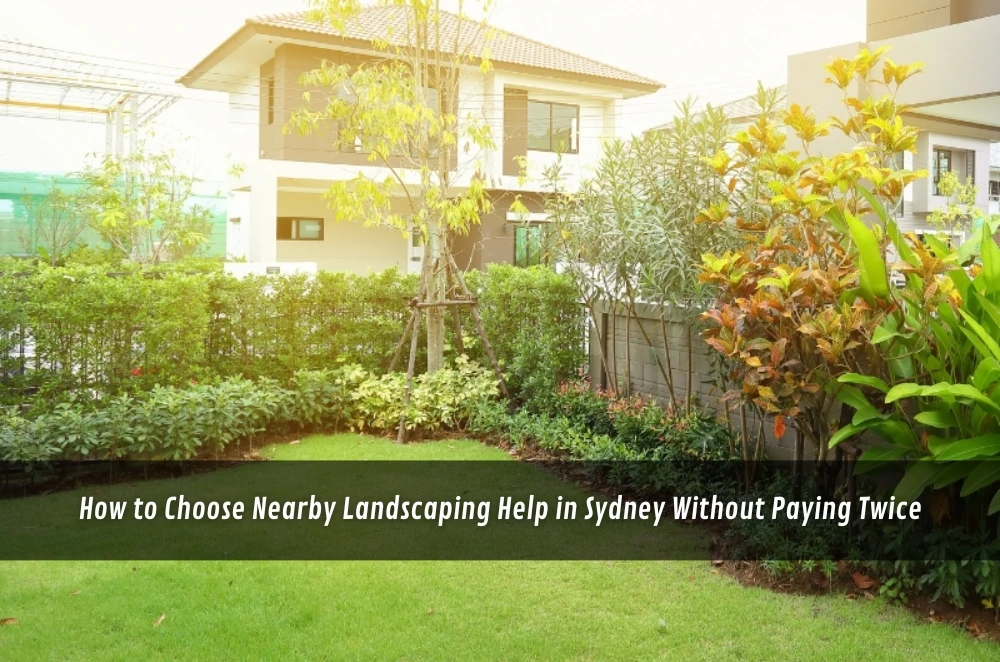

Landscaping in Sydney can look simple right up until the quotes arrive, and none of them sound like they’re talking about the same yard.
One person pitches a quick tidy, another starts discussing levels and drainage, and suddenly you’re wondering whether you asked the wrong question.
The tricky part is that “nearby landscaping help in Sydney” covers everything from a clean-up crew to a full outdoor rebuild.
If the scope isn’t clear, the pricing won’t be either.
Most blowouts don’t happen because someone is dodgy.
They happen because assumptions quietly pile up: what’s being removed, where waste goes, what “level” means, and whether water is going to behave in the next big downpour.
Here’s how to get a result that lasts, without turning it into a months-long saga.
Why Sydney quotes can be all over the shop
Sydney blocks are rarely neat rectangles with perfect access.
You get terraces, narrow side paths, retaining edges that are “fine for now”, and corners where water always seems to find its way back to the house.
Then there’s the weather.
A few dry weeks can make the yard look stable, and one heavy rain will reveal the real story: runoff carving channels, pavers shifting, mulch washing downhill, or a low spot turning to soup.
So two providers can walk the same space and picture two different jobs.
That’s not a pricing issue—it’s a scoping issue.
Start with the outcome, not the materials
A lot of people begin with “I want pavers” or “I want new turf” because it feels concrete.
But you’ll get better advice if you start with what you want the space to do.
Try these prompts, written in plain English:
- “I want it to look rental-ready with minimal upkeep.”
- “I want to stop water pooling near the back door.”
- “I want a small entertaining area that’s stable underfoot.”
- “I want the front to look sharp without weekly work.”
That’s your outcome.
Materials come later, and often change once someone points out what’s driving the problem.
Build a one-page brief that makes quotes comparable
You don’t need drawings.
You do need something that stops each provider from inventing the missing details.
Keep it to a page and include:
- What stays (trees, a clothesline, existing paving, irrigation)
- What goes (overgrown shrubs, tired edging, patchy lawn, weeds)
- Access notes (narrow side path, stairs, shared driveway, strata rules)
- The pain points (mud, runoff, slipping, sun-baked plants, privacy)
- The finish you expect (“tidy and clean” is fine if you define it)
- Your upkeep tolerance (weekly, monthly, or “almost never”)
Add 10–15 photos taken on your phone, including the access route from street to yard.
A few rough measurements help too (even “about 6 metres by 3 metres” beats nothing).
If you want a simple structure to follow, the All Green Gardening and Landscaping project checklist can help turn your thoughts into a clean one-pager before you call anyone.
Once you send the same brief to two or three providers, you’re finally comparing like with like.
What actually matters when choosing an approach (and a provider)
Price is a result of the decisions you make upfront.
If you only compare the totals, you’ll miss what you’re really buying.
Maintenance help vs project work
A maintenance crew is great for pruning, mowing, clean-ups, and keeping growth under control.
A project-focused team is better when you’re changing levels, surfaces, edging, drainage, or layout.
Where people get stuck is hiring maintenance for a project outcome.
It can be slow, piecemeal, and expensive because the work isn’t being planned as a sequence.
Quick lift vs long-life upgrade
A quick lift improves presentation fast: trim, mulch, tidy borders, and fresh turf in a simple area.
A long-life upgrade spends time on groundwork: soil improvement, stable edging, runoff control, and plant selection that suits heat and exposure.
If your yard is on a slope or you’ve got water issues, quick lifts can look great for a month and then unravel.
That’s not failure—it’s physics.
Access and disposal (the quiet budget drivers)
Sydney access can be the whole job.
If everything has to be carried through a narrow side path or up steps, labour goes up, and timelines stretch.
Waste disposal matters too.
“Green waste removal included” is not the same as “all spoil and demolition waste removed” (and the difference can be hundreds of kilos).
Ask each provider to state, in writing, what’s being removed and where it’s going.
This single step prevents a lot of unpleasant surprises.
Drainage and water movement
You don’t need a technical lecture.
You do need a straight answer to: “Where does water go when it rains hard?”
If someone avoids the topic, that’s a flag—especially if you’re adding paving, new turf, or a seating area.
Water will always take the easiest path, and it’s rarely the path you want.
Common mistakes that cost people the most
Mistake: Letting the quote define the job.
If you don’t provide a brief, each provider fills the gaps their own way, and you can’t compare.
Mistake: Choosing finishes before fixing the underlying issue.
Pavers won’t feel good underfoot if the base isn’t stable, and turf won’t thrive if it’s sitting in the wrong spot for sun and runoff.
Mistake: Underestimating the “edges”.
Edging looks minor, but it’s what keeps mulch in place, stops soil migration, and makes the yard look finished.
Mistake: Forgetting aftercare.
New planting often needs a settling-in period, even if it’s “low maintenance” long-term.
Mistake: Not agreeing on what “tidy” means.
One person’s tidy is “raked and blown”, another’s tidy is “all debris removed, edges clean, beds reshaped”.
Define it once, then insist it’s in the scope.
Operator Experience Moment
The smoothest projects I’ve seen start with someone saying, very clearly, “This is what stays, this is what goes, and this is the problem I want solved.”
When that’s missing, the job becomes a guessing game, and the quote becomes a collection of assumptions.
A simple one-page brief doesn’t just save money—it keeps the conversation practical and calm.
Local SMB mini-walkthrough: a realistic Sydney scenario
A café owner in the Inner West wants the courtyard to feel clean and inviting, not “overgrown storage”.
Access is via a tight lane, so everything comes through a narrow gate, and waste has to be managed carefully.
After rain, water tracks across the paving and leaves grit right at the door.
They keep one established feature plant and remove a row of struggling shrubs that never really worked.
The plan prioritises runoff control, then stabilises the surface, then refreshes planting with heat-tolerant options.
The finish is simple: fewer plants, better placement, and edges that hold their shape.
A simple plan for the next 7–14 days
Days 1–2: Watch the yard like a detective.
If it rains, great—observe where water moves and where it sits.
If it doesn’t, hose the area briefly and see where it runs.
Days 2–4: Write the one-page brief and take photos.
Do it in one sitting, then sleep on it and tighten it the next day.
Clarity is the goal, not perfection.
Days 4–6: Shortlist two to three nearby providers who do the kind of work you need.
Look for alignment: maintenance for upkeep, project teams for changes to layout, surfaces, levels, or drainage.
Days 6–10: Request quotes using the same brief.
Ask for inclusions and exclusions, waste removal details, finish level, and a realistic timeline.
If something is “assumed”, ask them to write that assumption down.
Days 10–14: Compare what they’re actually doing, not just the totals.
The best option is usually the one that sequences the work sensibly: solve the core problem first, then make it look good.
Practical opinions: Fix water movement before paying for pretty finishes.
Practical opinions: A clear scope beats a clever pitch every time.
Practical opinions: Low-maintenance is mostly a design discipline, not magic plants.
Key Takeaways
- A clear scope creates comparable quotes and fewer surprises
- Access, disposal, and drainage are the biggest hidden cost drivers in Sydney yards
- Choose maintenance help for upkeep and project teams for changes to levels, surfaces, or layout
- Define “done” in plain language, then get inclusions and exclusions in writing
Common questions we hear from businesses in Sydney, NSW, Australia
Q1: How many quotes should be gathered before making a decision?
Usually, two or three is enough if each provider is quoting the same one-page brief and listing assumptions clearly. The next step is to send identical photos and access notes to everyone so you’re not comparing apples with oranges. In Sydney, tight access and disposal logistics can change the cost more than the actual garden work.
Q2: What should be prioritised if water is pooling or the yard stays soggy?
In most cases, you prioritise understanding water movement before choosing turf, mulch, or paving. The next step is to note where downpipes discharge, where water runs during heavy rain, and which areas stay wet for days. In Sydney storms, small level changes can redirect water toward doorways and paths, so sequencing matters.
Q3: Is “low maintenance” mostly about plant choice?
It depends, but layout and edges usually do most of the work: stable borders, sensible bed sizes, and surfaces that don’t migrate. The next step is to decide how often you’ll realistically maintain the space, then design for that cadence. In Sydney’s hotter stretches, thirsty planting can become high-maintenance quickly if the area gets full sun or reflected heat.
Q4: What should be confirmed before booking any work?
Usually, you want scope, inclusions/exclusions, disposal details, and aftercare expectations written down before a start date is locked. The next step is to ask for a brief breakdown of deliverables (including cleanup and waste removal) and to clarify what happens if hidden issues appear once digging starts. In many Sydney suburbs, parking, strata rules, and site access windows can affect the schedule, so logistics should be agreed upon early.










Sign in to leave a comment.