
In hockey, speed and agility are crucial components of success. Whether you're a forward breaking away for a breakaway or a defenseman backchecking to stop an opponent, your ability to cover ice quickly can make all the difference. One of the most effective ways to improve your speed on the ice is by increasing your stride length. A longer stride allows you to cover more ground with each push, translating to faster acceleration and greater overall efficiency. In this post, we’ll explore practical strategies to help you that how do you increase your stride length and elevate your hockey performance.
Understanding Stride Length in Hockey
Stride length refers to the distance you cover with each step or push on the ice. In hockey, a powerful and efficient stride is a combination of strength, flexibility, and proper technique. While some players naturally have a longer stride, it’s a skill that can be developed with targeted training and practice. The key is to focus on improving your mechanics, building strength in the right muscle groups, and enhancing your flexibility.
1. Focus on Proper Skating Technique
Before diving into strength training or flexibility exercises, it’s essential to ensure your skating technique is sound. Proper form is the foundation of an effective stride. Here are a few tips to refine your technique:
- Knee Bend: A deep knee bend is critical for generating power. The lower you are to the ice, the more force you can apply with each push. Keep your knees bent at approximately a 90-degree angle to maximize your push-off.
- Full Extension: Many players fail to fully extend their legs during each stride. Focus on pushing through the entire length of your blade, extending your leg completely to maximize the distance covered.
- Recovery Phase: After each push, bring your leg back under your body efficiently. A quick recovery allows you to maintain momentum and prepare for the next stride.
2. Build Lower Body Strength
Increasing your stride length requires significant lower body strength, particularly in your quadriceps, glutes, hamstrings, and calves. These muscles are responsible for generating the power needed to push off the ice. Incorporate the following exercises into your off-ice training routine:
- Squats: Squats are one of the best exercises for building leg strength. Focus on deep squats to mimic the knee bend required in skating.
- Lunges: Lunges help improve single-leg strength and stability, which is essential for powerful strides.
- Deadlifts: This exercise targets your hamstrings and glutes, key muscle groups for explosive pushes.
- Plyometrics: Exercises like box jumps and lateral bounds can improve your explosive power, helping you generate more force with each stride.
3. Improve Hip Flexibility
Flexibility, particularly in the hips, plays a significant role in achieving a longer stride. Tight hip flexors can limit your range of motion, preventing you from fully extending your leg. Incorporate these stretches into your routine to improve hip flexibility:
- Hip Flexor Stretch: Kneel on one knee with the other foot in front, forming a 90-degree angle. Push your hips forward gently until you feel a stretch in the front of your hip.
- Pigeon Pose: This yoga pose is excellent for opening up the hips. Sit on the floor with one leg bent in front of you and the other extended behind.
- Dynamic Stretches: Incorporate dynamic stretches like leg swings into your warm-up routine to improve mobility and prepare your muscles for skating.
4. Work on Your Core Strength
A strong core is essential for maintaining balance and stability on the ice. It also helps transfer power from your lower body to your upper body, ensuring efficient movement. Incorporate core exercises like planks, Russian twists, and medicine ball throws into your training routine.
5. Practice Skating Drills
On-ice drills are one of the most effective ways to improve your stride length. Here are a few drills to incorporate into your practice sessions:
- Power Skating Drills: Focus on drills that emphasize full extension and powerful pushes. For example, practice long, gliding strides down the length of the ice, concentrating on extending your leg fully with each push.
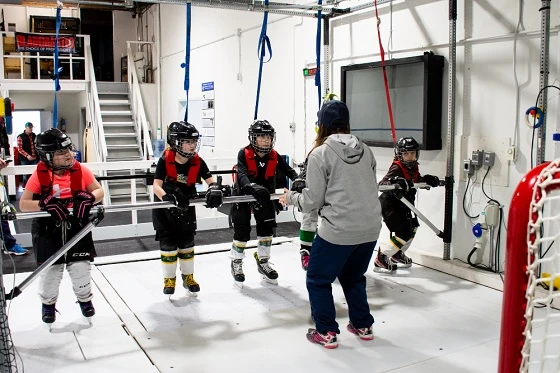
- Resistance Training: Use a resistance band or parachute while skating to build strength and power. This added resistance forces your muscles to work harder, helping you develop a more powerful stride.
- Backward Skating: Don’t neglect backward skating. It helps improve overall skating mechanics and strengthens the muscles used in forward strides.
6. Analyze and Adjust
Recording your skating technique can provide valuable insights into areas for improvement. Use video analysis to assess your stride length, knee bend, and leg extension. Compare your technique to that of elite players and identify areas where you can make adjustments.
7. Stay Consistent
Improving your stride length won’t happen overnight. It requires consistent effort and dedication. Make these exercises and drills a regular part of your training routine, and over time, you’ll notice significant improvements in your speed and efficiency on the ice.
Increasing your stride length is a game-changer for hockey players looking to enhance their speed and performance. By focusing on proper technique, building lower body strength, improving flexibility, and incorporating targeted drills, you can develop a more powerful and efficient stride. Remember, consistency is key, and with time and effort, you’ll see the results on the ice.
For more tips and personalized training programs, consider reaching out to the experts at Pro Stride Hockey.











Sign in to leave a comment.