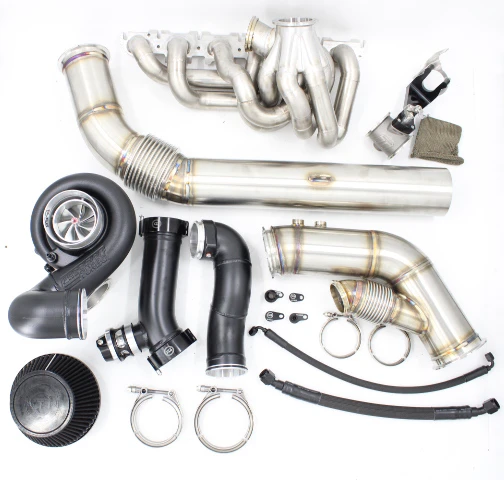

You’ve just upgraded your BMW B58 turbo to one with a better design, higher airflow, and improved supporting parts. Now, it’s time to do a dyno test and evaluate the differences between your new and old turbo, from the power curve to the boost pressure, peak horsepower, and spool time. Understanding the test data can help you understand how your upgrade affects your car’s performance.
What Data Does a Dyno Chart Give?
A dyno chart starts by giving you the horsepower and torque across an RPM range. It does this by capturing the engine’s performance while under load, charting how the power builds, peaks, and sustains. The shape of the horsepower and torque output across the RPMs explains the power and torque curves, respectively. Spool time measures how quickly your B58 upgraded turbo builds boost.
Reading the Data
When evaluating the test data, you can expect to see the baseline of the old turbo compared to the runs with your upgraded B58 single turbo kit. It shows the mechanical differences between the old and new turbo. You also want to identify peak gains, which can be seen in the vertical separation between curves. This equals the power added by the upgraded turbo. A wider torque band means more consistent acceleration. A faster spool time means your car is getting a better throttle response. Boost pressure shows the air pressure produced by the turbo above the atmospheric pressure.
Comparing the New and the Old
Comparing the numbers and shape of the graph is the final, most important step to evaluate whether your new turbo is providing the performance upgrade you hoped for. Higher boost pressure means more power, but the efficiency determines the usable performance boost. The horsepower curve should be a broad, smooth curve, and it should keep pulling at higher RPMs. The torque curve should be wide, flat, and consistent. Faster spool times are ideal for more power delivered quickly. However, if it comes slightly later and the power holds on longer, it may be well-matched for your build. Overall, look for more area under the curves.
About Vargas Turbocharger Technologies
Unlock the potential of your vehicle with Vargas Turbocharger Technologies. Based in Hayward, CA, VTT™ specializes in turbochargers, turbo accessories, and many other performance enhancements for a wide range of vehicles, including high-performance BMWs. Browse their selection of newly fabricated turbos (designed and built in-house by VTT™), rebuilt OEM turbos, custom turbos, and complete turbo kits. If your goal is to take your vehicle’s power and performance to the next level, turn to the experts at VTT™.
Get a turbo upgrade for your car at https://vargasturbo.com/
This article was originally published on vargasturbo.com’s blog here.










Sign in to leave a comment.