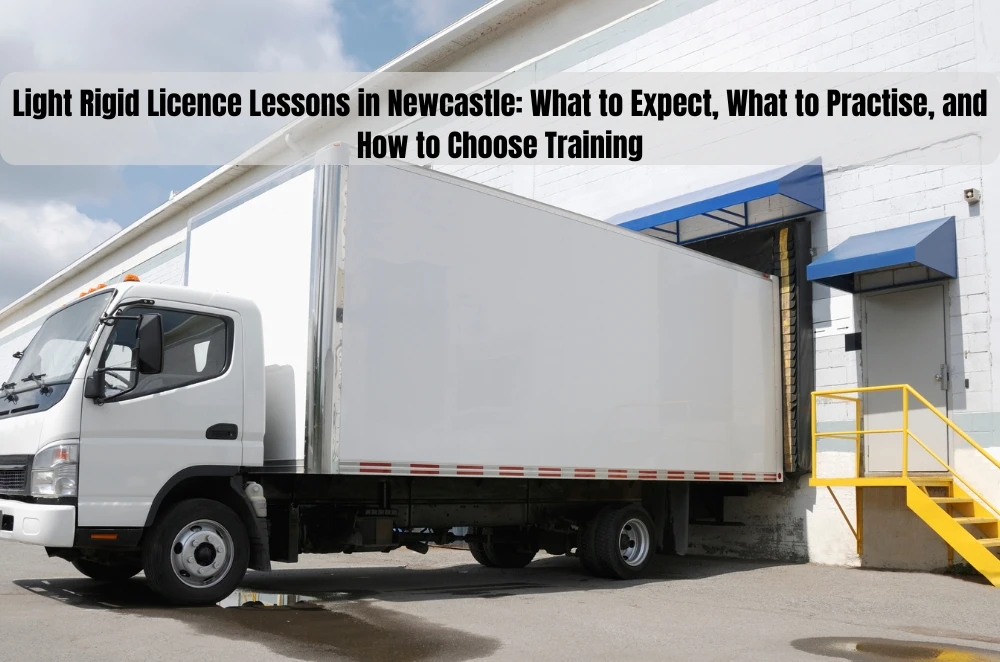

In Newcastle, “light rigid” sits in a sweet spot: big enough to open doors to more roles and vehicles, but still close enough to everyday driving that many learners underestimate how different it feels behind the wheel. The jump isn’t just about size. It’s about weight transfer, braking distance, wider turns, mirror discipline, and learning a routine that proves you can drive a heavier vehicle safely and consistently.
If you’re lining up light rigid (LR) licence lessons, it helps to know what the training is actually trying to build: not a one-off “test pass”, but a repeatable set of habits you can carry into work, volunteer driving, or anything involving buses, small trucks, or service vehicles.
What an LR licence covers in NSW
An LR licence is designed for vehicles that are heavier or carry more passengers than a standard car licence allows. In practical terms, LR is commonly associated with:
- Two-axle trucks and buses in the light rigid class
- Small buses (including some community transport and shuttle-style vehicles)
- Service and delivery vehicles that sit above car-licence limits
The exact boundary depends on vehicle specifications (including mass and seating), so if you’re considering light rigid licence lessons in Newcastle, part of responsible LR preparation is getting comfortable reading a compliance plate and understanding what you’re actually licensed to drive.
Why LR feels different to drive
Even if you’ve been driving for years, an LR vehicle behaves differently in ways that show up quickly during training and assessment.
Braking and following distance
A heavier vehicle needs more distance to slow down smoothly, and braking can feel “delayed” if you’re used to a car’s response. Assessors tend to look for anticipation: easing off earlier, planning your stops, and avoiding last-second braking that can unsettle passengers or load.
Turning and lane positioning
New drivers often “cut” corners out of habit. In an LR vehicle, that can bring your rear wheels uncomfortably close to kerbs, islands, or lane lines. Good LR driving is deliberate: setting up earlier, checking mirrors through the turn, and exiting cleanly without drifting.
Mirrors become your primary tool
A common early mistake is treating mirrors like a quick glance rather than an ongoing scan. In LR, mirrors aren’t optional extras; they’re how you manage space. Expect your trainer to push mirror checks before moving off, before changing lanes, approaching intersections, and when pulling in and out.
Vehicle height and width awareness
Overhanging branches, tight driveways, narrow streets, and poorly planned parking approaches can all become “surprises” if you’ve only driven cars. Training helps you build a mental model of the vehicle’s footprint—so you’re not guessing.
What LR lessons typically include
While each provider structures training differently, LR lessons in NSW usually blend three streams: vehicle familiarisation, on-road driving, and assessment-style routines.
Pre-drive checks and safety routines
This is where many learners lose easy marks. Instructors will usually take you through a repeatable pre-drive process (think: seating position, mirrors, seatbelt, basic checks, and safe starting procedures). The goal is to make it automatic—because on assessment day, nerves can erase memory.
Low-speed control
A lot of “good driving” happens below 30 km/h: tight turns, roundabouts, reverse positioning (where relevant), and managing blind spots in car parks or depots. LR training often spends time here because it’s where mistakes are most likely to become costly.
Real-road conditions around Newcastle
Newcastle offers a useful mix of driving environments: industrial areas, multi-lane roads, hilly sections, and busy intersections. Good training should prepare you for what you’re actually likely to face—rather than keeping you in the easiest possible streets.
Assessment preparation
Even if you’re a confident driver, you’ll usually benefit from structured practice under “assessment conditions”: following instructions, making safe decisions under time pressure, and staying consistent from start to finish.
Common mistakes that trip people up
LR learners often fail for predictable reasons—usually not because they’re unsafe people, but because they carry over car habits that don’t translate.
- Late mirror checks (especially before lane changes and turns)
- Poor gap selection at roundabouts and intersections (hesitating too long or going too early)
- Turning too tight and clipping kerbs
- Inconsistent speed control (too fast downhill, too slow in flow, braking too late)
- Not planning stops early (hard braking feels “normal” in a car, but looks messy in a heavier vehicle)
- Letting nerves shrink attention (forgetting routine checks, missing signs, or second-guessing safe decisions)
A good trainer will correct these early and give you a simple “decision framework” you can repeat when you’re stressed.
How to choose LR lessons in Newcastle
You don’t need a perfect driving school—just one that matches your needs, gives you enough time behind the wheel, and teaches in a way you can repeat without prompting.
Look for a training approach that’s practical, not just instructional
LR driving is a physical skill. You want lessons that put you in real scenarios, explain the “why” behind each technique, and let you practise until you can do it consistently.
Ask how they structure training and assessment support
Some providers offer combined training and assessment pathways; others focus on training only. Either way, you’ll want clarity on what happens on the day and how much practice you’ll get beforehand.
Consider where you’ll train
If you live in Newcastle, you’ll typically learn best when your lessons reflect your local conditions—traffic patterns, road types, and the kinds of manoeuvres you’ll actually be doing. Training that feels “too easy” can be a red flag if it leaves you under-prepared for busier roads.
Vehicle suitability matters
Not all LR vehicles feel the same. If you’re training for a role (say, a shuttle bus versus a small truck), it helps if the training vehicle reflects what you’ll drive later—at least in general handling and layout.
A practical example of what LR training can look like
If you want a sense of how one NSW provider describes LR training and the vehicle types it’s geared toward, you can see the course overview in this LR licence training page.
How to prepare before your first lesson
You don’t need to “pre-learn” everything, but small prep steps can make your lessons more productive.
- Drive like you’re being assessed in your car for a week: smoother braking, earlier mirror checks, clearer gap selection
- Practise scanning: mirrors, ahead, side streets, pedestrians—then back to mirrors
- Get comfortable with instructions: a simple trick is to narrate your plan quietly (“mirror, indicate, position, go”) to stay calm and structured
- Sleep and hydration matter more than people admit—fatigue shows up as sloppy decisions
When it’s worth taking extra time
Some learners can step into LR training and progress quickly. Others benefit from extra practice—not because they’re “bad drivers”, but because they’re building new habits under pressure.
Extra time can be worth it if you:
- Haven’t driven much recently
- Get anxious in traffic
- Struggle with spatial awareness (tight turns, kerb distance, lane positioning)
- Need to drive a specific vehicle type soon for work
There’s no prize for rushing. The goal is to come out safer and more confident—because LR vehicles don’t forgive casual driving the way cars sometimes do.
Key Takeaways
- LR training is less about “bigger vehicle” and more about new habits: mirrors, planning, space management, and smooth control.
- Newcastle roads are a good testing ground—aim for lessons that include real-world traffic and varied conditions.
- Most LR mistakes are predictable (late mirrors, tight turns, poor planning) and can be fixed with structured practice.
- Choose training based on teaching quality, practice time, and clarity around assessment preparation—not just convenience.
- A little prep (mirror discipline, smoother braking, calm decision-making) makes your lessons more effective from day one.











Sign in to leave a comment.