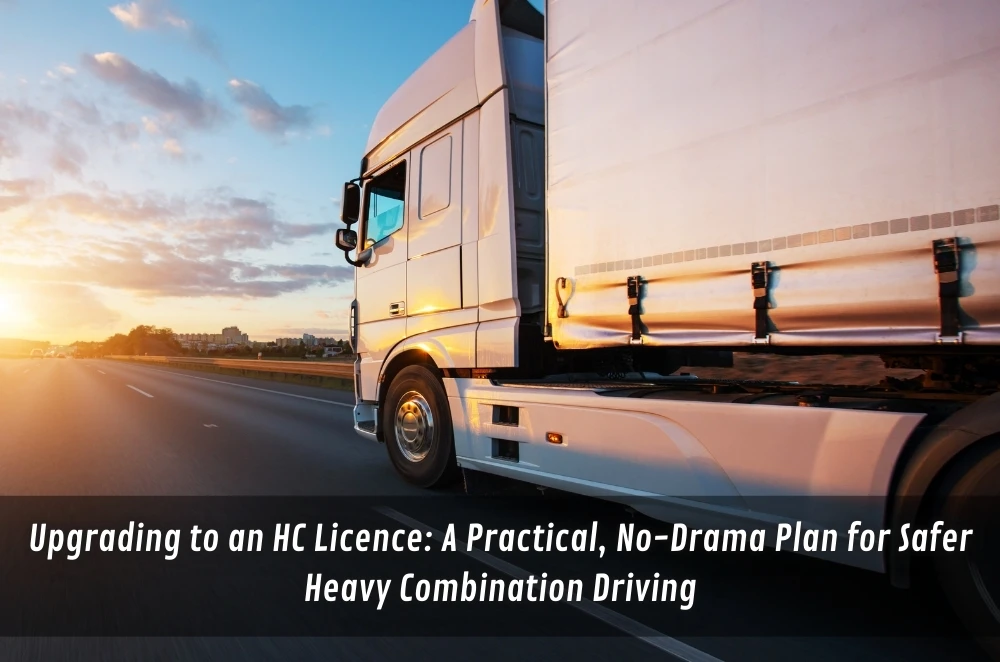

Stepping up to a Heavy Combination (HC) class isn’t just “a bigger licence”. It changes how you plan, how you position, and how you manage risk when the trailer starts influencing the whole vehicle.
Most people who struggle with the upgrade aren’t “bad drivers”. They’re usually carrying habits from smaller combinations that don’t scale, especially under pressure.
If the goal is a confident upgrade, the fastest path is usually the calm one: understand what’s being assessed, train the fundamentals properly, and remove the avoidable mistakes.
What an HC upgrade really changes in day-to-day driving
An HC combination asks you to think earlier and wider, because the trailer isn’t a passenger—it’s a steering influence.
You’ll feel the difference most in low-speed control, lane discipline, and how much space you need to recover when something goes slightly off.
Reversing is often the headline skill, but forward planning is the hidden differentiator: approach angles, setup, mirrors, and knowing when to stop and reset rather than “saving it”.
You’re also operating in a world where small errors stack fast: a late mirror check becomes a poor line, which becomes a rushed correction, which becomes a clip risk.
The upgrade is about consistency and judgement, not hero moves.
Eligibility and decision factors: “ready now” vs “not yet”
Before booking training, it helps to be honest about readiness, because “almost ready” can waste sessions.
Here are the decision factors that usually matter most.
Seat time and comfort with larger vehicles
If most driving has been short runs or light urban work, the upgrade can feel like jumping two steps at once. Longer stints build the calm scanning rhythm you need.
Mirror routine and situational awareness
If mirror checks are occasional rather than automatic, the workload in an HC will overwhelm you when traffic compresses or when you’re setting up a turn.
Low-speed accuracy
A lot of assessment tasks expose low-speed weaknesses: drifting wide, late corrections, and inconsistent steering input. If slow control feels messy, fix that first.
Attitude to resets
Drivers who treat a reset as a failure often force a manoeuvre and compound the error. Assessors usually prefer the safe stop, the controlled reset, and the correct finish.
Choosing a provider and training approach
A good provider makes the assessment standard feel predictable rather than mysterious, and teaches a process you can repeat under stress.
Look for training that clearly covers pre-drive checks, vehicle control, reversing setup, observation, and the “why” behind the technique—not just reps.
How good HC training is structured (and how to spot weak training)
Good training tends to follow a sequence: foundations first, then complexity.
A typical structure starts with cockpit setup and mirror positioning, then slow control and tracking, then reversing with a repeatable method, then roadcraft in mixed conditions.
If you want a concrete example of what’s typically covered and how sessions are sequenced, Core Truck Driving School HC licence overview is a useful reference point.
Weak training often looks like “let’s drive around and see what happens,” with random tips and not much measurement of progress.
If feedback is mostly “do it again” without a clear adjustment (setup point, mirror target, steering timing), that’s usually a sign the method isn’t defined.
A solid trainer will stop the run early to fix the input that causes the error, because repeating the mistake is practising the mistake.
Common mistakes that derail capable drivers
These are the patterns that most often show up in people who are otherwise safe and experienced.
Rushing the setup
In reversing and in tight turns, the setup does most of the work. A poor setup forces aggressive steering later, which is when lines get crossed and confidence disappears.
Over-steering, then chasing the trailer
Big corrections create bigger problems. The fix is usually smaller, earlier inputs with time to observe the trailer response.
Late mirrors and “hope steering”
If the mirrors only get checked once things feel wrong, it’s already late. Build a rhythm: check, adjust, check again, confirm.
Treating stopping as “losing”
Stopping is a tool. A controlled stop to regain alignment is safer than a rushed save, and assessors can see the difference.
Ignoring the tail swing and cut-in
Many near-misses come from forgetting the rear exists while focusing on the front. In an HC, both ends matter all the time.
Practising without a method
Doing ten reverses without consistent reference points can lock in bad habits. Practise a repeatable routine: position, reference, slow input, observe, correct, reset.
Operator Experience Moment
A common moment in heavy-combination training is watching a driver “do everything right” and still end up out of position—because they started the manoeuvre from a slightly wrong angle.
When you pause and rebuild the setup from scratch, the same driver often nails it calmly on the next run.
That’s the point where it clicks: the licence upgrade isn’t about tougher steering, it’s about better decisions earlier.
A simple 7–14 day plan to prepare (without overtraining bad habits)
This plan is designed to build readiness quickly while avoiding the trap of practising mistakes.
Day 1–2: Define the assessment expectations
Write down the core tasks: pre-drive checks, observation, low-speed control, reversing, turns, and general roadcraft. Keep it simple and specific.
Day 3–4: Lock in cockpit and mirror setup
Do not underestimate this. If your mirrors aren’t giving consistent reference points, your steering will always feel late.
Day 5–7: Build a mirror rhythm
Practise a routine you can repeat under stress: mirror check before changes, during the manoeuvre, and after corrections. Say it out loud if you need to.
Day 8–10: Slow-speed control and tracking
Work on smooth clutch/brake control (as applicable), steady speed, and holding a line without constant corrections. Stability beats speed every time.
Day 11–14: Reversing with a defined method
Use clear reference points and slow inputs. Focus on recognising the “early warning signs” that the trailer is drifting so you correct earlier.
If possible, schedule training so the gap between sessions is long enough to practise, but not so long you forget the method.
Practical Opinions (exactly 3 lines)
If you’re unsure whether you’re ready, prioritise a short assessment-style session over more solo practice.
When practising, build a routine first, then add difficulty—random reps rarely translate under pressure.
A safe reset is a skill; treat it as part of the method, not a fallback.
Local SMB mini-walkthrough (Sydney context)
A Sydney plumbing business wants to add an HC-capable driver to cover bigger jobs and reduce subcontracting.
They start by listing the routes: metro drops, ring-road travel, and occasional regional runs.
Next, they set a minimum standard: consistent mirror routine, controlled reversing, and calm decision-making in traffic.
They roster one experienced driver for training time so the upgrade doesn’t smash the weekly schedule.
They update the yard procedure: spotter rules, reversing zones, and a simple pre-departure checklist.
Finally, they plan a two-week ramp-up: lighter loads first, then more complex deliveries once the driver’s rhythm is stable.
Making the upgrade safer and easier: what to look for in your own driving
If you want one self-check that predicts success, it’s this: can you stay calm while doing the basics perfectly?
When stress rises, most people speed up. In HC work, speed usually makes the picture worse.
The goal is to slow the process down mentally—scan earlier, set up earlier, and correct earlier.
That’s why structured training works: it replaces improvisation with a repeatable sequence.
Key Takeaways
- HC upgrades reward early planning, consistent mirror work, and calm resets more than “confidence” alone.
- The setup is the manoeuvre—get the starting position right and the rest becomes simpler.
- Practise with a method and reference points, or you risk hardening bad habits.
- In the next 7–14 days, prioritise mirror rhythm, slow control, and a defined reversing routine.
Common questions we hear from Australian businesses
Do drivers need lots of experience before upgrading to HC?
Usually, people do best when they’re already comfortable with larger vehicles and have a consistent observation routine. A practical next step is to do a short readiness check with a trainer and ask what specific gaps to close. In Sydney traffic conditions, the ability to stay composed during merges and lane changes often matters as much as the reversing task.
How long does HC training typically take?
It depends on current skill, how recently someone has been driving, and how quickly they adopt a repeatable method. A good next step is to book an initial session and request a simple plan that covers pre-drive, low-speed control, reversing, and on-road components. In most cases, fitting sessions around Sydney work rosters is easier when you plan practice windows between lessons.
What’s the biggest reason people don’t pass on the first go?
In most cases, it’s not one huge mistake—it’s small issues stacking under pressure, like rushed setup, late mirrors, and over-correction. A practical next step is to practise stopping and resetting calmly, because it breaks the “panic spiral” before it starts. Around busy Sydney industrial areas, tight yards and compressed traffic are where these habits show up fastest.
How should a small business support a driver going for an HC upgrade?
Usually, the best support is time and structure: a clear training window, less pressure on the first few shifts, and simple yard rules that reinforce safe reversing. A next step is to map the typical routes and identify the two or three highest-risk manoeuvres (tight turns, reversing entries, loading docks). In most cases, Sydney SMEs see better outcomes when they treat the upgrade like onboarding to a higher-risk role, not just “getting a new ticket.”








Sign in to leave a comment.