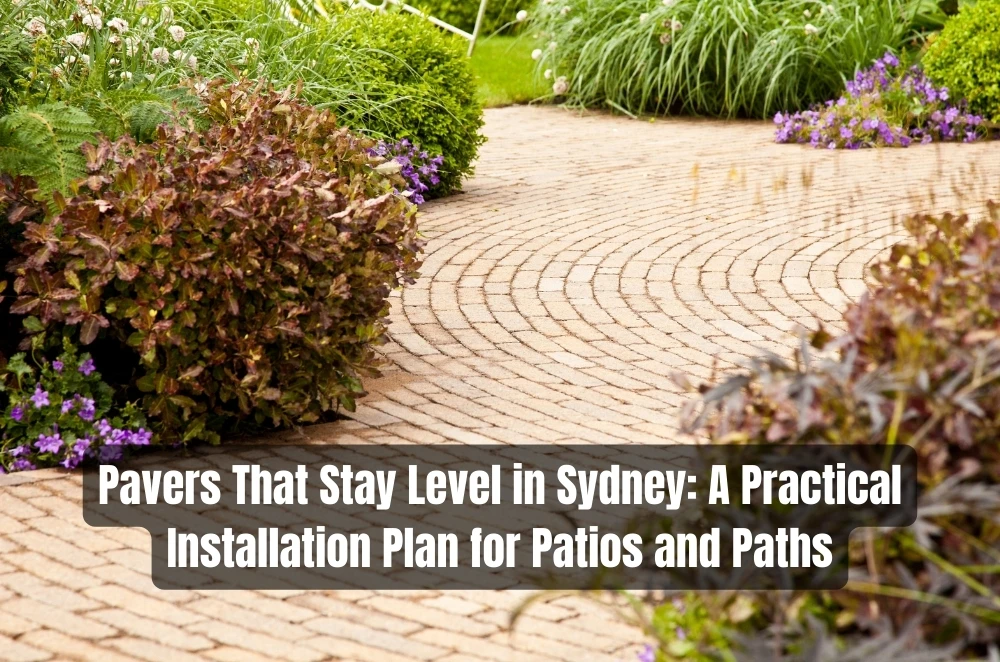

Good paving looks simple when it’s finished—especially when it’s delivered by a nearby paving team for Inner West Sydney that can plan access and staging properly.
What most people don’t see is that the long-term result is decided underneath: how deep the base is, how well it’s compacted, where the water goes, and whether the edges are locked in properly.
Sydney weather can be a stress test—heavy rain that shows drainage problems, hot days that dry surfaces fast, and shaded corners where weeds and algae take hold if moisture hangs around.
This guide is a way to plan patios and paths that stay flat, drain well, and feel solid underfoot.
What “quality paving” really means (and what usually fails first)
Quality paving is boring in the best way.
It stays level, it doesn’t rock when you walk across it, and you don’t get puddles sitting there after a storm.
Edges don’t creep, joints don’t open up, and you don’t end up tripping over little lips that weren’t there at handover.
When paving fails early, it’s usually one of a few things: soft spots in the ground, uneven compaction, weak edges, or water washing joint sand out because the surface has nowhere to drain.
Choosing pavers: thickness, feel, and where they make sense
Picking pavers is not just a style decision.
The “right” paver depends on what you’re using the space for, how much traffic it gets, and whether it stays wet or shaded.
Thickness and real-world use
A patio for outdoor dining is different from a path that gets wheelie bins dragged across it twice a week.
If the area will take heavier loads occasionally—trolleys, small machinery, frequent bins—it’s smart to choose pavers and a build that suits that, rather than hoping it will be fine.
Finish and grip in wet spots
Some finishes look great and become annoying once they’re damp.
Shaded side paths, steps, and pool-adjacent areas need traction that holds up when leaves and moisture are involved.
If you’ve ever felt a path go slick after a few rainy weeks, you already know why this matters.
Colour, heat, and maintenance
Darker pavers can get hot in direct sun.
Lighter pavers can show stains more easily, especially where there’s constant foot traffic or outdoor dining.
Neither is “wrong”—it just helps to choose with your actual use in mind.
Base prep and drainage: where the job is won
If you’re trying to make pavers last, the base is where you spend your attention.
Most paving issues are base issues that don’t show up until months later.
Base depth and compaction
A stable base needs enough depth for the conditions, and it needs even compaction.
If one section is compacted well and another is a bit soft, the surface settles unevenly, and you get wobbles, dips, and lipping.
If the area used to be a garden bed, has been recently dug, or has root activity, it’s worth calling that out because it changes what “proper prep” looks like.
Bedding consistency
A consistent bedding layer makes finished levels easier to control.
When bedding is rushed, you often see it later as small height differences between pavers—nothing huge, just enough to catch your eye (or your toe).
Drainage fall and water flow
Water needs a plan.
Even a slight, consistent fall can stop pooling and slow joint washout, but it has to be built into the levels from the start.
This is especially important in narrow side paths or courtyards boxed in by walls, where water can’t just “find somewhere else” to go.
Common mistakes that cause weeds, wobble, and pooling
These are the mistakes that sound minor at quote stage and become irritating later.
- The base is too thin or not compacted evenly. Settling creates dips and rocking.
- Edges aren’t restrained properly. Pavers creep, joints open, and movement spreads.
- Drainage fall is ignored. Pooling leads to washout and slippery shaded corners.
- Soft spots aren’t dealt with. One weak patch becomes the whole surface’s problem.
- Bedding is rushed. Small inconsistencies turn into lipping over time.
- Jointing is treated as “last step, quick step.” Poor joints mean faster movement and weeds.
- The layout ignores how people actually use the space. Great-looking paving can still feel awkward day to day.
Decision factors: comparing quotes and choosing the right approach
A paving quote should tell you what’s happening below the surface.
If it only talks about the pavers themselves, you’re missing the part that keeps them level.
What a solid scope should spell out
Ask for clarity on excavation depth, base material, and compaction approach.
Ask where water is expected to go and how the fall will be formed.
Ask what edge restraint is being used and where it will sit, because edges are where movement often starts.
Also ask about transitions: steps, thresholds, garden borders, and how the paving meets lawn or existing concrete.
If you want a quick reference for what a proper paving scope should cover, installing quality pavers for Sydney patios and paths can help you sanity-check the quote.
Repair, overlay, or rebuild?
Sometimes you’re not choosing between “pave or don’t pave”.
You’re choosing between fixing one area and dealing with the same issue again later, versus rebuilding the base properly once.
If the pavers are fine but the levels are wrong in multiple places, patch repairs can become a repeating job.
If drainage is wrong, it tends to keep showing up no matter how many times you re-lay a small section.
Small design calls that save future headaches
Patios should be sized for furniture and walking space, not just for looks.
Paths should fit the way you move through the site—bins, prams, two people passing, whatever applies.
A tiny change in layout can be the difference between “this works” and “this annoys me every day”.
A simple 7–14 day plan to get from idea to install-ready
You don’t need to rush into paving, but you do want to avoid getting stuck in endless “maybe” mode.
Days 1–2: Decide what the paving is for
Is this an entertaining patio, a side path, a common-area walkway, a shopfront entry?
Note constraints early: shade, roots, tight access, pooling water, strata rules, and timing limitations.
Days 3–5: Mark the footprint and think about water
Mark the area out so the size is real.
Walk it after rain (or hose it) and note where water sits now.
Decide where the water should go once the paving is in.
Days 6–9: Get quotes you can compare
Ask each provider to include excavation depth, base build and compaction, drainage fall approach, edging, and jointing/finishing.
Confirm whether removal and disposal are included, because that’s often where totals quietly change.
Days 10–14: Prepare access and schedule
Clear access points and plan parking/loading.
If it’s a commercial or strata site, think about pedestrian routes and safety during works.
Operator Experience Moment
The best paving jobs don’t feel “fancy” during the build—they feel methodical.
When the base is compacted evenly and edges are properly restrained, the pavers sit down nicely and stay there.
When one of those steps is rushed, the fix later usually means lifting pavers, which no one enjoys paying for twice.
Local SMB Mini-Walkthrough
A Sydney café has a courtyard path that’s uneven and puddles after heavy rain.
They measure how staff and customers move through the space so the path width makes sense.
The plan focuses on fixing the fall so water runs away from seating areas, not into them.
Edge restraints are upgraded to handle constant foot traffic and trolley movement.
Work is scheduled outside peak trade hours to keep the site safe and usable.
A hose test is done at handover to check that water moves where it should.
Practical Opinions
If water can’t escape, the paving will eventually tell you.
Spend effort on the base and edges before spending effort on patterns.
If a quote won’t explain depth, fall, and edging, treat it as incomplete.
Key Takeaways
- Pavers stay level when base depth, compaction, drainage fall, and edge restraint are done properly.
- Choose pavers for real use (traffic, shade, wet areas), not just how they look on day one.
- Compare quotes by scope details, especially excavation, base build, drainage, and edging.
- A 7–14 day planning window helps you avoid rushing the fundamentals.
Common questions we hear from Australian businesses
Q1) How do we stop pavers sinking or rocking over time?
Usually, it comes back to the base: adequate depth, consistent compaction, and strong edge restraint. A practical next step is to ask for those three items in writing in the quote, not just verbally. In most Sydney yards, disturbed ground and old garden beds are the spots that need extra attention.
Q2) Do we really need a drainage fall for a small patio?
In most cases, yes, because small puddles still wash joint sand out and create slippery shaded corners. A practical next step is to confirm where water will run once paving is installed and how that fall will be formed. Usually, Sydney downpours make weak drainage obvious quickly.
Q3) When is it worth rebuilding instead of fixing a few sunken pavers?
It depends on whether the issue is local (one soft patch) or widespread (base and drainage across the whole area). A practical next step is to inspect the worst section by lifting a small area and checking the base condition rather than guessing. In most cases, repeated sinking is a sign the underlying build needs attention.
Q4) How can we compare paving quotes without being a paving expert?
Usually, you can compare a short checklist: excavation depth, base material and compaction, drainage fall plan, edge restraint type, and jointing/finishing. A practical next step is to ask every quote to include those items clearly so you’re comparing like-for-like. In most Sydney sites, access and disposal assumptions also change the price more than people expect.











Sign in to leave a comment.