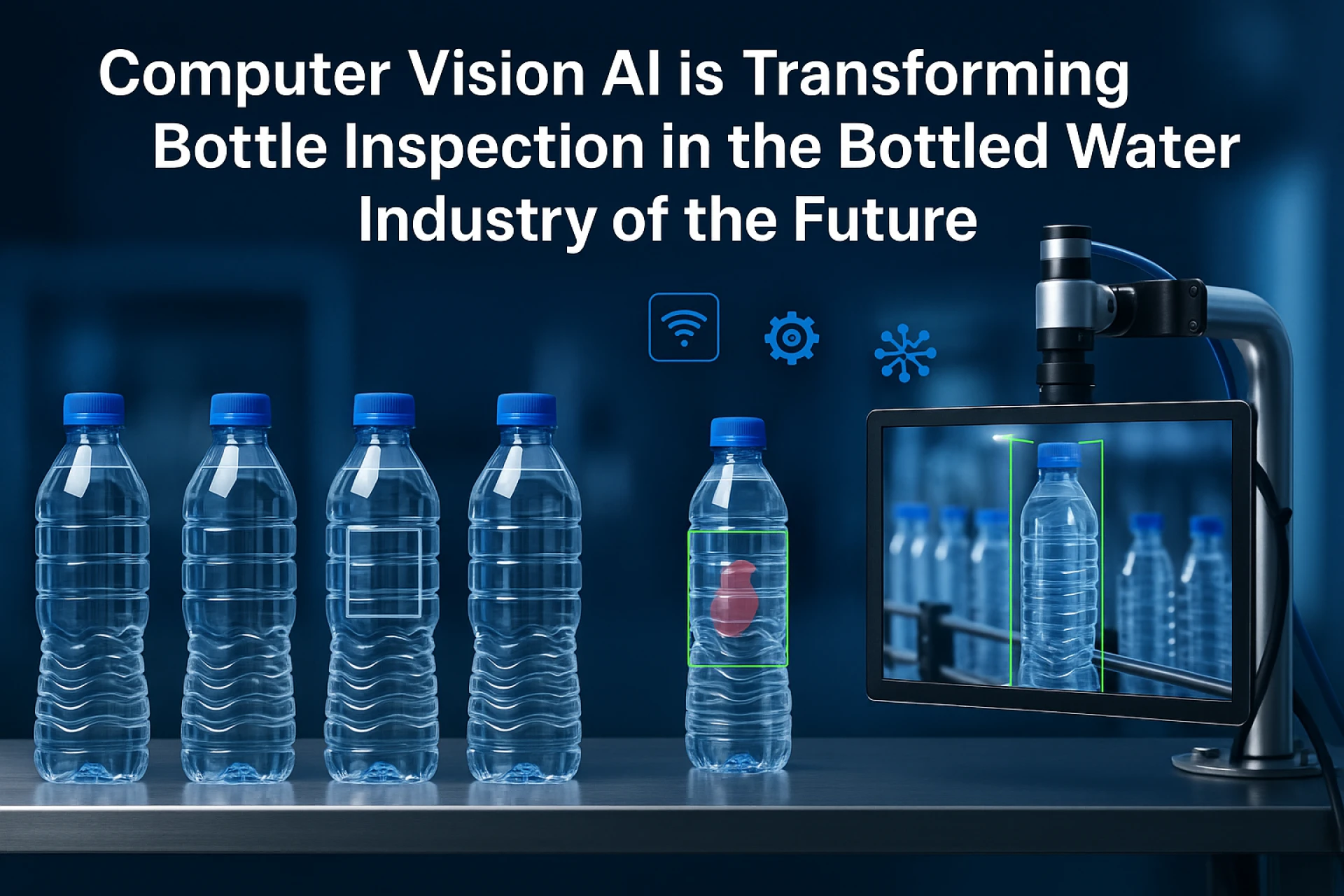

In today's rapidly evolving marketplace, every sector is experiencing a transformational disruption powered by AI and automation. This certainly describes the bottled water sector, which has long featured mass production with a focus on strict hygiene processes. As consumers become more health conscious and seek better hydration options, bottled water brands are compelled to deliver products that need to be not only pure but also packaged appropriately and safely.
The days of inspecting bottles manually by physically inspecting the bottle for defects is long gone. Computer vision for bottle quality control is driving the transformation of inspection methods by providing speed, precision, and consistency across the production line. Smart automation allows the manufacturer to even assess real-time detection for minor defects delivering better product safety and efficiency.
The bottled water market globally currently is valued at $302 billion, and is projected to grow at a CAGR of 5.5% by 2031, automation has never been more strategically critical. This post will assess the significance of bottle quality, and how Vision AI is evolving inspection into a competitive advantage for brands.
Why Product Quality is Important for Bottled Water Companies in a Competitive Market
It is essentially impossible to maintain affordable, consistent product quality in the bottled water industry. Why?
1. Consumer Safety
Being in the business of providing clean, uncontaminated water is crucial for public safety. Even one instance of a lapse in quality could result in significant adverse health effects, FDA actions or lawsuits, and loss of trust.
2. Competitive Differentiation
In a crowded marketplace with many bottled water companies, quality matters. Computer vision-enabled AI lets manufacturers produce pure, consistent product and build for differentiation in a crowded shelf landscape.
3. Brand Loyalty
Consumer loyalty is subsequently built through acceptable quality. Acceptable quality yields increased consumer trust over time. Customer trust is something that is only built from consumers consuming your product multiple times and repeatedly experiencing properly packed and safe bottles.
4. Regulatory Compliance
The bottled water industry is subject to rigorous safety and labelling requirements. Vision AI can help bottled water companies ensure standards are maintained and help avoid safety, labelling, and regulatory infractions by flagging inconsistencies before product is released into the public.
5. Cost Savings
AI can help help identify defects early on in the manufacturing process which can yield important cost savings to the business in terms of reducing product waste, eliminating costly recalls, and boosting how raw materials are utilized.
6. Customer Retention
Manufacturers who produce higher quality product through greater consistency and reliability will ultimately see greater customer loyalty. Customers who trust that they can expect quality from your product will continue to return to your brand time and time again, and recommend your product to others and share in your growth.
7. Added Value to Efficiency
Computer vision-enabled AI can help motorize many, if not most of the manual inspections and this often lead to greater efficiencies in the manufacturing process.
Automating Bottling Inspection with Computer Vision
Vision systems powered by AI and machine learning are replacing inspection activities that were prone to human error. Here are the primary ways they are automating the inspection process:
Bottle Cap Inspection
Achieving proper cap sealing is essential for hygiene and freshness. AI-driven systems will be able to inspect the following:
- Push-pull caps
- Screw caps
- Tamper-evident seals
Computer vision systems are able to detect whether the cap alignment, security, and material defect is acceptable too. Many defects can be detected at the same time, and the system learns and adapts over time for further accuracy.
Fill Level Checks
There is no such thing as a "normal" fill-level inspection in which a person does not miss bottles or fail to inspect and check for accuracy. Computer vision systems accurately measure the volume of water in each bottle so that bottle fills are neither under-filled or over-filled. Undercutting fills are bad for brand reputation while over-filled bottles put at risk increased production costs.
The AI-driven system uses multiple (strategically placed) cameras, running in real time, along the conveyor to capture every moment as it's happening. Volume detections will take place by checking the volume of water contained in each frame captured, and subsequently analyzed by the machine learning algorithm.
Label Accuracy and Print Validation
A label contains identity and essential information for consumers as well as the brand (e.g. batch number, ingredients, and manufacture date). Computer vision systems will detect and verify:
- The label position for alignment and coverage
- Missing and or skewed labels
- Check the printed data for
Sophisticated systems have the capabilities to read barcodes and QR codes, aiding manufacturers in inventory control and potentially even assisting on the drone side for selecting appropriate packages for delivery.
Contamination and Foreign Particle Detection
Even microscopic contaminants can cause undesired water quality. Vision AI produces high-resolution images and applies deep learning to detect:
- Foreign particles
- Dust
- Plastic pieces
- Insect parts
This level of detection is far beyond the capabilities of humans and provides an excellent safeguard for consumer protection.
Structural Defect Detection
Bottles with cracks, dents, or misshapes can leak or collapse during distribution – which can lead to all kinds of logistic headaches. Vision systems use a combination of multi-angle cameras to assess wells and the entire surfaces of all bottles to help ensure structural integrity.
Color Consistency
For brands with colored or tinted bottles, brand identity and material efficiency translate into the necessity for color consistency. Vision AI can quantify and assess hue and transparency levels, allowing a manufacturer to ensure color consistency across products.
Seal Integrity
Faulty seals are a serious problem in the bottled water industry. AI can detect:
- Cracks
- Leaks
- Pin holes
- Wonky seal lines
Using deep learning models and high-resolution imaging, these systems can perform faster and more reliably than humans can.
Real-World Use Case: Vision AI in Action
Corporate titans like PepsiCo have begun to implement computer vision into their production line already. Pepsi and Frito-Lay are using machine learning and vision AI to:
- Monitor production in real-time
- Defective product output reduction
- Improved supply chain management
By utilizing a proactive strategy, the goals will limit product recalls, and enhance customers' trust in their products.
AI-Powered Bottle Inspection - Nextbrain
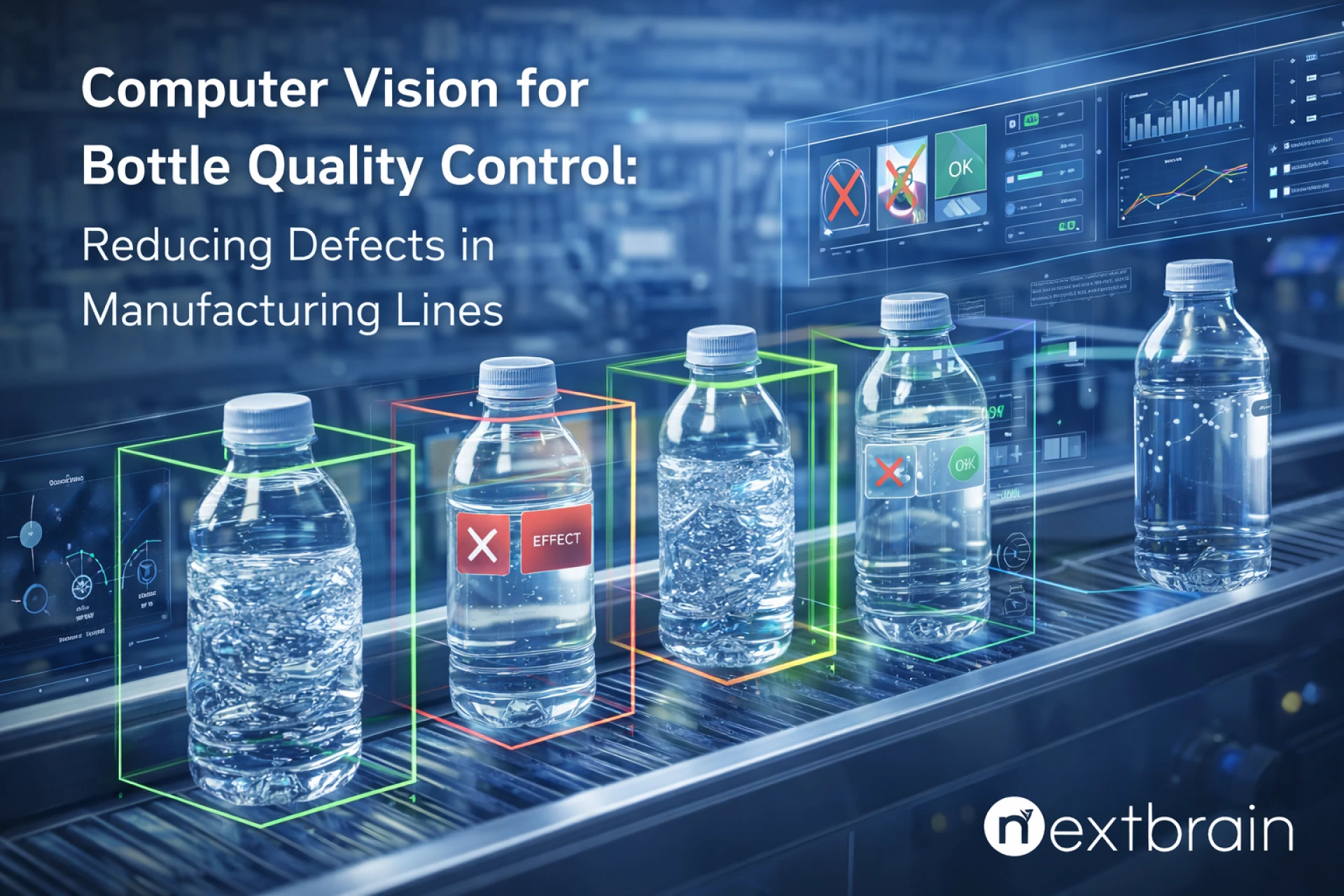
Nextbrain offers AI Video Analytics Software designed for industries, such as bottled water manufacturing. Our computer vision AI systems are built to implement automation and intelligence into quality control, improving speed and reliability.
Deploying deep learning algorithms in conjunction with high-resolution cameras we are able to assess the below.
- Bottle shape and size
- Cap integrity
- Label placement
- Seal quality
- Presence of contamination
By automating inspection at every stage, Nextbrain assists companies in maintaining high quality while also reducing overhead costs.
Final Thoughts: The Future of Bottled Water Quality is AI-Driven
With consumer demand for quality bottled water on the rise, brands need to adopt smarter solutions that provide safety, efficiency, and compliance. The ability to see everything accurately and in real-time is not just a bonus, it is a must. Quality control should be a quality assurance step, eliminating manual inspection and allowing brands to monitor their product as it is created.
The bottled water space is changing, and it is time for brands to take the plunge into computer vision AI to create a competitive advantage that lasts.
At Nextbrain, we enable companies to embrace intelligent automation with our AI-enabled computer vision solutions that reimagine the bottling process from a 360-degree perspective
Are you prepared to automate your bottle inspection process?
Reach out to Nextbrain's AI experts to discover how computer vision can redefine your manufacturing processes.








Sign in to leave a comment.